Genesis 13:7 Daily Devotional & Meaning – Strife, Sanctification, and Spiritual Separation

Daily Verses Everyday! Day 60
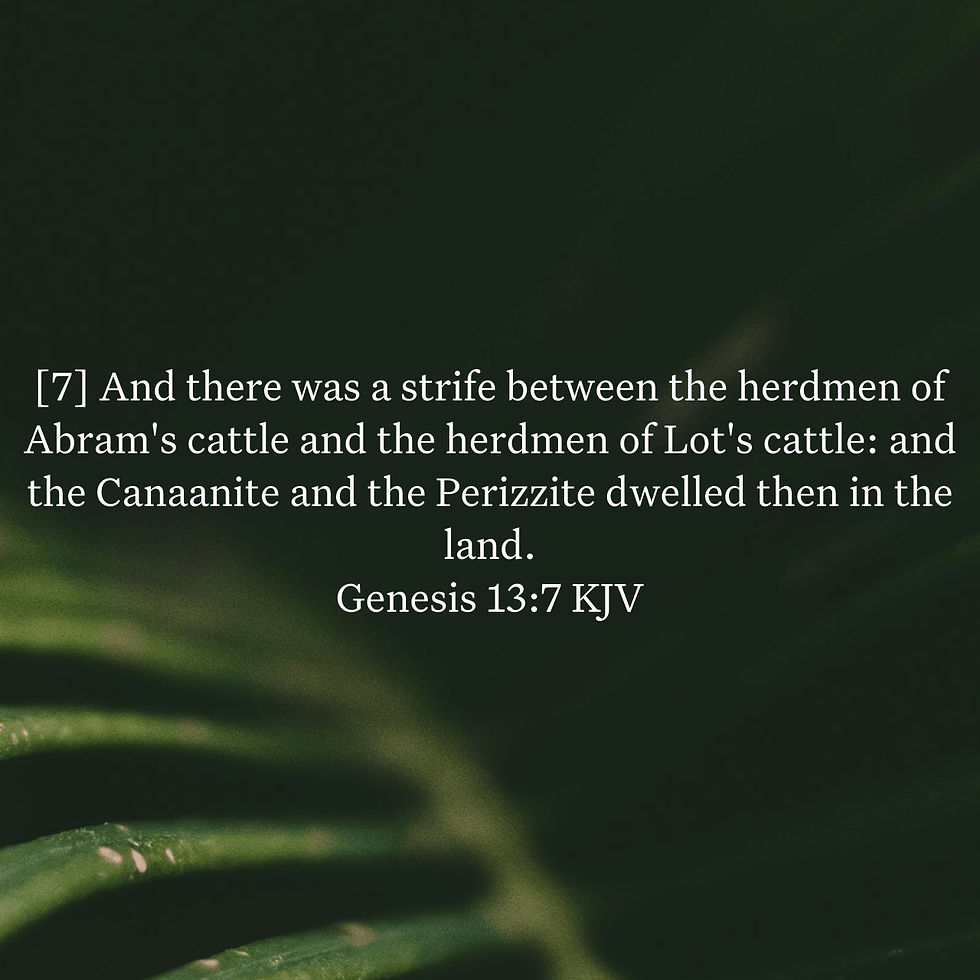
“And there was a strife between the herdmen of Abram’s cattle and the herdmen of Lot’s cattle: and the Canaanite and the Perizzite dwelled then in the land.”
This verse may seem like a passing detail in the story of Abram and Lot, but it reveals much about human nature, spiritual priorities, and the quiet tests that come with God’s blessing. The scene takes place not during famine or trial but during prosperity. Both Abram and Lot had grown wealthy. Their flocks had multiplied, their herdsmen had increased, and their tents now filled the land. The same abundance that was a sign of God’s favor became the soil in which conflict grew. Scripture often shows that the most difficult trials of faith are not always in times of suffering but in times of plenty. When blessings multiply, the heart is exposed, revealing whether it clings to the Giver or to the gifts.
The strife here did not begin between Abram and Lot directly but between their servants, who were ordinary men managing the flocks. Yet their quarrel reflected something larger: two households growing in different directions. Abram was walking by faith in the promise of God, content to live as a pilgrim and a stranger. Lot was drawn toward the comforts of settled life and the allure of fertile land. The servants’ fighting over pasture and water was the outward symptom of an inward drift, showing us that the two hearts no longer aligned in purpose. Strife does not appear suddenly; it grows quietly when unity of spirit is lost. When those who serve different masters of the same family begin to look more to their own gain than to peace, division inevitably follows.
This may seem strange to us now, but anyone who has ever truly found God and devoted their life to Him can say for certain that their old ways have died and their new ways are what make them who they truly are. And because they built their lives around those old ways, many of the people who were part of that life will no longer be moving in the same direction. Those friends, coworkers, or even family members may still be focused on the world they left behind. They may still value the things that once held your heart, like success, comfort, reputation, pleasure, or control. But when the Spirit of God transforms a person, priorities shift. What once satisfied no longer does. The soul begins to hunger for what is eternal, and suddenly, the familiar paths of old companionship become roads that lead opposite ways.
Abram and Lot represent this divergence beautifully. Although they shared blood and history, their hearts were beginning to drift apart. Abram was being led by the unseen hand of God into promises that could not yet be touched or measured. Lot, though outwardly blessed, was still guided by sight and what appeared fruitful, looked easy, and promised gain. This is often how God separates those who are His from those who merely accompany them. It is not always a violent or bitter break; sometimes, it is simply that the purposes of God require different paths. When one chooses faith and the other chooses comfort, distance becomes inevitable.
This separation can be painful. It can feel like loss when people who once understood you no longer do. Yet spiritual growth often requires holy distance. You cannot walk with God and remain unchanged, and that change will test every relationship built on worldly values. Those who walk by faith will find themselves misunderstood, sometimes even resented, by those who remain bound to what they can see and control. Abram and Lot’s herdsmen fought over pastures, but the real conflict was over perspective as one sought what was best for now, and the other sought what was eternal.
Many believers experience this same pattern when they begin to live fully for God. Old friendships may grow distant. Certain conversations no longer hold interest. Environments that once felt comfortable now feel heavy and out of place. It is not arrogance or rejection but transformation. When the heart begins to long for holiness, it cannot remain satisfied in compromise. This is what Jesus meant when He said that new wine cannot be contained in old wineskins. The new life that God gives cannot fit into the patterns of the old life. To keep walking forward with Him, some things and some relationships must be released.
This is called sanctification, which is the work of the Holy Spirit in transforming us to be more like Christ in mind, spirit, heart, and strength. It is the ongoing process through which God reshapes us from the inside out, removing what does not belong to His nature and replacing it with what reflects His Son. Sanctification is not merely the act of learning new habits or moral behavior; it is the inward renewal of the soul. It is the Spirit of God molding a person to think as Christ thinks, desire what Christ desires, and love as Christ loves. This is not accomplished in a moment but over a lifetime, as the believer continually surrenders to the refining hand of God.
Just as metal is refined by fire, sanctification often takes place in the heat of conflict, discomfort, and separation. Abram’s situation with Lot serves as a picture of this refining. God was separating Abram from attachments that could not go where He was leading him. Lot was not evil, but he represented a connection to an older season of Abram’s life, one tied more to human companionship and security than to the solitary walk of faith God was calling him into. Sometimes, the Spirit sanctifies us by removing what we lean on apart from Him, even when those things seem good. It is in that emptying that we become ready to be filled with something greater.
To be sanctified means to be set apart from sin for God’s purposes. Abram was being set apart for a divine covenant that would bless the entire world. To reach that promise, he needed a pure heart, undistracted faith, and undivided loyalty. The strife between the herdsmen became the tool through which God accomplished this deeper work. Likewise, in our own lives, sanctification often comes through the things we resist the most like disagreements, losses, disappointments, or seasons of loneliness. God uses them not to harm us but to detach us from what competes with His presence.
The Holy Spirit works quietly in this process, convicting the heart, softening stubbornness, and awakening new desires. He changes how we think before He changes how we act. He reveals truth, exposes self-deception, and produces within us a hunger for righteousness that cannot be satisfied by anything else. Sanctification is the evidence that someone truly belongs to God. Without it, faith remains shallow like a confession of the lips but not a transformation of the life. But when the Spirit sanctifies a person, their speech, their choices, and their motives begin to carry the fragrance of Christ. The things that once brought pleasure begin to lose their grip, and holiness becomes a joy, not a burden.
This transformation, however, is not always visible to others right away. In fact, it can cause friction with those who once walked closely with us. As Lot moved closer to Sodom and Abram remained in the land God had promised, the difference between them became clearer. It is the same when a believer begins to yield fully to the Spirit’s sanctifying work. The more a person becomes like Christ, the more distinctly they stand apart from the world around them. It is not self-righteousness; it is light naturally shining where there was once shadow. The Spirit does not produce pride in the sanctified heart; He produces humility, gentleness, and a willingness to love even those who do not understand.
To be sanctified is to live in a state of continual surrender. It means letting go of control and trusting that God’s pruning, though painful, always leads to fruitfulness. Jesus said, “Every [branch] that beareth fruit, he purgeth it, that it may bring forth more fruit” (John 15:2). Abram’s separation from Lot was a kind of pruning. It simplified his life so that God could multiply His blessing. Sanctification works the same way. The Spirit removes the unnecessary things like the attitudes, desires, and distractions that clutter the soul until all that remains is what reflects the character of Christ.
This process cannot be rushed. Sanctification takes time, just as Abram’s journey took time. Each test, each moment of strife, each act of obedience shapes the heart into something more enduring. The Spirit teaches us patience through delay, trust through uncertainty, compassion through pain, and purity through temptation. Through each experience, He draws us nearer to God’s heart. And in drawing nearer, we find that holiness is not about rules; it is about relationship. It is the intimacy that grows when nothing stands between the believer and the presence of God.
When Abram chose peace over conflict, he demonstrated the fruit of sanctification. His trust in God allowed him to release control of the land and leave the outcome in divine hands. This same trust is what the Spirit seeks to form in us. The sanctified heart no longer strives for recognition or possession; it rests in assurance that God will provide what is needed. It is a freedom from striving and a fullness of peace that cannot be explained in worldly terms.
In the end, sanctification is the believer’s preparation for eternity. It is the Spirit’s work of making us fit for the presence of a holy God. It is not something we achieve; it is something we yield to. Just as Abram did not sanctify himself but allowed God to lead him into it, we too must let the Spirit shape us through every circumstance. Each moment of surrender and each time we choose faith over comfort, obedience over compromise, humility over pride, we become a little more like Christ.
So, when separation comes or when old relationships fade because the direction of your life has changed, do not see it as punishment. See it as sanctification and the loving work of God setting you apart for something higher, purer, and more eternal. The same Spirit who called you out of your old ways is the One who now walks beside you, teaching you how to live as a new creation. And like Abram, if you trust Him, you will one day look back and see that every distance, every loss, and every change was necessary to bring you into the fullness of the promise that God had in mind from the very beginning.
If you would like to explore Genesis in a sustained, verse-by-verse way with space to reflect, journal, and trace how these foundational truths unfold through Scripture the Verse by Verse book expands these reflections into a unified reading experience. The book gathers these meditations into a structured journey through Genesis, designed to help readers linger in the text and engage God’s Word more deeply over time.


Comments