
Genesis 4:15 Daily Devotional & Meaning – God’s Justice and Mercy

Updated: Feb 28
Daily Verses Everyday! Day 20
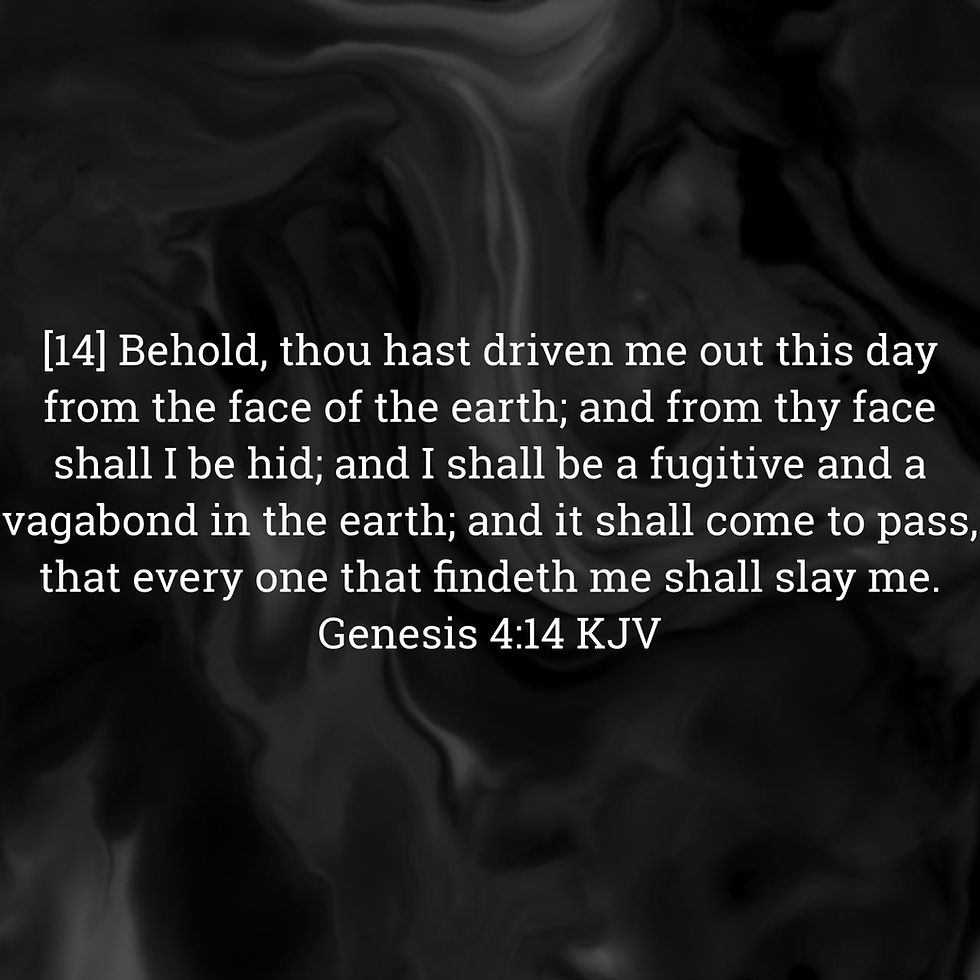
“And the LORD said unto him, Therefore whosoever slayeth Cain, vengeance shall be taken on him sevenfold. And the LORD set a mark upon Cain, lest any finding him should kill him.”
Here again, we are introduced to the beautiful nature of a loving God. Even in the midst of Cain’s sin and the severity of his punishment, God’s mercy shines through. The curse on Cain was just and severe: he would wander, labor fruitlessly, and live apart from God’s favor but God also steps in to protect him. By placing a mark upon Cain, God prevents others from taking vengeance into their own hands, saying that anyone who harms him will face sevenfold retribution.
This act reveals several profound truths about God’s character. First, He is just, for sin has consequences, and wrongdoing is neither ignored nor excused. Yet, He is also merciful; even the first murderer is not left defenseless or abandoned to the wrath of others. God’s love and justice coexist perfectly; punishment does not negate protection, and discipline does not exclude compassion.
A major question arises from this verse: Who else was there? So far, we only know of Cain and Abel, born to Adam and Eve, yet nowhere does the text explicitly say they were the only children. When God blessed Adam and Eve, He commanded them to “Be fruitful, and multiply, and replenish the earth” in Genesis 1:28. It is reasonable to infer that they had other children, though the timeline is unclear. We do not know how long it was from their creation to the moment they sinned, nor exactly when Cain and Abel were born in that sequence. The story of Cain and Abel leaves many details unspecified, including the total number of Adam and Eve’s children at that point. Yet, the text implies that others existed, enough that God could warn Cain that anyone who harmed him would face sevenfold vengeance. This subtle detail reminds us of the mystery and richness of Scripture: even when not all information is given, God’s justice and mercy are complete. The narrative points us beyond the immediate story to a broader understanding of humanity and God’s ongoing governance over the unfolding human family. Even if there were others who might have sought vengeance, God intervened to restrain harm. His love and care extend beyond the individual sinner to the community, ensuring that justice is tempered by mercy.
Regarding the mark upon Cain, the text does not specify whether it was a physical mark, or if it was a sign of God’s protection, so we can only speculate. It could have been a visible sign, a distinguishing feature that warned others not to harm him. Or it could have been an invisible sign, a divine safeguard that only God and those with intent to harm could perceive. Either way, the mark represents God’s protective hand over the sinner, even one as fallen as Cain.
The number “seven” is often associated with completion and perfection in the Bible. It is interesting, then, that God specifically phrases the warning as “sevenfold vengeance.” This is not an arbitrary number; it emphasizes the fullness and certainty of God’s justice. Anyone who would harm Cain would face complete and perfect retribution, leaving no doubt that wrongdoing against another is taken seriously. By using the number seven, God communicates both a limit and a guarantee. While sin and vengeance are real, they are under His sovereign control. There is no chaos outside His oversight. The sevenfold vengeance also highlights the balance between justice and mercy because Cain, guilty as he is, will not be killed by others, but God’s justice remains intact and unshakable. The divine symmetry of the number seven reassures us that God’s actions are purposeful, measured, and perfectly righteous.
If you would like to explore Genesis in a sustained, verse-by-verse way with space to reflect, journal, and trace how these foundational truths unfold through Scripture the Verse by Verse book expands these reflections into a unified reading experience. The book gathers these meditations into a structured journey through Genesis, designed to help readers linger in the text and engage God’s Word more deeply over time.


Comments