Genesis 16:10 Daily Devotional & Meaning – Hagar’s Blessing, Ishmael’s Descendants, and God’s Grace Beyond Failure

Daily Verses Everyday! Day 70
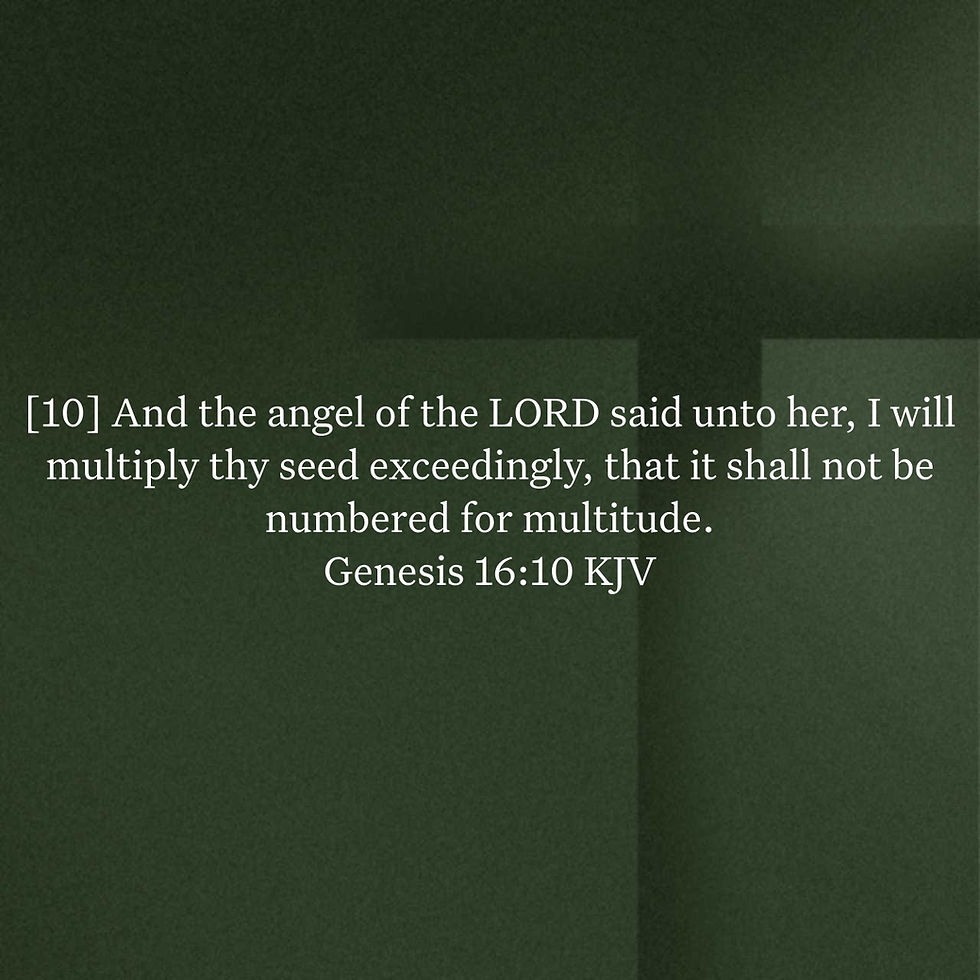
“And the angel of the LORD said unto her, I will multiply thy seed exceedingly, that it shall not be numbered for multitude.”
When we read this verse, it is tempting to focus on the context of human failure. Abram and Sarai, despite being called by God and receiving His promises, took matters into their own hands. Sarai, in her impatience and doubt, gave Hagar to Abram to bear a child, trying to fulfill God’s promise through human effort. From a worldly perspective, this situation seems rife with injustice, moral compromise, and potential consequences. Hagar, a young slave woman, becomes the instrument of Sarai and Abram’s impatience. One might naturally expect God to respond with retribution and punish either Abram, Sarai, or Hagar for the tangled web of sin and disobedience. After all, the human heart often looks for immediate justice when wrongdoing occurs.
Yet God’s response is startling. Instead of retribution, the angel of the Lord speaks blessing over Hagar: “I will multiply thy seed exceedingly, that it shall not be numbered for multitude.” Here, we see a profound principle of God’s character: He is not limited by human failure. He does not allow sin to cancel His promises or His purposes. Even amidst Abram and Sarai’s missteps, God remains faithful. The child that Hagar carries, born out of human compromise, is not overlooked or condemned because God will multiply his descendants, showing that His plans transcend human sin.
The promise given to Hagar mirrors the promise God had given to Abram himself earlier in Genesis 12 and 13. God had promised Abram that his seed would be as numerous as the stars of heaven and that all nations would be blessed through his offspring. Now, through Hagar, God assures her that she too will be a mother of nations, a testimony to His generosity and sovereignty. This is remarkable: Hagar, a foreigner, a servant, a woman caught in the consequences of others’ sin, is elevated by God to share in the promise of multiplication and blessing. In doing so, God reveals that His grace is not limited by ethnicity, social status, or the imperfections of human circumstances.
This verse also reminds us that God’s plans cannot be thwarted by our attempts to rush, manipulate, or shortcut His timing. Abram and Sarai sought to fulfill God’s promise through their own strategies. Yet God does not abandon His purposes. Even when we make mistakes, He can redeem the outcomes for His glory and for the fulfillment of His promises. Hagar’s seed would eventually become Ishmael and his descendants, forming nations of their own, and God’s covenant with Abram through Isaac would not be negated. God works through complexity, weaving His purposes into situations that appear messy, unjust, or even painful.
Additionally, this verse shows the tenderness of God toward the marginalized. Hagar had fled in fear, had been treated harshly, and was facing an uncertain future. And yet, God speaks hope, multiplication, and a future beyond counting. It reminds us that God sees those who are often invisible to human eyes, and He chooses to bless them in ways that exceed worldly expectation. The promise is both personal and eternal: it assures her dignity, purpose, and the certainty that her life matters deeply to God.
Through Hagar, we see a glimpse of the Gospel principle that God’s purposes are never limited by human limitations or failures. His plans are bigger than our mistakes. His blessing is not earned by perfection but given in accordance with His mercy and sovereignty. In Hagar, a foreign servant, God plants the seeds of nations, which is a testimony that even in the midst of sin, His grace multiplies.
God’s words to Hagar reveal His faithfulness, His capacity to redeem human failure, and His care for the marginalized. We are reminded that no matter our mistakes, no matter the failures of those around us, God’s promises remain steadfast. As He multiplied Hagar’s seed exceedingly, so too does He work in the lives of those who trust Him, bringing forth fruit that far exceeds human expectation, and showing that His grace is always greater than our sin.
Fast-forwarding through history, we see the fulfillment of God’s promise to Hagar. Her son Ishmael became the father of 12 princes, and his descendants spread across the Arabian Peninsula. These descendants would come to inhabit regions stretching from Havilah to Shur, near Egypt, and into northern Arabia in Genesis 25:18. Over generations, Ishmael’s line became associated with numerous tribes and peoples who played significant roles in the history of the Near East. While the Bible also identifies other nations in these regions, Hagar’s seed was multiplied in accordance with God’s promise, testifying to His faithfulness even across centuries.
Some of Ishmael’s descendants, according to biblical and historical tradition, became part of the peoples interacting with Israel, such as the Philistines. They lived in complex relationships with the Israelites, at times in conflict and at times in coexistence. The larger point is clear: God’s promise to Hagar was not limited to her immediate circumstances; it was generational, lasting beyond her lifetime and beyond the immediate challenges she faced.
In the long arc of history, Islamic tradition holds that Ishmael’s lineage gave rise to the Arab peoples, with the city of Mecca becoming central to their identity and religious heritage. Muhammad, the prophet of Islam, is traditionally regarded as a descendant of Ishmael. This connection illustrates the astonishing breadth of God’s promise: from a slave girl fleeing injustice in the wilderness to the father of nations and peoples whose influence spans the globe. What began as a story of pain, fear, and human failure became a testament to the enduring and multiplying power of God’s blessing.
The butterfly effect suggests that a small action can have far-reaching and unforeseen consequences. Looking back through history, we can see a long-lasting chain of effects from Abram and Sarai’s decision. Several thousand years later, a man was born who would claim to be a prophet and become the central figure of a religion that today has over 2 billion followers, with projections suggesting it may one day rival Christianity in global influence. If Abram had not complied with his wife’s request and had not taken Hagar as she suggested, this particular historical trajectory or this chain of events would not have existed in the same way. It serves as a sobering reminder of how even human compromises and seemingly small decisions can ripple through history, shaping peoples, nations, and beliefs across millennia.
But all the blame cannot be placed solely on Abram for the consequences of human action. Throughout Scripture, we see repeatedly that disobedience, even small lapses, can have lasting effects, sometimes affecting generations. For example, when King Saul was commanded by God to strike the Amalekites completely, he did not fully obey; he spared some of the people and the livestock. God told him that because he had not carried out the command completely, the Amalekites would remain a thorn in Israel’s side forever in 1 Samuel 15:1–33. Just as with Abram and Hagar, this story illustrates a fundamental biblical principle: God’s instructions are precise, and human compromise or partial obedience can set off consequences that extend far beyond the moment. Yet even in these cases, God’s faithfulness and sovereignty remain intact. His purposes are never ultimately thwarted, though human choices can influence the course of history and the unfolding of events.
Looking at the bigger picture, the chain of consequences from Abram and Hagar, Ishmael, and the later choices of nations shows a pattern: God remains faithful to His covenant promises, yet human choices shape the historical trajectory of His plan. This includes the rise of Islam as a major world religion, the conflicts surrounding Jerusalem, and the ongoing unfolding of prophetic fulfillment. From a Christian perspective, it demonstrates both the weight of human decisions and the unwavering faithfulness of God: He accomplishes His purposes despite human sin, yet the consequences of actions can ripple across generations in ways we cannot always foresee.
This reflection calls us to humility, obedience, and discernment. Our choices matter. Our decisions have far-reaching consequences, and even when God’s promises are sure, human failure and impatience can shape the course of history. Yet we are also reminded that God’s providence is greater than our mistakes. He works through our failures and through the imperfect actions of humanity to accomplish His eternal purposes. Hagar’s story, Ishmael’s descendants, and the historical trajectory we see today testify to the profound truth that God’s faithfulness endures across generations, and that His grace multiplies even when our understanding is limited and our actions are imperfect.
If you would like to explore Genesis in a sustained, verse-by-verse way with space to reflect, journal, and trace how these foundational truths unfold through Scripture the Verse by Verse book expands these reflections into a unified reading experience. The book gathers these meditations into a structured journey through Genesis, designed to help readers linger in the text and engage God’s Word more deeply over time.


Comments