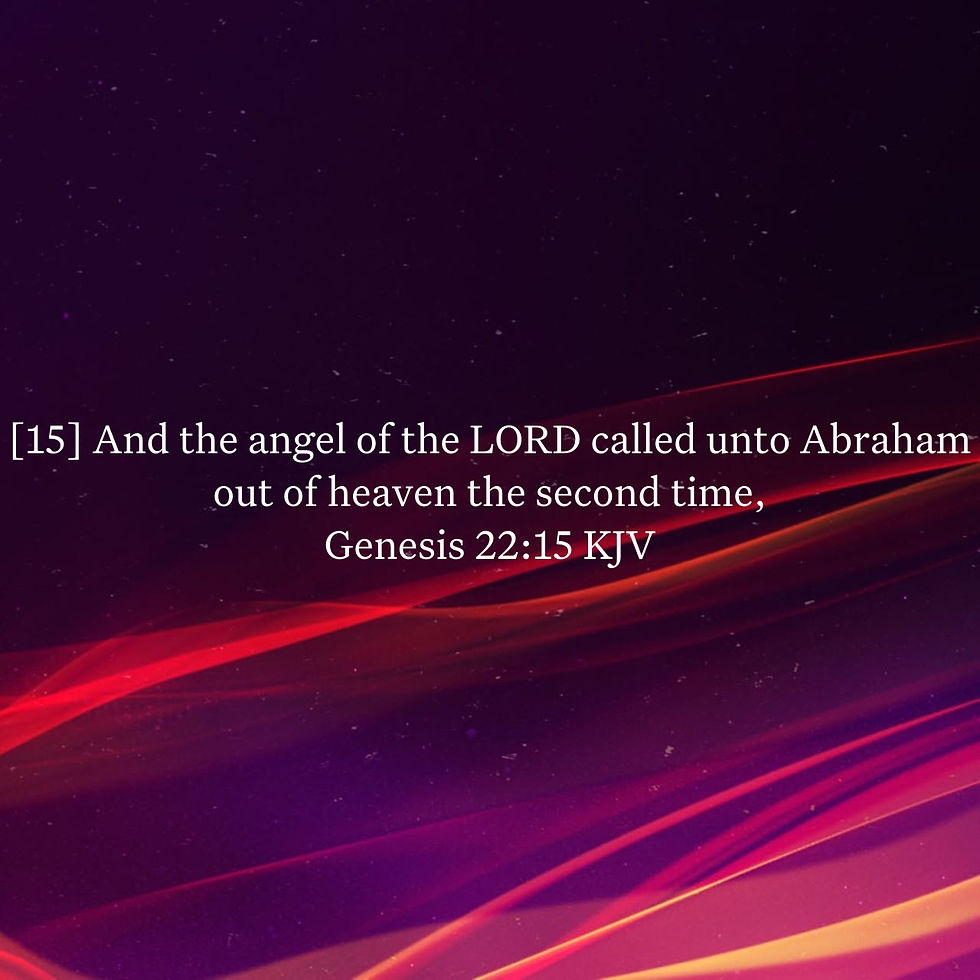
Genesis 22:15 Daily Devotional & Meaning – The Angel of the Lord Called Again and God Reaffirmed the Promise

Daily Verses Everyday! Day 92
“And Abraham called the name of that place Jehovahjireh: as it is said to this day, In the mount of the Lord it shall be seen.”
There is something deeply striking about the fact that Genesis 22:15 tells us, once again, that “the angel of the Lord” called unto Abraham out of heaven. This is not a throwaway detail. Scripture could have simply said, “And God called unto Abraham again,” or “And the Lord spoke to Abraham again.” But instead, the text carefully repeats that the angel of the Lord is the one speaking. This is now the second time in this chapter that Abraham hears this heavenly voice. The first time, the voice stopped the knife. The second time, the voice confirms the blessing.
Just imagine that for a moment.
Abraham is still standing on the mountain. His heart is probably still pounding. The knife that had been lifted over Isaac has now been lowered. Isaac is alive. The ram has been offered in his place. The smoke of the sacrifice may still be rising from the altar. The smell of burnt offering may still be in the air. The place that only moments earlier felt like the place of death has now become the place of provision. Abraham has just named it Jehovahjireh, “The LORD will provide.” And then, before he even leaves the mountain, heaven speaks again.
What would that be like?
Try to imagine the silence after the sacrifice. Abraham and Isaac have just passed through one of the most intense moments any father and son could ever experience. There are no recorded words from Isaac. There is no long conversation written down between them. We are simply left with the weight of the moment. Then suddenly, out of heaven, the voice calls again. Not from the ground. Not from another person. Not from some distant camp. From heaven. The same divine messenger who had stopped Abraham now speaks again with covenant authority.
That phrase, “out of heaven,” matters. Abraham is not receiving ordinary advice. He is not hearing the wisdom of a friend. He is not being comforted by human words after a difficult trial. He is being addressed from the realm of God. Heaven itself breaks into the earthly moment. The mountain becomes a meeting place between God and man. Abraham’s obedience has not gone unnoticed. His fear of God has not been hidden. His willingness to surrender Isaac has been seen by the Lord, and now the Lord speaks from heaven to interpret the meaning of what has happened.
The repeated mention of the angel of the Lord is especially important because, throughout the Old Testament, this figure often speaks with more than ordinary angelic authority. Sometimes the angel of the Lord speaks as a messenger from God, but other times he speaks with the authority of God Himself. In Genesis 22, this is exactly what we see. In verse 12, the angel says, “Now I know that thou fearest God, seeing thou hast not withheld thy son, thine only son from me.” Notice that phrase: “from me.” Abraham was commanded by God to offer Isaac, and yet the angel of the Lord speaks as though Abraham’s obedience was directed to him. That makes this figure mysterious and majestic. He is called the angel of the Lord, yet he speaks with divine authority.
For Christians, this has often been understood as a possible appearance of the pre-incarnate Christ, or at the very least a divine manifestation through which God personally speaks. We should be careful not to say more than the text directly says, but we should also not miss the weight of what the text does say. This is not merely an angel delivering a casual update. This is the voice of heaven confirming the covenant promise of God. Abraham is hearing the word of the Lord through the angel of the Lord, and that word comes after the most costly act of obedience Abraham has ever offered.
The first call from heaven was urgent: “Abraham, Abraham.” It stopped his hand. It prevented the death of Isaac. It revealed the ram. It turned the altar of judgment into the altar of provision. But the second call has a different purpose. The second call does not stop Abraham from doing something. It confirms what God is going to do. The first call interrupts the sacrifice. The second call interprets the obedience. The first call saves Isaac. The second call reaffirms the promise.
That is beautiful because God does not merely rescue Abraham from the moment and then leave him confused. God speaks again. He gives meaning to the test. Abraham may have already known that God provided, but now God is about to declare that Abraham’s obedience has covenant significance. The trial was not meaningless. The anguish was not wasted. The climb up the mountain was not forgotten. The binding of Isaac was not unseen. The Lord saw it all, and now the angel of the Lord calls a second time.
There is a powerful lesson in that. Sometimes we want God to speak before the test, during the test, and immediately at every step along the way. But in Genesis 22, God gives Abraham a command, and then there is a long silence. Abraham rises early. He gathers the wood. He takes Isaac. He travels three days. He sees the mountain from afar. He leaves the servants behind. He climbs with his son. He builds the altar. He binds Isaac. He stretches out his hand. Only then does heaven speak. The silence was not absence. God was watching the entire time. The second call proves that heaven had not missed a single step.
This matters for us because faith often feels like walking under silence. We obey what God has already said, even when we do not yet hear what He will say next. Abraham did not receive a full explanation before the mountain. He did not receive a detailed map of how the test would end. He had the promise of God, the command of God, and the character of God. That was enough for him to keep walking. Then, at the appointed time, heaven spoke. And then, after the provision, heaven spoke again.
Imagine being Abraham in that moment. You have just surrendered the dearest thing in your life, at least in your heart. Isaac was not merely a son. Isaac was the miracle child. Isaac was the laughter after decades of waiting. Isaac was the visible proof that God keeps impossible promises. Isaac was the child through whom the covenant line would continue. To lay Isaac on the altar was to lay down not only your love, but also your understanding of the promise. Abraham had to trust God when obedience seemed to threaten the very thing God had given.
And now, after all of that, the angel of the Lord calls again. Abraham hears his name from heaven, and this time the voice does not say, “Lay not thine hand upon the lad.” That part is finished. Isaac is safe. The substitute has died. The sacrifice has been accepted. Now the voice is about to speak blessing. What must it have felt like to realize that God was not finished speaking? What must it have felt like to stand there with Isaac alive beside him and hear heaven declare that the promise still stands?
There is also tenderness in the phrase “the second time.” God speaks more than once. He does not only intervene in the crisis. He also confirms after the crisis. He does not only stop the knife. He also strengthens the heart. He does not only provide the ram. He also renews the promise. Many believers know what it is like for God to help them survive something, but Genesis 22 reminds us that God also speaks after survival. He does not leave His people standing in shock on the mountain. He calls again. He reassures. He reaffirms. He reveals that the test had purpose.
This second call also shows that Abraham’s relationship with God has reached a new depth. Earlier in Abraham’s life, God called him to leave his country and go to a land he did not know. Then God promised him descendants, land, and blessing. Abraham believed God, and it was counted to him for righteousness. But now, in Genesis 22, Abraham’s faith has been tested in the most personal way possible. He has shown that he does not worship the promise more than the Promise-Giver. He does not love the gift more than the God who gave it. He does not cling to Isaac in a way that rivals his trust in the Lord.
That is why heaven speaks again. The second call is not because God needed new information, as though He was ignorant before the test. God knows all things. Rather, the test reveals Abraham’s faith in history. It displays the reality of his trust. It brings the hidden posture of his heart into visible obedience. God knew Abraham’s heart, but now Abraham’s faith has been manifested. The second call from heaven publicly confirms what the test has revealed.
There is a powerful devotional application here. Many people want the blessing of verse 16 and following, but they do not want the surrender of verse 10. They want God to speak blessing over their lives, but they do not want to climb the mountain of obedience. Yet Genesis 22 shows us that the voice of God’s promise often becomes clearest in the place of surrender. Abraham hears the second call after he has laid everything down. That does not mean we earn God’s promises by our works. Abraham had already received the covenant by grace. But obedience brings him into deeper fellowship with the God who made the promise.
And again, this scene points us forward to Christ. The angel of the Lord calls from heaven, Isaac is spared, and the substitute is offered. Later, at the baptism of Jesus, a voice from heaven would say, “This is my beloved Son, in whom I am well pleased.” At the transfiguration, heaven would speak again: “This is my beloved Son, in whom I am well pleased; hear ye him.” Heaven speaks over the Son. But at the cross, the beloved Son would cry out, “My God, my God, why hast thou forsaken me?” There would be no voice stopping the sacrifice. There would be no ram in the thicket to replace Him. He would be the Lamb provided by God.
So when Genesis 22:15 tells us that the angel of the Lord called unto Abraham out of heaven the second time, we should slow down and feel the wonder of it. Heaven is not silent forever. God sees obedience. God sees surrender. God sees faith when no one else does. He sees the trembling hand, the broken heart, the costly altar, and the quiet trust. And when the time is right, He speaks.
For Abraham, that second call meant the test was over, the promise remained, and the Lord had accepted his obedience. For us, it reminds us that God’s voice is not only found in comfort but also in surrender. He speaks on the mountain. He speaks after the altar. He speaks after the provision. He speaks again.
And sometimes, the second call is the one that helps us understand the first. The first call may stop us. The second call may steady us. The first call may rescue us. The second call may reveal the purpose. The first call may show us that God provides. The second call may remind us that God’s promises still stand.
Abraham came to that mountain with Isaac, a knife, wood, fire, and a command he could barely understand. He left that mountain with Isaac alive, a sacrifice offered, a place named Jehovahjireh, and the voice of heaven confirming the covenant. That is the mercy of God. He does not merely test His people. He provides for them. He does not merely command them. He speaks to them. He does not merely bring them to the mountain. He meets them there.
If you would like to explore Genesis in a sustained, verse-by-verse way with space to reflect, journal, and trace how these foundational truths unfold through Scripture the Verse by Verse book expands these reflections into a unified reading experience. The book gathers these meditations into a structured journey through Genesis, designed to help readers linger in the text and engage God’s Word more deeply over time.


Comments