Genesis 28:11 Daily Devotional & Meaning – Jacob’s Stone Pillow and the Lonely Road

Daily Verses Everyday! Day 157
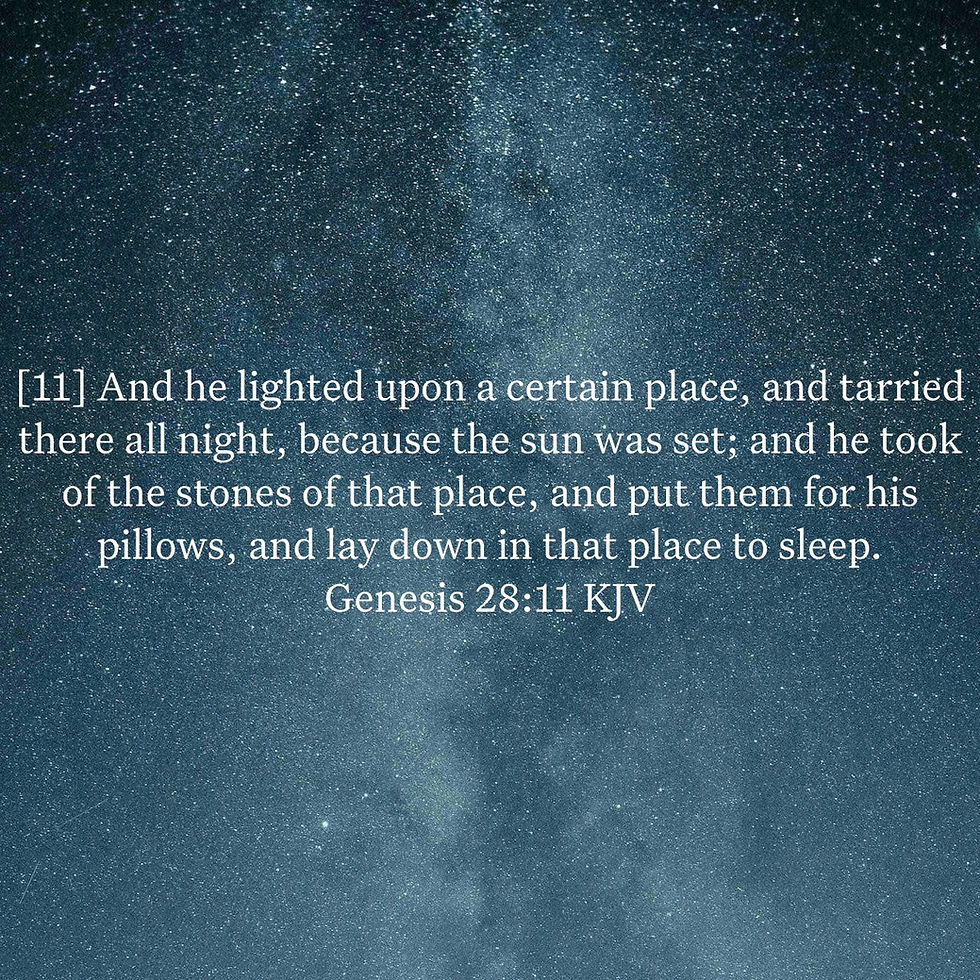
“And he lighted upon a certain place, and tarried there all night, because the sun was set; and he took of the stones of that place, and put them for his pillows, and lay down in that place to sleep.”
This verse shows Jacob at one of the lowest and loneliest points in his life so far. He has left Beersheba. He is traveling toward Haran. His family is behind him, but not in peace. His brother hates him. His father has blessed him, but the memory of deception still hangs over the household. His mother sent him away to preserve his life, but that very sending means separation. Jacob is now away from the tents, away from his parents, away from home, and night has fallen.
The verse says, “he lighted upon a certain place.” At first, this sounds ordinary. Jacob comes to a place along the road. The text does not immediately name it. It is simply “a certain place.” To Jacob, it may have looked like any other stopping place. He did not know yet what God was about to do there. He did not know that this unnamed place would become Bethel, the house of God. He did not know that the ground where he would sleep would become holy in his memory.
That is one of the beautiful patterns of God’s providence. There are moments in life that seem ordinary when we arrive at them, but later we realize God was there. A place may seem like “a certain place” before God speaks. A day may seem like a normal day before God changes us. A painful season may seem like wasted time before God reveals His purpose. Jacob lies down in a place he does not yet understand, but God already knows what it will become.
Jacob “tarried there all night, because the sun was set.” The sun going down is more than a time marker. It helps us feel the mood of the scene. Jacob’s life has entered a kind of darkness. He is not at home. He is not yet at Haran. He is between places. The sun has set, and he must stop. He cannot continue traveling. He must rest in the open, under the night sky, with only stones around him.
This is a very different picture from the life Jacob had known. Earlier, Jacob is described as a plain man dwelling in tents. He was not Esau, the hunter of the field. Jacob belonged to the tent life, the domestic space, the protected world of the household. But now he is outside. He is exposed. He has no soft bed, no familiar covering, no mother nearby, no father’s tent, no household servants attending him. He has only the ground beneath him and stones for pillows.
That detail is meant to strike us. Jacob “took of the stones of that place, and put them for his pillows.” A stone is not comfortable. A stone is hard, cold, and unyielding. This is not the sleep of a man at ease. This is the sleep of a man who has been humbled. The one who grasped for blessing now rests his head on a rock. The one who used smooth words to deceive his father now lies on hard ground. The one who wanted the promise now begins to feel the cost of the path he has taken.
There is a kind of mercy in this hardness. God is not abandoning Jacob, but He is allowing Jacob to feel the weight of his situation. Jacob needs more than blessing. He needs transformation. He needs to learn that the covenant is not secured by manipulation. He needs to learn dependence. He needs to learn that God can meet him when all earthly comforts are stripped away.
Sometimes God allows His people to lie down with stones for pillows.
That does not always mean literal poverty or homelessness. Sometimes it means a season where life becomes hard, uncomfortable, and stripped down. The things that once made us feel secure are removed. The familiar supports are gone. The future is uncertain. The night feels long. The place feels nameless. The ground feels hard. Yet those seasons can become places where God reveals Himself in ways we would not have known otherwise.
Jacob would not have chosen this place as a sanctuary. He would not have looked at the stone pillow and said, “This is where heaven will open.” But God often chooses unlikely altars. He meets Moses at a burning bush in the wilderness. He meets Elijah not in the wind, earthquake, or fire, but in a still small voice. He meets Jonah in the belly of the fish. He meets Paul in prison. And here, He is about to meet Jacob beside the road, while his head rests on a stone.
This teaches us not to despise the hard places too quickly. A hard place may become a holy place. The place where we feel most alone may become the place where God shows us that we were never alone. The uncomfortable season may become the very setting of revelation. Jacob’s stone pillow is not soft, but it is near the place where God will speak.
The verse says Jacob “lay down in that place to sleep.” Sleep requires surrender. A person cannot remain fully guarded and truly sleep at the same time. Jacob is vulnerable. He must close his eyes in a strange place. He must stop trying to control everything for a moment. This is significant because Jacob’s life has been marked by grasping and scheming. He has tried to secure blessing by his own cleverness. But now he must rest. He must lie down. He must sleep. And while he sleeps, God will speak.
That is deeply symbolic. Jacob is not going to create the vision that comes next. He is not going to climb up to heaven by his own effort. He is not going to force God to bless him. He will be asleep when God reveals the ladder reaching from earth to heaven. The revelation will come by grace, not by Jacob’s control. The promise will be spoken while Jacob is passive, because the covenant depends on God’s faithfulness, not Jacob’s manipulation.
This is one of the most important lessons in Jacob’s life. He must learn that God is the giver of the blessing. Jacob can receive. Jacob can obey. Jacob can walk. But Jacob cannot manufacture the presence of God. He cannot seize heaven by deceit. Heaven must open from above. The Lord must speak. The promise must be given.
The hard ground becomes the place where Jacob’s self-reliance begins to loosen.
This verse also reminds us that God often meets people when they have reached the end of the day. “The sun was set.” Jacob has traveled as far as he can for that day. He cannot push farther. The darkness forces him to stop. Many of us do not like stopping. We prefer movement, control, and progress. We like to feel that we are doing something. But sometimes God lets the sun set so that we must stop moving and become still enough to receive.
Jacob had to stop before he could see the dream. He had to lie down before he could look up. He had to rest before he could hear. This is not because laziness is virtuous, but because human striving must eventually yield before divine revelation. There are truths about God that we do not receive while running in panic. We receive them when He brings us to stillness.
The place where Jacob stops is unnamed at first, but God knows it. The stones are ordinary, but God will use them. The night is dark, but heaven is near. Jacob feels alone, but angels are about to appear in his dream. This is one of the great ironies of the passage: Jacob thinks he is stopping in a lonely place, but he is actually lying at the threshold of a divine encounter.
How often is that true in our own lives? We think, “This is just a hard season.” But God sees a place of formation. We think, “This is just a delay.” But God sees a moment of preparation. We think, “This is just loneliness.” But God sees an opportunity to reveal His presence. We think, “This is just a stone pillow.” But God sees the future pillar of Bethel.
Jacob’s circumstances look reduced, but God’s presence is not reduced. His comfort is gone, but the covenant remains. His home is behind him, but heaven is above him. His family is divided, but God’s promise is still whole. He has no bed, but he has the care of God. He has no visible protection, but he is under divine watch.
There is great comfort here for those who feel displaced. Jacob is not settled. He is not where he wants to be. He is not yet where he is going. He is between places. Many people experience seasons like that. They are between jobs, between homes, between relationships, between callings, between grief and healing, between failure and restoration. The in-between can feel like a nameless place where the only pillow available is stone.
But God is not absent from the in-between.
In fact, some of the greatest encounters with God happen there. When we are no longer surrounded by everything familiar, we begin to discover whether God Himself is enough. Jacob had known the God of Abraham and Isaac by inheritance, but now he would begin to know Him personally. The road away from home becomes the place where inherited faith starts becoming personal encounter.
This verse also shows that God’s mercy meets Jacob before Jacob has fully changed. Jacob has not yet wrestled with God. He has not yet confessed his name. He has not yet become Israel. He has not yet learned all the painful lessons Laban will teach him. Yet God is about to reveal Himself. This is grace. God does not wait until Jacob is fully mature before He speaks. He meets him while he is still Jacob.
That should encourage us. God’s presence in our lives is not proof that we have already become everything we should be. Often, God meets us precisely because we need to be changed. He comes not because we are finished, but because He is faithful. He speaks not because we are strong, but because we need His promise to carry us.
Jacob’s stone pillow also points us toward a broader biblical truth: God often uses the low places to reveal high things. Jacob’s head is on the ground, but his dream will reach to heaven. His body is lying low, but his eyes will be opened to the activity of angels. He is in a place of weakness, but God will speak covenant promise over him. The descent into humility becomes the doorway to seeing glory.
This is consistent with the way God works throughout Scripture. The proud are brought low, but the humble are lifted up. The barren woman becomes fruitful. The younger son carries the promise. The shepherd boy becomes king. The crucified Christ rises in glory. God delights to reveal His strength where human strength has run out.
Jacob is not being destroyed by this hard place. He is being prepared.
When the sun set, Jacob had to sleep. When he slept, God gave the dream. When God gave the dream, Jacob learned that the place was not empty. When Jacob awoke, he would say, “Surely the LORD is in this place; and I knew it not.” That statement is the key to the whole scene. God was there before Jacob recognized Him. The Lord’s presence did not begin when Jacob became aware of it. Jacob’s awareness simply caught up with reality.
This is a vital lesson. God’s presence does not depend on our immediate perception. There are times when we do not feel Him, but He is still near. There are times when the place feels ordinary, but God is at work. There are times when the night feels empty, but heaven is open. There are times when we say later, “Surely the Lord was in this place, and I knew it not.”
Genesis 28:11 prepares us for that discovery. It shows us Jacob before the revelation. He is tired. He is alone. He is in a certain place. The sun has set. His pillow is stone. He lies down to sleep. Nothing about the scene looks glorious yet. But God is about to turn that place into one of the defining moments of Jacob’s life.
This should teach us patience with the unfinished parts of our story. We may be living in verse 11, while God is preparing verse 12. We may be lying down in the dark, while God is about to open heaven. We may only see stones, while God sees Bethel. We may think the day has ended, while God is preparing to speak in the night.
Jacob’s journey reminds us that the Lord does not abandon His people when the sun sets. He does not leave them when they sleep in strange places. He does not forget them when they are between departure and arrival. He is the God of the road, the night, the stone pillow, and the dream.
Jacob lay down in that place to sleep. But while Jacob slept, God was awake. While Jacob rested on stone, God was guarding the promise. While Jacob did not know what came next, God knew the whole road. And before morning came, Jacob would discover that the hardest place of the journey had become the house of God.
If you would like to explore Genesis in a sustained, verse-by-verse way with space to reflect, journal, and trace how these foundational truths unfold through Scripture the Verse by Verse book expands these reflections into a unified reading experience. The book gathers these meditations into a structured journey through Genesis, designed to help readers linger in the text and engage God’s Word more deeply over time.


Comments