Genesis 32:15 Daily Devotional & Meaning – Jacob’s Generous Gift of Peace

Daily Verses Everyday! Day 205
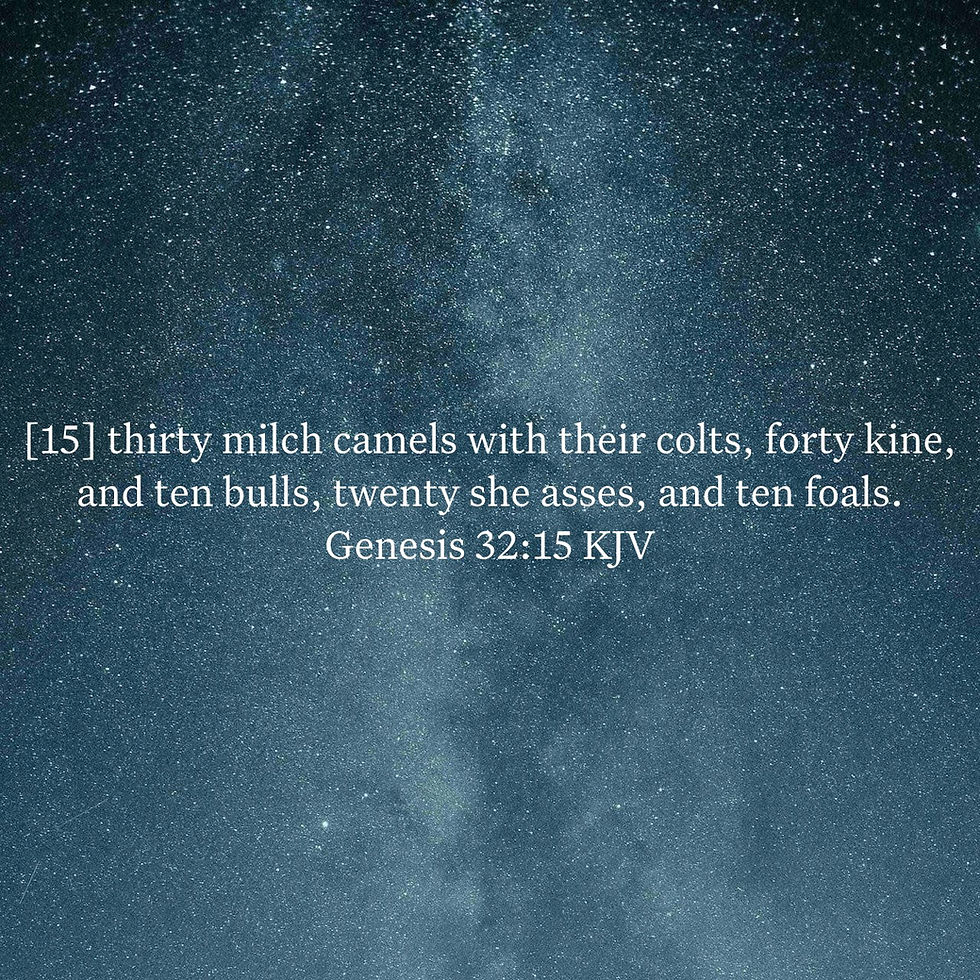
“Thirty milch camels with their colts, forty kine, and ten bulls, twenty she asses, and ten foals.”
Jacob’s gift to Esau was not merely large; it was carefully considered. Verse 15 continues the detailed inventory of the animals Jacob selected from his possessions: “Thirty milch camels with their colts, forty kine, and ten bulls, twenty she asses, and ten foals.” Each group represented real wealth, daily usefulness, future productivity, and personal sacrifice. Milch camels were nursing camels capable of providing valuable milk, and their colts increased both their worth and their future potential. The cattle could produce milk, calves, labor, and meat. The bulls represented strength, breeding, and the expansion of the herd. The female donkeys and their foals were useful for transportation, work, and continued reproduction. Jacob was not giving Esau sick, barren, worn-out, or useless animals. He was offering some of the most productive and valuable creatures in his possession. This teaches us that genuine repentance and reconciliation are often accompanied by a willingness to give something of real value. Jacob could not undo the deception of the past, but he could demonstrate that he was no longer grasping for everything he could obtain. The man who once took advantage of Esau’s hunger and later participated in deceiving Isaac was now approaching his brother with open hands. He had spent much of his earlier life taking, but here he was learning to give.
Jacob’s gift did not purchase forgiveness, and it did not erase his sin. Forgiveness cannot truly be bought. Nevertheless, his generosity provided visible evidence that his heart and posture had changed. Scripture repeatedly distinguishes between attempting to earn forgiveness and producing fruit consistent with repentance. John the Baptist told the people, “Bring forth therefore fruits meet for repentance” in Matthew 3:8. He did not teach that good works could save them, but that genuine repentance would become visible in the manner in which they lived. Likewise, when Zacchaeus encountered Christ, he declared in Luke 19:8, “Behold, Lord, the half of my goods I give to the poor; and if I have taken any thing from any man by false accusation, I restore him fourfold.” Jesus did not say that Zacchaeus purchased salvation through restitution. Rather, his willingness to release his wealth revealed that salvation had entered his house. When God transforms a heart, that transformation will eventually affect the hands, the wallet, the relationships, the priorities, and the choices of the individual.
Jacob’s earlier conflict with Esau involved a blessing associated with prosperity, dominion, and inheritance. Jacob had received the blessing from Isaac through deception, and he had fled with very little. In Genesis 32:10, Jacob acknowledged, “For with my staff I passed over this Jordan; and now I am become two bands.” God had blessed him abundantly during the years he spent with Laban. Yet the blessing of God had not been given merely so Jacob could accumulate possessions for himself. God’s blessings became a means through which Jacob could pursue peace with the brother he had wronged. This is an important lesson for believers. Whatever God places in our hands should remain available for His purposes. Wealth, property, influence, knowledge, time, abilities, and opportunities must never become idols that we clutch as though they belong solely to us. Psalm 24:1 declares, “The earth is the Lord’s, and the fulness thereof; the world, and they that dwell therein.” Everything Jacob possessed ultimately belonged to God, and everything we possess belongs to Him as well. We are not owners in the absolute sense; we are stewards entrusted with what God has provided.
There is also humility in the quality of Jacob’s offering. He did not send Esau leftovers. This echoes the principle seen throughout Scripture that God and others should not be given what costs us nothing. When David was offered Araunah’s threshing floor and animals without payment, he refused, saying in 2 Samuel 24:24, “Nay; but I will surely buy it of thee at a price: neither will I offer burnt offerings unto the Lord my God of that which doth cost me nothing.” David understood that a sacrifice without cost was hardly a sacrifice at all. Similarly, in Malachi 1, God rebuked the people for bringing blind, lame, and sick animals as offerings. They kept the best for themselves and gave God what they did not want. The Lord asked in Malachi 1:8 whether they would dare present such offerings to their governor. Jacob’s gift to Esau stands in contrast to that careless spirit. He selected valuable, productive animals because he understood that reconciliation mattered enough to cost him something.
There are times when Christians speak warmly about peace but remain unwilling to surrender anything to obtain it. We may say that we desire reconciliation while refusing to release our pride. We may say that we want healing while insisting that the other person must make the first move. We may pray that a relationship be restored while guarding every possession, preference, opinion, and personal advantage. Jacob’s actions challenge such shallow desires. Romans 12:18 commands, “If it be possible, as much as lieth in you, live peaceably with all men.” That verse does not promise that every relationship will be restored, because peace requires the participation of more than one person. Nevertheless, it places a responsibility upon us to do what lies within our power. Jacob could not control Esau’s reaction, but he could control the spirit in which he approached him. He could not force Esau to forgive, but he could demonstrate humility, generosity, and sincerity. In the same way, we cannot govern another person’s heart, but we can govern our own conduct before God.
At the same time, Jacob’s gift reminds us that peacemaking should not be confused with manipulation. Jacob certainly hoped the present would soften Esau’s anger, but reconciliation could not rest entirely on the size of the gift. Gifts can be used selfishly when they are offered merely to control another person, escape consequences, silence conviction, or avoid an honest confession. Proverbs 18:16 says, “A man’s gift maketh room for him, and bringeth him before great men,” yet Scripture also warns against bribery and corrupt influence. The difference is found in the heart and purpose of the giver. Jacob’s present was appropriate only because it was joined to humility, prayer, acknowledgement of fear, and a willingness to face Esau personally. He did not send the animals and then flee in the opposite direction. He continued toward the encounter. True repentance does not merely send a gift; it eventually steps forward, faces the wound, accepts responsibility, and seeks mercy.
The mention of the animals with their young also highlights the future-oriented nature of Jacob’s gift. He was not only giving Esau immediate possessions but also resources capable of multiplying. The camels came with their colts, and the female donkeys came with their foals. In an agricultural society, this meant that the gift could continue producing value long after the initial meeting. There is a generosity that gives only enough to ease the conscience, and there is a generosity that seeks the lasting good of another. Jacob’s present appears to belong to the latter category. His gift could enlarge Esau’s herds and provide continuing benefit. This resembles the biblical principle that love does not merely seek its own relief; it seeks the good of the other person. First Corinthians 13:5 teaches that love “seeketh not her own.” When we attempt to make amends, our first concern should not simply be, “How can I stop feeling guilty?” It should also be, “How can I genuinely bless the person who has been harmed?”
This does not mean that every broken relationship can be repaired through money or material compensation. Some wounds are emotional, spiritual, or deeply personal. In such cases, a gift may even appear insulting if it is used in place of sincere repentance. Yet the principle remains: repentance should be willing to bear a cost. That cost may involve financial restitution, but it may also involve time, changed behavior, patient listening, accountability, surrendered pride, or the acceptance of appropriate consequences. A person who says, “I am sorry,” yet refuses to change the behavior that caused the injury has not fully understood biblical repentance. Paul described godly sorrow in 2 Corinthians 7:11 by pointing to the earnestness, clearing, indignation, fear, desire, zeal, and concern it produced among the Corinthians. Godly sorrow moves beyond words into transformed action.
Jacob’s gift also reveals that prosperity is safest when it has passed through the hands of a humbled person. Earlier in Jacob’s life, possessions and blessings were objects to be gained through cleverness. He bargained, maneuvered, and struggled. He had wanted the birthright, the blessing, the flocks, and the future. Yet by this point, God had been teaching him that blessing is not found merely in possessing abundance. True blessing is found in walking with the God who gives it. Jacob could part with hundreds of valuable animals because his hope no longer rested entirely in the herd. God had promised to be with him. Hebrews 13:5 instructs believers, “Let your conversation be without covetousness; and be content with such things as ye have: for he hath said, I will never leave thee, nor forsake thee.” When the presence of God becomes our treasure, earthly possessions become easier to release. When possessions become our treasure, even small acts of generosity feel unbearable.
The Lord may sometimes test our hearts by asking us to release part of what He has given. Abraham was asked to offer Isaac, the son connected to the promise. The rich young ruler was told to sell what he had and give to the poor because his possessions had captured his heart. The early church in Acts 2 and Acts 4 willingly shared their goods so that those in need could be cared for. None of these passages teach that poverty itself earns righteousness. Rather, they reveal that faith loosens the grip of earthly treasures. Jesus taught in Matthew 6:21, “For where your treasure is, there will your heart be also.” Jacob’s treasure was being relocated. His security was slowly moving away from what he owned and toward the God who had promised to preserve him.
The precise number and variety of the animals also show that Jacob acted intentionally. He did not make a vague promise to Esau that he might do something kind in the future. He counted, selected, separated, and sent the animals. Love and repentance often require specificity. It is easy to speak in generalities: “I will do better,” “I care about you,” or “I want to make things right.” Yet meaningful reconciliation frequently asks more direct questions. What exactly must change? What must be returned? What habit must end? What truth must be confessed? What responsibility must be accepted? What boundary must be honored? What act of kindness would serve the other person rather than merely satisfy ourselves? Jacob’s numbered gift teaches us that good intentions should become deliberate actions.
His offering also reflects wisdom. Proverbs 15:1 says, “A soft answer turneth away wrath: but grievous words stir up anger.” Jacob was attempting to approach an angry brother gently. He did not march toward Esau demanding recognition of his rights under Isaac’s blessing. He did not announce, “God has blessed me, and therefore you must submit to me.” Instead, he called Esau his lord and presented himself as Esau’s servant. Although Jacob may have acted partly from fear, his behavior nevertheless demonstrates the wisdom of lowering oneself when seeking peace. Pride intensifies conflict, while humility creates room for mercy. Proverbs 13:10 says, “Only by pride cometh contention.” Many conflicts continue far longer than necessary because neither person is willing to take the lower place. Both wait for the other to apologize first. Both gather evidence of the other’s wrongdoing. Both protect their dignity while the relationship dies. Jacob shows us the wisdom of stepping downward in humility so that peace may have an opportunity to rise.
Yet the ultimate example of costly reconciliation is not Jacob’s gift to Esau. It is the gift of Christ for sinners. Jacob gave animals from his flocks to approach an offended brother, but God gave His only begotten Son to reconcile an offending world to Himself. Romans 5:8 declares, “But God commendeth his love toward us, in that, while we were yet sinners, Christ died for us.” Second Corinthians 5:19 teaches that “God was in Christ, reconciling the world unto himself, not imputing their trespasses unto them.” We were not the innocent party seeking peace with someone who had wronged us. We were the rebels. We were the offenders. We had sinned against the holy God, yet He initiated the work of reconciliation. The cost was not thirty camels, forty cattle, ten bulls, twenty donkeys, or any earthly treasure. The cost was the precious blood of Christ, “as of a lamb without blemish and without spot,” as First Peter 1:19 declares.
Jacob hoped his gift would appease Esau, but Jesus Christ truly satisfied divine justice. Jacob’s animals could soften human anger, but they could not atone for sin. Hebrews 10:4 reminds us, “For it is not possible that the blood of bulls and of goats should take away sins.” Only Christ could accomplish that work. Through His death and resurrection, believers are not merely offered a temporary truce with God but complete reconciliation, adoption, forgiveness, and eternal life. Colossians 1:20 says that Christ made peace “through the blood of his cross.” Therefore, every Christian act of reconciliation should flow from the reconciliation we have already received. We forgive because we have been forgiven. We humble ourselves because Christ humbled Himself. We give because God first gave to us. We seek peace because the Prince of Peace sought us while we were still His enemies.
Verse 15 therefore calls us to examine what we are willing to place in the path of reconciliation. Jacob chose valuable animals, productive herds, and future wealth. What might God be asking us to release? Perhaps it is pride, money, comfort, control, resentment, or the right to have the final word. Perhaps reconciliation requires an apology without excuses. Perhaps it requires returning something taken, correcting a false statement, acknowledging a failure, or patiently rebuilding trust over time. We must remember that forgiveness and reconciliation are not always identical. Forgiveness may be offered from the heart even when the other person remains unrepentant, while full relational restoration may require truth, safety, repentance, and renewed faithfulness. Nevertheless, believers should always resist bitterness and remain willing to obey God in whatever steps of peace He places before them.
Jacob’s detailed gift ultimately reveals a man who was beginning to understand that people are more valuable than possessions. He was willing to become materially poorer if it might help restore the brotherly bond he had damaged. That is a lesson desperately needed in a world where relationships are often sacrificed for money, inheritance, status, property, and pride. Families divide over estates. Friends separate over debts. Churches fracture over control. Marriages suffer because possessions and preferences are valued above love. Jesus asked in Mark 8:36, “For what shall it profit a man, if he shall gain the whole world, and lose his own soul?” We might also ask what it profits a person to keep every possession while losing every meaningful relationship through stubbornness and greed.
May God give us the wisdom to hold His blessings with open hands. May He teach us to give our best rather than our leftovers, to pursue peace without manipulation, to repent with actions rather than empty words, and to trust Him more than we trust what we possess. Jacob’s herds had increased because of God’s mercy, and now those same herds could become instruments of humility and peace. In the same way, every blessing God gives us can either become an idol we defend or a tool we surrender for His glory. The choice reveals where our true treasure lies. Let us therefore remember that we came into this world with nothing, that everything we possess has been received from the hand of God, and that one day we will leave all earthly wealth behind. Only what is done in faith, love, obedience, and service to Christ will carry eternal significance.
If you would like to explore Genesis in a sustained, verse-by-verse way with space to reflect, journal, and trace how these foundational truths unfold through Scripture the Verse by Verse book expands these reflections into a unified reading experience. The book gathers these meditations into a structured journey through Genesis, designed to help readers linger in the text and engage God’s Word more deeply over time.



Comments