Genesis 34:9 Daily Devotional & Meaning – Make Ye Marriages with Us

Daily Verses Everyday! Day 219
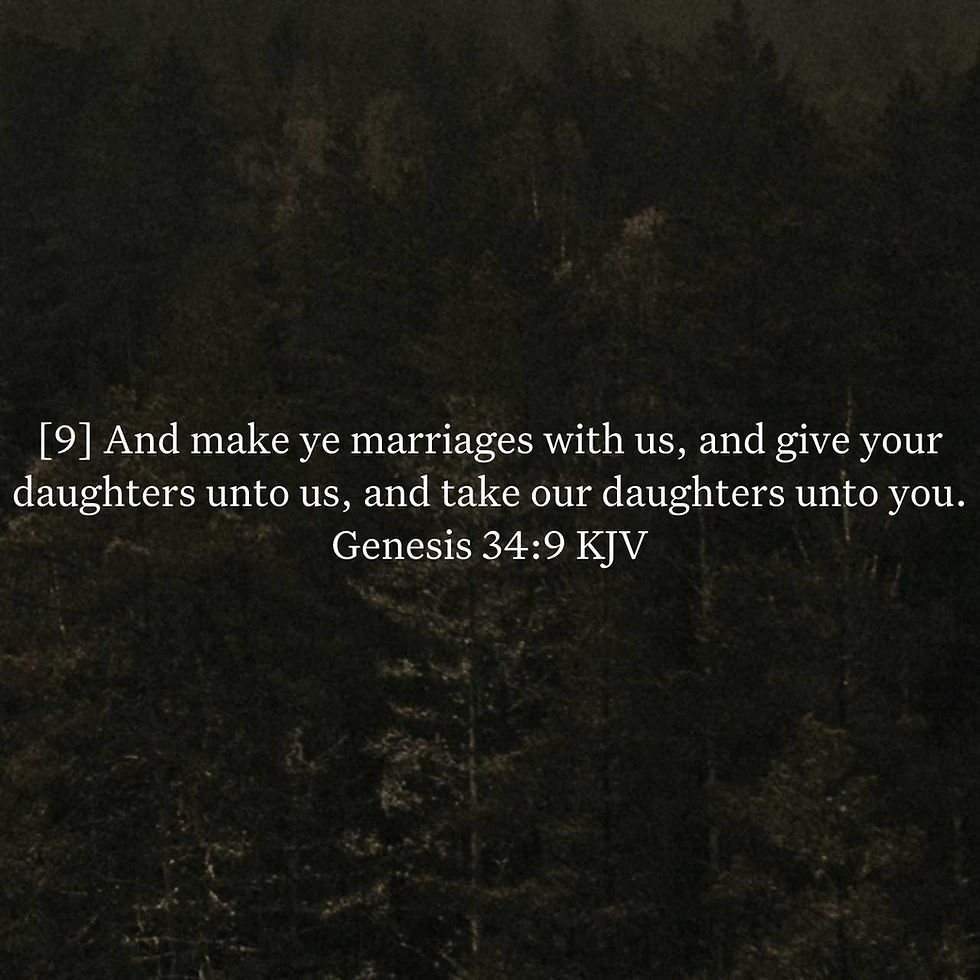
“And make ye marriages with us, and give your daughters unto us, and take our daughters unto you.”
Hamor’s proposal now expands beyond Shechem’s desire for Dinah. What began with one man violating one woman is presented as an opportunity to unite two entire communities: “And make ye marriages with us, and give your daughters unto us, and take our daughters unto you.”
The language sounds cooperative. Hamor is not merely asking Jacob’s family to give Dinah to Shechem. He is proposing ongoing intermarriage between the sons and daughters of both peoples. He presents the arrangement as mutual: you give to us, and we will give to you. Both families will receive spouses. Both communities will become connected. What could appear threatening might be transformed into a partnership.
Yet beneath the language of unity is a dangerous attempt to solve moral evil through social compromise.
Dinah had been violated. That was the issue before them. Shechem had committed an act “which thing ought not to be done.” Yet instead of confronting his son’s guilt, Hamor attempted to make the offense the beginning of a broader alliance. Rather than asking how justice could be done for Dinah, he asked how the two groups might benefit from one another.
It is as though a company had stolen another company’s most valuable invention, and when confronted, its leadership responded, “Instead of discussing the theft, why do we not merge our businesses? You can use our resources, we can use yours, and from this point forward everything can belong to all of us.”
A merger might create profit. It might reduce conflict. It might even appear generous. But it would not answer the original wrongdoing. The stolen invention would still have been stolen. The victim would be pressured to accept partnership with the offender before the offender had acknowledged his guilt.
Hamor’s proposal tried to bury an injustice beneath the promise of future unity.
This is one of the ways sinful people avoid repentance. When the truth becomes uncomfortable, they change the subject. Instead of addressing what was done, they begin discussing what might be gained. Instead of confession, they offer cooperation. Instead of justice, they offer opportunity. Instead of repentance, they suggest that everyone move forward together.
But there can be no righteous unity without truth.
Amos 3:3 asks, “Can two walk together, except they be agreed?” Genuine fellowship requires agreement about what is true, what is good, and who possesses ultimate authority. Jacob’s family had been called by the God of Abraham and Isaac. Hamor’s people belonged to the Canaanite world surrounding them. The difference between them was not fundamentally racial or ethnic. Scripture does not condemn marriage merely because two people come from different nations. The deeper issue was spiritual allegiance.
Would Jacob’s household remain devoted to the Lord, or would it gradually be absorbed into the beliefs, customs, and moral practices of the surrounding people?
God had called Abraham out from his country and kindred. He had promised to make of him a great nation and to bless all the families of the earth through his seed. Abraham understood that the covenant line must not be swallowed by the idolatry of Canaan. That is why Genesis 24 records his command concerning Isaac: “Thou shalt not take a wife unto my son of the daughters of the Canaanites, among whom I dwell.”
Abraham was not teaching that Canaanite women possessed less human dignity. All people bear the image of God. Rahab was a Canaanite woman who trusted the Lord, joined herself to Israel, and later appeared in the genealogy of Jesus Christ. Ruth was a Moabitess who confessed, “Thy people shall be my people, and thy God my God,” and she too entered the messianic line.
The concern was never biological purity. It was covenant faithfulness.
Rahab and Ruth did not draw God’s people into idolatry. They abandoned the gods of their former lives and placed their faith in the true God. The danger in Genesis 34 was that Jacob’s family would enter permanent unions with people who had shown no evidence of turning to the Lord.
Hamor did not say, “Teach us the ways of your God.”
He did not ask about the altar Jacob had erected.
He did not acknowledge El-elohe-Israel, the God of Israel.
He did not express repentance over the wickedness committed by his son.
He simply proposed, “Make ye marriages with us.”
He wanted union without conversion, fellowship without shared faith, and peace without repentance.
The temptation would have been considerable. Jacob’s family had recently returned to Canaan after years of living with Laban. They were strangers in the region. Hamor’s family controlled the city. Intermarriage would give Jacob’s household social acceptance, political security, economic opportunity, and perhaps protection from surrounding enemies.
From a human perspective, the proposal could have seemed like the safest way forward.
Jacob no longer needed to remain an outsider. His sons could marry women from the city. His daughters could marry influential men. The families could combine resources, strengthen their positions, and reduce the possibility of conflict. Jacob’s household could become established within the land.
But not every open door has been opened by God.
Some opportunities offer immediate security while quietly demanding spiritual compromise.
Some relationships promise acceptance but slowly weaken our allegiance to the Lord.
Some agreements appear peaceful because they remove conflict, yet they remove conflict only by asking God’s people to stop being distinct.
Proverbs 14:12 warns, “There is a way which seemeth right unto a man, but the end thereof are the ways of death.” Hamor’s offer may have seemed practical, but practicality is never the highest standard for the people of God. The first question cannot merely be, “Will this make life easier?” It must be, “Will this honor the Lord?”
The world frequently invites believers into arrangements that sound fair and mutually beneficial: “Give us your daughters, and take our daughters unto you.” The message is essentially, “We will share our lives with you if you will become one with us.”
There is nothing wrong with living peacefully among unbelievers, loving our neighbors, conducting honest business, forming friendships, serving communities, and treating every person with dignity. Jeremiah later told the Jewish exiles to seek the peace of the city in which they lived. Jesus commanded His people to love their neighbors and even their enemies. Paul taught in Romans 12:18, “If it be possible, as much as lieth in you, live peaceably with all men.”
Separation from sin is not permission for pride, hostility, or isolation.
However, loving the world’s people is different from joining the world’s rebellion against God.
The believer is called to be present without being absorbed, compassionate without compromising, peaceful without surrendering truth, and loving without allowing another person to become more important than obedience to Christ.
Jesus prayed concerning His disciples in John 17:15–17, “I pray not that thou shouldest take them out of the world, but that thou shouldest keep them from the evil. They are not of the world, even as I am not of the world. Sanctify them through thy truth: thy word is truth.”
Christ did not ask the Father to remove His people from every unbeliever. He asked that they be kept from evil and sanctified through truth.
The danger in Hamor’s proposal was not that Jacob’s family would know Canaanites. They already lived among them. The danger was that repeated marriage unions would bind their household to the worship, morality, and identity of the city until the covenant family became indistinguishable from everyone around them.
Marriage creates one of the deepest human bonds God has established. Genesis 2:24 says that a man shall leave his father and mother, cleave unto his wife, and they shall be one flesh. This union is not casual. It affects the home, the children, daily worship, moral decisions, loyalties, priorities, and the direction of future generations.
A person does not merely marry an appearance, a personality, or a collection of shared interests. Marriage joins lives.
That is why spiritual agreement matters so deeply.
Second Corinthians 6:14 asks, “What fellowship hath righteousness with unrighteousness? and what communion hath light with darkness?” Paul’s teaching extends beyond marriage, but it certainly applies to the marriage covenant. A Christian and an unbeliever do not merely hold different opinions about a secondary subject. They possess different centers of worship.
One says that Jesus Christ is Lord.
The other does not submit to Him as Lord.
One seeks to order life according to Scripture.
The other does not recognize Scripture as the final authority.
One desires children to know and worship Christ.
The other may desire a completely different spiritual direction.
Affection may be strong, but affection alone cannot resolve the question of ultimate allegiance.
This does not mean that a believer already married to an unbeliever should abandon the marriage. First Corinthians 7 specifically teaches that if an unbelieving spouse is willing to remain, the believer should not depart. God can use the faithful witness of a Christian husband or wife within that home.
But a believer choosing marriage should not knowingly enter a covenant that will divide the deepest loyalties of the household. Marriage is already difficult when two people share faith in Christ. When they worship different masters, every major decision may expose the division.
Hamor was inviting Jacob’s family to create not one such union, but many.
“Give your daughters unto us, and take our daughters unto you.”
One marriage would lead to another. One generation would raise the next. Family loyalty would become tied to the city. Religious customs would enter the homes. Children might grow up hearing about the Lord at one gathering and the gods of Canaan at another. Over time, the distinction between the covenant people and their neighbors could disappear.
This is how compromise often works. It rarely begins by openly demanding that a person renounce God.
It begins with a small accommodation.
It says, “You do not have to stop believing. Just stop allowing your belief to affect this decision.”
It says, “You may keep your altar. Just place it alongside ours.”
It says, “You may worship your God privately. Just do not insist that He alone is Lord.”
Compromise does not always ask us to throw away the truth immediately. Sometimes it asks us to place truth beside error and treat both as equal. But the Lord does not accept a place among many gods. He alone is God.
Exodus 20:3 would later declare, “Thou shalt have no other gods before me.” Deuteronomy 6:4 says, “Hear, O Israel: The Lord our God is one Lord.” The covenant people were called to love Him with all their heart, soul, and might.
Hamor’s proposal threatened that wholehearted devotion.
Israel’s later history shows how serious this danger would become. Solomon possessed extraordinary wisdom and received abundant blessing from God, yet First Kings 11 records that he loved many foreign women who turned his heart after other gods. The issue was not their nationality in itself. The text specifically emphasizes their idolatrous influence.
First Kings 11:4 says, “For it came to pass, when Solomon was old, that his wives turned away his heart after other gods: and his heart was not perfect with the Lord his God.”
Solomon may have believed that his wisdom was strong enough to withstand the influence. He may have considered many of his marriages politically useful. They formed alliances and increased his international standing. Yet what appeared politically advantageous became spiritually destructive.
A relationship can provide earthly advantage while producing spiritual ruin.
Nehemiah later confronted similar compromise among the returned exiles. He reminded them of Solomon and asked in Nehemiah 13:26, “Did not Solomon king of Israel sin by these things?” The wisest king in Israel had been drawn away because he treated covenant faithfulness as something that could coexist with divided worship.
Hamor was proposing the seed of that same danger long before Israel became a nation.
His words also reveal how daughters were being discussed as instruments of alliance. “Give your daughters unto us, and take our daughters unto you.” Women appear in his proposal as the means by which men, families, property, and communities would be joined.
Dinah’s voice remains absent.
The woman who had been violated was being discussed as part of a negotiation among men. Then Hamor broadened the arrangement to include future daughters on both sides. Their marriages would create social bonds, secure cooperation, and produce mutual advantage.
Marriage does unite families, but a daughter is not merchandise.
A woman is not a bargaining chip.
A son is not a tool for political advancement.
Every person bears the image of God and should be treated with dignity. Marriage should involve faithful covenant, not the exploitation of human beings for power, wealth, status, or peace.
Hamor’s proposal may have sounded balanced because both sides would give and receive. Yet an arrangement can be reciprocal and still be unrighteous. Two groups may agree to exchange what neither has the moral right to treat as property. Mutual consent between powerful decision-makers does not guarantee justice for those whose lives are being negotiated.
The language of fairness can conceal the absence of righteousness.
Hamor was effectively saying, “We will give something to you if you give something to us.” Yet the heart of marriage is not exchange but covenant love.
Christian marriage is not a transaction in which each spouse remains only while receiving sufficient benefit. It is a sacred promise before God. Husband and wife are called to give themselves faithfully to one another, not to use one another for status, pleasure, money, children, security, or social acceptance.
Ephesians 5 presents marriage through the pattern of Christ and the church. Christ did not negotiate a mutually profitable arrangement with His bride. He “loved the church, and gave himself for it.”
That is the heart of covenant: self-giving faithfulness.
Hamor’s proposal, by contrast, remained centered upon what each group might gain. His son would receive Dinah. The men of the city would gain access to Jacob’s daughters. Jacob’s sons could receive women from the city. As the following verses reveal, the people and possessions could eventually become intertwined.
Everything was moving toward social and economic integration, but nothing had moved toward repentance.
This is another reminder that unity itself is not always righteous.
Our culture often treats unity as an unquestionable good. We hear that people should come together, set aside differences, and move forward. In many situations, that is wise and beautiful. Scripture celebrates the unity of believers and commands us to pursue peace.
Psalm 133:1 says, “Behold, how good and how pleasant it is for brethren to dwell together in unity!”
But biblical unity is unity in truth.
Jesus did not pray that His followers would be united with wickedness. He prayed that those who belonged to Him would be one in the Father and the Son. Ephesians 4 speaks of “the unity of the Spirit” and “the unity of the faith.” Christian unity has Christ as its center and truth as its foundation.
The builders at Babel were united, but their unity was rebellion against God.
The crowd that demanded Christ’s crucifixion was united, but their agreement did not make them righteous.
Herod and Pilate became friends while participating in the rejection of Jesus.
Unity can magnify good, but it can also organize evil.
Therefore, the question is not merely whether people are united. The question is what unites them, whom they obey, and where their union is leading.
Hamor desired unity that would protect his son’s interests and benefit his city. He did not desire unity founded upon repentance toward God.
The church must learn this distinction. We must not sacrifice truth merely to preserve institutional peace. We must not hide abuse because exposure might divide a congregation. We must not silence the wounded because leaders want everyone to “move forward together.” We must not call for reconciliation while refusing to confront sin.
Peace that protects wrongdoing is not the peace of Christ.
Jeremiah rebuked those who healed the hurt of God’s people slightly, saying, “Peace, peace; when there is no peace.” A wound covered without being cleansed may look better temporarily, but infection remains beneath the surface.
Hamor’s proposal was a bandage placed over an untreated wound.
Before discussing marriages, the family needed to confront what had happened to Dinah. Before forming alliances, Shechem’s guilt needed to be acknowledged. Before talking about a shared future, truth and justice needed to be addressed.
The same order matters in our relationships.
Reconciliation is precious, but reconciliation cannot be demanded by the offender.
Forgiveness is commanded, but forgiveness should never be manipulated into silence.
Unity is desirable, but unity purchased through denial becomes falsehood.
Restoration requires truth.
First John 1:7 says, “If we walk in the light, as he is in the light, we have fellowship one with another.” Fellowship is connected to walking in the light. Darkness must be exposed, not renamed as peace.
This verse also calls believers to examine where they may be exchanging spiritual distinction for acceptance. Hamor’s proposal offered Jacob’s family a way to belong. They no longer had to remain strangers in the land. Through marriage, they could become part of the city.
The desire to belong is powerful.
No one enjoys feeling like an outsider. We want relationships, community, acceptance, and security. Those desires are not inherently sinful. God created human beings for fellowship. Yet the desire to belong becomes dangerous when we are willing to disobey God to gain acceptance.
Peter felt this pressure in the courtyard when others identified him as a disciple of Jesus. He denied Christ because association with the Lord had become dangerous. He wanted to avoid the cost of standing apart.
Israel repeatedly felt the same temptation. In First Samuel 8, the people demanded a king so that they might be “like all the nations.” God had called them to be His distinct people, but they saw their difference as a disadvantage.
The believer may experience that pressure today.
The world says, “Believe what you want, but do not let your faith make you different.”
Do not define marriage according to Scripture.
Do not insist that Christ alone is the way to the Father.
Do not call sin what God calls sin.
Do not allow your faith to affect your relationships, ambitions, entertainment, sexuality, finances, or public conduct.
You may keep the name Christian, provided that Christianity changes nothing.
But Jesus did not call His followers to disappear into the surrounding culture. He called them the salt of the earth and the light of the world. Salt that loses its savor is useless. Light that is hidden beneath a bushel does not fulfill its purpose.
First Peter 2:9 describes believers as “a chosen generation, a royal priesthood, an holy nation, a peculiar people,” called to show forth the praises of Him who called them out of darkness into His marvelous light.
To be “peculiar” does not mean to behave strangely for the sake of attention. It means to belong uniquely to God as His possession.
Jacob’s family belonged to the Lord’s covenant purpose. Their distinction was not grounds for pride. They had done nothing to earn God’s calling. Jacob’s own history was filled with deception, fear, favoritism, and failure. God had chosen this family by grace.
Holiness should therefore produce humility, not superiority.
Believers are not called to look down upon unbelievers. We are sinners saved by grace. There is no room for arrogance. We love, serve, witness, welcome, and proclaim Christ to all people because the gospel is offered to every nation.
Yet grace does not erase the call to holiness. The same Christ who receives sinners also says, “Follow me.” He calls people out of darkness, not into a comfortable mixture of darkness and light.
Hamor wanted the two peoples to become one without anyone needing to surrender to the God of Israel.
The gospel creates a very different kind of unity.
Through Jesus Christ, Jews and Gentiles are reconciled to God and to one another. Ephesians 2 teaches that Christ has broken down the middle wall of partition and created one new man. But this unity does not occur because truth is abandoned. It occurs because both groups are reconciled to God through the cross.
People from every tribe, language, nation, and background become one in Christ, not by preserving every idol, but by confessing one Lord.
Galatians 3:28 declares that there is neither Jew nor Greek, bond nor free, male nor female, “for ye are all one in Christ Jesus.”
This is not assimilation into a human city. It is reconciliation into the family of God.
The church does not say, “Give us your children, and we will give you ours so that we may gain from one another.” The church proclaims, “Come to Jesus Christ, repent, believe the gospel, and become part of a family purchased by His blood.”
At the cross, Christ does not compromise with sin. He bears its judgment.
He does not unite light and darkness. He delivers people from the power of darkness and translates them into His kingdom.
He does not protect the offender at the expense of the wounded. He is both the righteous Judge and the compassionate Savior.
The unity Christ creates is holy because Christ Himself is its foundation.
Hamor’s proposal reminds us that Satan often imitates what God creates. God creates covenant unity; sin offers compromise. God creates fellowship in truth; sin offers agreement through silence. God joins people through sacrificial love; sin joins them through mutual advantage. God calls diverse peoples into one body under Christ; sin blends truth and error until distinction disappears.
We need discernment to recognize the difference.
Not every invitation to cooperate should be rejected. Believers can work with unbelievers in many legitimate areas for the common good. We can serve neighborhoods, care for the poor, protect children, conduct business, pursue justice, and build peaceful communities alongside people who do not share our faith.
But we must never enter an arrangement that requires disobedience to God or treats spiritual truth as negotiable.
Daniel served faithfully within Babylon, but he would not eat in a way that defiled him.
Shadrach, Meshach, and Abednego served the king, but they would not bow before his image.
The apostles respected governing authorities, but when commanded to stop preaching Christ, they answered, “We ought to obey God rather than men.”
Faithfulness knows how to cooperate without capitulating.
Jacob’s family needed that kind of wisdom. Tragically, the sons would not respond with godly faithfulness. They would pretend to accept Hamor’s proposal while secretly planning violence. They recognized the danger of intermarriage, but they used the sacred sign of circumcision deceptively and committed an atrocity against the city.
Their refusal to compromise did not justify their cruelty.
This chapter refuses to give us an easy human hero. Hamor sought unity without righteousness. Shechem sought marriage after violation. Jacob’s sons sought vengeance through deception and massacre. Every direction reveals the corruption of sin.
The answer is not Hamor’s compromise.
The answer is not Simeon and Levi’s violence.
The answer is the righteousness, truth, mercy, and justice found perfectly in God.
This is important for Christians who may believe there are only two possible responses to a sinful culture: complete assimilation or angry destruction. Scripture calls us to neither.
We are not to become indistinguishable from the world.
Neither are we to hate the people of the world.
We are to be holy and loving.
We are to speak truth and show mercy.
We are to refuse compromise while proclaiming reconciliation through Christ.
We are to overcome evil with good.
Jesus demonstrated this perfectly. He ate with publicans and sinners, yet He never participated in their sin. He touched the unclean, yet He remained undefiled. He showed compassion to the woman taken in adultery, yet He told her, “Go, and sin no more.” He welcomed sinners without affirming the sin that enslaved them.
Christ was separate from sinners in holiness while drawing near to sinners in mercy.
That is the calling of His people.
Hamor’s words offered Jacob’s household belonging within Shechem. Christ offers us citizenship in heaven.
Hamor offered marriages that would join two earthly communities. Christ joins believers to Himself in an eternal covenant.
Hamor offered a peace that ignored Dinah’s wound. Christ purchased peace through His own wounds.
Isaiah 53:5 declares, “The chastisement of our peace was upon him; and with his stripes we are healed.”
The peace of God does not deny justice. At the cross, justice and mercy meet. Sin is exposed in all its seriousness, and sinners are offered forgiveness through the sacrifice of the Son of God.
The church is described as the bride of Christ. Yet unlike Shechem, Christ did not take His bride by force for selfish gratification. He gave Himself to rescue her. Revelation looks forward to the marriage supper of the Lamb, when the redeemed will be united forever with the Savior who loved them and washed them from their sins in His own blood.
That is holy union.
That is covenant love.
That is a marriage founded not upon taking, but upon sacrifice.
Genesis 34:9 therefore warns us not to confuse broad agreement with righteous fellowship. Hamor’s proposal appeared generous, reciprocal, and peaceful, but it asked Jacob’s family to forget who they were and to become permanently joined to a people who had not turned to their God.
The offer promised acceptance, but it threatened assimilation.
It promised security, but it endangered faithfulness.
It promised peace, but it avoided repentance.
It promised union, but not holiness.
Every believer will face some version of this temptation. We may be invited into relationships, partnerships, ambitions, or social circles that promise advantage while quietly weakening our devotion to Christ. The compromise may appear small. The benefits may be real. The acceptance may feel deeply satisfying.
But no earthly gain is worth exchanging faithfulness to God.
Jesus asked in Mark 8:36, “For what shall it profit a man, if he shall gain the whole world, and lose his own soul?”
Hamor would soon speak of the land, trade, possessions, and prosperity. His proposal would become increasingly attractive from a worldly perspective. But the people of God cannot measure decisions only by what they might gain.
We must ask what our choices will do to our worship.
Will this relationship draw me closer to Christ or continually pressure me away from Him?
Will this partnership require me to remain silent about what God has called true?
Will this opportunity make sin easier to excuse?
Will the children raised from this decision be taught to love the Lord with all their hearts?
Will I preserve outward peace by surrendering inward obedience?
These questions are not expressions of fear. They are acts of wisdom.
Hamor said, “Make ye marriages with us.” God had called Jacob’s household to something higher than becoming comfortably absorbed into Shechem. They were to carry the covenant promise forward until the One through whom all nations would be blessed came into the world.
That One is Jesus Christ.
Through Him, the goal is not for God’s people to remain eternally separated by ethnicity or nationality. The goal is for people from every nation to be reconciled to God and united in worship of the Lamb.
Revelation 7:9 portrays a great multitude “of all nations, and kindreds, and people, and tongues” standing before the throne. Their diversity is not erased, but their worship is united. They do not become one because truth no longer matters. They become one because they have been redeemed by the same Savior.
That is the unity toward which Scripture moves.
Not unity through compromise, but unity through redemption.
Not unity that ignores sin, but unity created because Christ has dealt with sin.
Not unity centered upon human advantage, but unity centered upon the glory of God.
May we love all people without surrendering our allegiance to Christ. May we welcome every repentant sinner without joining ourselves to idolatry. May we recognize that marriage is more than social convenience, physical attraction, or economic opportunity. It is a covenant that shapes lives, homes, children, and generations.
May parents never treat their sons and daughters as tools for status or security. May believers entering marriage seek a spouse who will walk beside them in devotion to Christ. May churches pursue unity that is rooted in truth rather than peace maintained through silence.
And when the world invites us to become one with it by loosening our grip upon God’s Word, may we remember that we already belong to another kingdom.
We have been bought with a price.
We are the bride of Christ.
We are called to live in the world without becoming of the world.
We are sent to love those around us, not to imitate their rebellion.
And we wait for the day when every redeemed people will be joined together, not beneath the promises of Hamor, but beneath the lordship of Jesus Christ, the Lamb who gave Himself so that sinners from every nation might become one holy family forever.
If you would like to explore Genesis in a sustained, verse-by-verse way with space to reflect, journal, and trace how these foundational truths unfold through Scripture the Verse by Verse book expands these reflections into a unified reading experience. The book gathers these meditations into a structured journey through Genesis, designed to help readers linger in the text and engage God’s Word more deeply over time.


Comments