Genesis 35:12 Daily Devotional & Meaning – The Land Promised to Abraham, Isaac, and Jacob

Daily Verses Everyday! Day 229
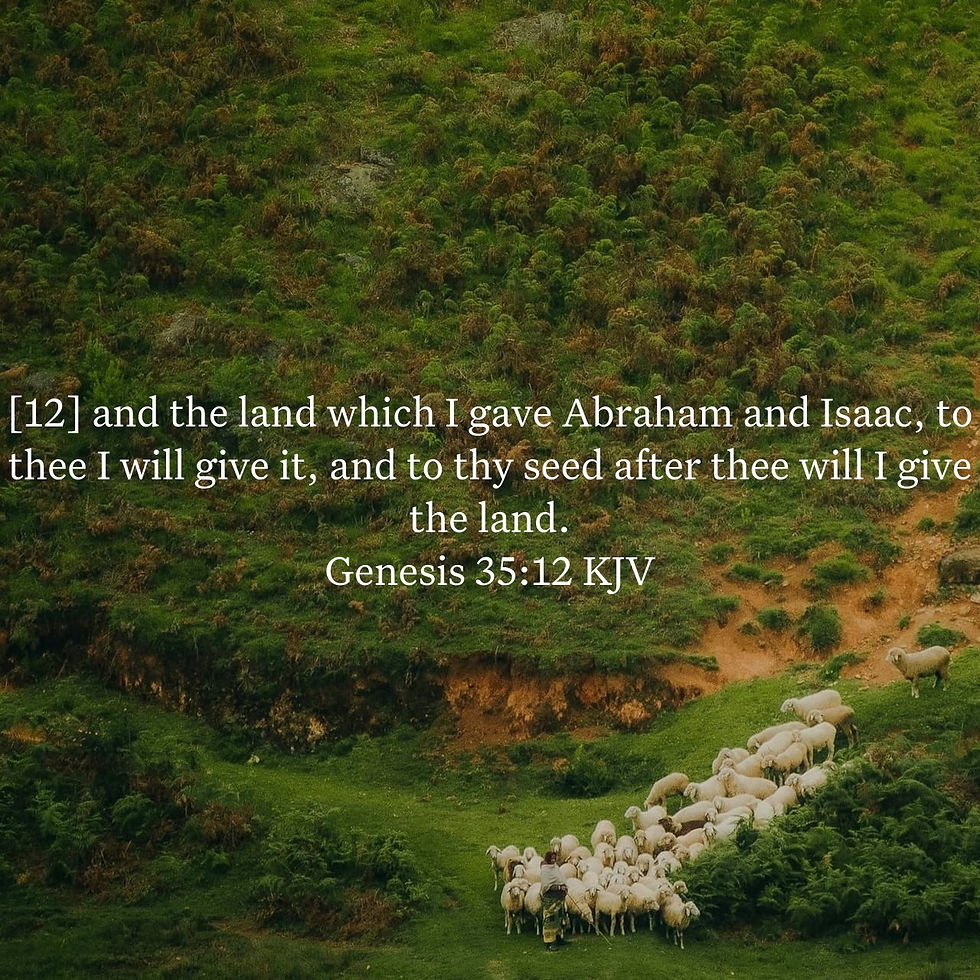
“And the land which I gave Abraham and Isaac, to thee I will give it, and to thy seed after thee will I give the land.”
“And the land which I gave Abraham and Isaac, to thee I will give it, and to thy seed after thee will I give the land.” God is not beginning a new promise here. He is reaffirming one that had already been spoken across generations. The land Jacob is standing upon is the same land God promised to Abraham, the same land He confirmed to Isaac, and now the same land He promises directly to Jacob and to his descendants after him. This verse shows us once again that the covenant did not belong merely to one generation. Abraham died, but the promise did not die with him. Isaac would die, but the promise would not die with him either. Jacob himself would eventually die, yet God’s word would continue through his descendants because the promise was not being sustained by the lifespan of the patriarchs. It was being sustained by the faithfulness of God.
The promise of the land first became clear when God called Abram out of his homeland. Genesis 12:1 says, “Now the LORD had said unto Abram, Get thee out of thy country, and from thy kindred, and from thy father's house, unto a land that I will shew thee.” Abram was commanded to leave what was familiar and travel toward a land that God would reveal. He did not receive every detail before he went. He had to trust the God who called him. Hebrews 11:8 later says, “By faith Abraham, when he was called to go out into a place which he should after receive for an inheritance, obeyed; and he went out, not knowing whither he went.” From the very beginning, therefore, the land promise was connected to faith. Abraham went because God had spoken.
When Abram arrived in Canaan, God made the promise more specific. Genesis 12:7 says, “And the LORD appeared unto Abram, and said, Unto thy seed will I give this land.” That simple statement becomes one of the great promises running through the rest of Genesis. Canaan was not merely the place where Abraham happened to settle. It was land that God had specifically connected to His covenant purposes. Later, after Abram and Lot separated, God expanded the promise in Genesis 13:14-15, saying, “Lift up now thine eyes, and look from the place where thou art northward, and southward, and eastward, and westward: For all the land which thou seest, to thee will I give it, and to thy seed for ever.” Then Genesis 13:17 says, “Arise, walk through the land in the length of it and in the breadth of it; for I will give it unto thee.” The certainty of the language is striking. God did not say that Abraham might receive the land if circumstances worked out favorably. He said, “I will give it.”
That distinction matters because the promise rested upon divine action. Abraham was not told to secure the promise through his own strength. He was told to trust the God who had spoken. Genesis 15 makes the covenant even more specific. God told Abram in Genesis 15:7, “I am the LORD that brought thee out of Ur of the Chaldees, to give thee this land to inherit it.” Abram then asked how he would know that he would inherit it, and God established covenant with him. Genesis 15:18 says, “In the same day the LORD made a covenant with Abram, saying, Unto thy seed have I given this land.” Notice again the certainty. God spoke of the land as given even though Abraham did not yet possess it in the full sense.
That tells us something important about the promises of God. What is still future to us can already be certain because God has spoken it. Abraham’s circumstances often looked very different from the promise. He lived as a stranger in the land. Genesis 23 shows him purchasing a burial place for Sarah because he did not yet possess Canaan as his own. The man to whom God had promised the land had to buy a field in the land in order to bury his wife. To human eyes, that could have looked like a contradiction. Yet God had never promised Abraham that every part of the covenant would be fully realized during Abraham’s lifetime. Hebrews 11:13 says of the patriarchs, “These all died in faith, not having received the promises, but having seen them afar off, and were persuaded of them, and embraced them.”
Faith does not require that God fulfill everything according to our preferred timetable. Abraham believed God even when he could see only the beginning. Then the promise passed to Isaac. After Abraham died, Genesis 26 records a famine in the land. Isaac considered going toward Egypt, but God appeared to him and said in Genesis 26:2-3, “Go not down into Egypt; dwell in the land which I shall tell thee of: Sojourn in this land, and I will be with thee, and will bless thee; for unto thee, and unto thy seed, I will give all these countries.” God then continued, “and I will perform the oath which I sware unto Abraham thy father.” The promise to Isaac was explicitly connected to the oath given to Abraham. The covenant had continuity.
Now the same promise comes to Jacob. The first great land promise to Jacob occurred at Bethel while he was fleeing from Esau. Genesis 28:13 says, “I am the LORD God of Abraham thy father, and the God of Isaac: the land whereon thou liest, to thee will I give it, and to thy seed.” Jacob was leaving the land when God told him that the land beneath him would belong to him and his descendants. He did not own it. He did not control it. He did not even know when he would return. Yet God spoke the promise anyway. Then Genesis 28:15 says, “I will bring thee again into this land.”
That makes Genesis 35:12 especially powerful. The man who once left the land is now standing in it again. The God who said, “I will bring thee again,” has done exactly that. Jacob’s return becomes evidence that the promise is moving forward. He still does not possess the land in its fullness. His descendants have not yet become a nation. But one stage of the promise has already been fulfilled. Jacob left, and God brought him back.
The wording is also significant: “the land which I gave Abraham and Isaac, to thee I will give it.” Abraham, Isaac, and Jacob are placed together in one unbroken line of covenant faithfulness. These names later become one of the most important formulas in Scripture. God repeatedly identifies Himself as the God of Abraham, the God of Isaac, and the God of Jacob. When Moses encounters God at the burning bush, Exodus 3:6 says, “I am the God of thy father, the God of Abraham, the God of Isaac, and the God of Jacob.” God had not forgotten the patriarchs. He had not forgotten the covenant. He had not forgotten the land.
Centuries could pass, generations could rise and die, Israel could become enslaved in Egypt, but God’s promise would still stand. Exodus 6:4 says, “And I have also established my covenant with them, to give them the land of Canaan, the land of their pilgrimage, wherein they were strangers.” Then Exodus 6:8 says, “And I will bring you in unto the land, concerning the which I did swear to give it to Abraham, to Isaac, and to Jacob.” What God says to Jacob here in Genesis 35 becomes part of what He later uses to reassure Israel while they are still in Egypt.
That should immediately teach us something about the faithfulness of God. From a human perspective, slavery in Egypt could have appeared to contradict everything God had promised. How could a people enslaved in another country inherit Canaan? Yet Egypt did not cancel Canaan. Pharaoh did not cancel the covenant. Slavery did not cancel the promise. The Red Sea did not cancel the promise. The wilderness did not cancel the promise. The giants in the land did not cancel the promise. God had spoken.
We often judge what God is doing based only on the chapter we are currently living in. If Jacob had judged everything from Padanaram, he might have wondered about the land. If Joseph had judged everything from the pit, he might have wondered about God’s purpose. If Israel had judged everything from Egyptian slavery, they might have concluded that the promise was dead. But God sees the entire story. Isaiah 46:10 says that He is the One “Declaring the end from the beginning, and from ancient times the things that are not yet done.”
That is why faith has to rest upon the character of God rather than upon immediate circumstances. The fulfillment of the land promise would continue long after Jacob’s death. Jacob’s family would eventually go down into Egypt because of famine. Genesis 46 records Jacob leaving Canaan once again, which might seem strange in light of the promise, but God spoke to him during that transition. Genesis 46:2-4 says, “And God spake unto Israel in the visions of the night, and said, Jacob, Jacob. And he said, Here am I. And he said, I am God, the God of thy father: fear not to go down into Egypt.” Then God promised, “I will go down with thee into Egypt; and I will also surely bring thee up again.”
Leaving the land did not mean losing the promise. God can move His people through temporary seasons without abandoning His permanent purposes. Jacob would die in Egypt, yet even in death he demonstrated faith that Canaan remained the land of promise. Genesis 49:29 records Jacob commanding his sons, “bury me with my fathers in the cave that is in the field of Ephron the Hittite.” Jacob wanted his body returned to Canaan because Egypt might be where he died, but Egypt was not where the covenant pointed.
Joseph later demonstrated the same faith. Hebrews 11:22 says, “By faith Joseph, when he died, made mention of the departing of the children of Israel; and gave commandment concerning his bones.” Joseph believed Israel would leave Egypt because he believed what God had promised to Abraham, Isaac, and Jacob. That is the power of trusting the word of God. A man can die believing what he has not yet seen because he knows the One who spoke it.
Eventually Moses would lead Israel out of Egypt, and Joshua would lead them into Canaan. Joshua 21:43 says, “And the LORD gave unto Israel all the land which he sware to give unto their fathers.” Then Joshua 21:45 says, “There failed not ought of any good thing which the LORD had spoken unto the house of Israel; all came to pass.”
“All came to pass.”
That statement stands as one of the clearest declarations of God’s faithfulness in Scripture. The promise spoken to Abraham did not fail. The promise confirmed to Isaac did not fail. The promise given to Jacob did not fail. Generations passed, but God remained faithful.
That is why we should never confuse delay with failure. A promise may take generations to unfold and still be perfectly certain. God’s timetable is not ours. Jacob hears, “to thy seed after thee will I give the land.” Those words force him to think beyond himself. Some of what God was promising would be fulfilled through people Jacob would never meet.
That requires humility because we naturally want to see the results of everything God is doing through us. Yet sometimes God allows one generation to plant what another generation will harvest. Abraham received the promise. Isaac inherited the promise. Jacob received confirmation of the promise. Their descendants would eventually possess what the patriarchs had only seen from a distance.
Paul describes this principle in First Corinthians 3:6 when he says, “I have planted, Apollos watered; but God gave the increase.” God often works through many people and many generations. No single person gets to claim the entire work. That should free us from the need to see everything completed in our own lifetime. Faithfulness matters even when fulfillment extends beyond us.
There is also an important distinction we must preserve when reading this verse. God’s promise of the land was specifically given within His covenant dealings with Abraham, Isaac, Jacob, and their descendants. We should not take this verse and turn it into a general promise that every believer will receive a particular piece of property or whatever material thing he desires. The verse means what it says. God promised this land to this covenant family.
The application for us is found first in the character of the God who made the promise. God is faithful. God remembers. God keeps covenant. God does not speak carelessly. God does not forget His word. That should shape how we understand every promise He truly gives His people. Second Corinthians 1:20 says, “For all the promises of God in him are yea, and in him Amen.” Our confidence is not that we can take any verse and turn it into a personal guarantee. Our confidence is that whatever God truly promises, He is faithful to fulfill according to His purpose.
The land promise also becomes part of the larger redemptive story leading toward Christ. Israel needed the land because God was forming a people. Within that people He would establish worship, priesthood, sacrifice, law, prophecy, and kingdom. Jerusalem would eventually become the center of Israel’s national life. David would reign. Solomon would build the temple. The prophets would speak. Ultimately Jesus Christ would enter the world through this covenant people.
The land is therefore not an isolated promise disconnected from redemption. It becomes part of the setting in which God unfolds His redemptive plan. Matthew 1 traces the genealogy of Christ through Abraham, Isaac, and Jacob. Matthew 1:2 says, “Abraham begat Isaac; and Isaac begat Jacob.” The same names God mentions here in Genesis appear at the beginning of the Gospel because the covenant promises were moving forward toward Christ.
Jacob could not see all of that from Bethel. He saw land. God saw generations. Jacob saw his household. God saw Israel. Jacob saw the immediate promise. God saw centuries of redemptive history.
That should remind us of the enormous difference between our perspective and God’s. We see one moment. God sees the entire purpose. We see what is happening now. God knows how it connects to what came before and what will come after.
The patriarchs themselves understood that even the land pointed toward something greater. Hebrews 11:9 says that Abraham lived in the promised land “as in a strange country,” dwelling in tents with Isaac and Jacob, “the heirs with him of the same promise.” Then Hebrews 11:10 says, “For he looked for a city which hath foundations, whose builder and maker is God.” Hebrews 11:13 says they confessed that they were “strangers and pilgrims on the earth,” and Hebrews 11:16 says, “they desire a better country, that is, an heavenly.”
That does not make the earthly promise meaningless. Canaan was real, and God really gave it to Israel. But it reminds us that the greatest blessing has always been God Himself. Jacob was promised land, but the greatest blessing in Jacob’s life was not the soil beneath his feet. It was the presence of the God who had promised it.
Genesis 28:15 did not merely say, “I will give you land.” God said, “I am with thee.” Genesis 31:3 did not merely command Jacob to return. God said, “I will be with thee.” The covenant was never only about possession. It was about belonging to God and being part of His purpose.
We need to remember that because blessings can easily become greater in our hearts than the One who gives them. A gift from God is never greater than God. A promise is precious because of the One who makes it. The land mattered because God had chosen it within His covenant purpose.
There is also something deeply personal in the way God says, “the land which I gave Abraham and Isaac, to thee I will give it.” God could simply have said, “I will give you this land.” Instead He names Abraham and Isaac. Jacob is being reminded that he stands within a history of divine faithfulness. His story did not begin with him.
Jacob received promises that had been spoken before he was born. He inherited a covenant he did not invent. He stood within a story God had already been writing for generations. That should humble us. We too are recipients before we are contributors. We know the gospel because it was proclaimed before we were born. We possess Scripture because God preserved His word. We worship the same God worshipped by generations before us.
Jacob inherited what God had begun with Abraham, but he also had a responsibility to pass the knowledge of God to those who came after him. The verse says, “and to thy seed after thee will I give the land.” There is always another generation in view.
Psalm 78:5-7 says that God established testimony in Jacob and appointed a law in Israel so that fathers would make His works known to their children, “That the generation to come might know them.” God’s faithfulness should be remembered and taught. Jacob’s children needed to know the story of Abraham, Isaac, Bethel, Padanaram, and God’s promises. If one generation forgets God’s faithfulness, the next generation can begin treating His blessings as though they appeared by accident.
That is why Scripture repeatedly commands God’s people to remember. Deuteronomy 8 warns Israel not to enter the land, enjoy its abundance, and then forget the LORD who brought them there. Deuteronomy 8:18 says, “But thou shalt remember the LORD thy God.”
Remember what God said.
Remember what God did.
Remember where He brought you from.
Remember who gave the blessing.
Jacob had every reason to remember. Every time he looked at the land, he could remember Abraham. He could remember Isaac. He could remember the night God first spoke to him at Bethel. He could remember the promise that God would bring him back. Now he was back.
The ground beneath his feet had become evidence that God keeps His word.
That should challenge us to remember what God has already done in our own lives. Not every blessing we receive is a specific covenant promise like Canaan was to Jacob, but every act of God’s faithfulness should teach us something about His character. If He has carried us before, remember. If He has corrected us before, remember. If He has provided before, remember. If He has brought us through seasons we thought we would never survive, remember.
Remembering does not guarantee that the next season will unfold exactly as we expect. It does something greater. It reminds us who God is.
Psalm 105:8 says, “He hath remembered his covenant for ever, the word which he commanded to a thousand generations.” God remembers. That is why His people should remember too.
There is a beautiful contrast throughout Scripture between human forgetfulness and divine remembrance. We forget easily. God does not. Exodus 2:24 says, while Israel groaned beneath Egyptian slavery, “And God heard their groaning, and God remembered his covenant with Abraham, with Isaac, and with Jacob.” That does not mean God had actually forgotten the covenant and suddenly recalled it. It means He was moving to act according to what He had already promised.
The names appear again.
Abraham.
Isaac.
Jacob.
The same line found here in Genesis 35.
Pharaoh could forget Joseph, but God did not forget Jacob. Human rulers could change, but God’s covenant remained.
That is why Genesis 35:12 is much more than a statement about geography. It is a declaration of divine faithfulness across generations. God gave the promise to Abraham. God confirmed it to Isaac. God gives it now to Jacob. Then God says it will continue to Jacob’s descendants after him.
The promise moves through generation after generation because the same God stands behind every generation.
Men die, but God remains.
Circumstances change, but God remains.
Empires rise and fall, but God remains.
People forget, but God remembers.
Psalm 90:1 says, “Lord, thou hast been our dwelling place in all generations.” Israel would eventually receive a land, but their ultimate security was never meant to be the land itself. Their security was God.
Whenever Israel trusted the land while rebelling against God, judgment followed. The land could never substitute for covenant faithfulness. The temple could never substitute for obedience. Religious heritage could never substitute for faith.
Jacob was the grandson of Abraham and the son of Isaac, but God still personally dealt with Jacob. Jacob could not live merely on Abraham’s encounters with God. He needed his own walk with God. In the same way, Jacob’s children could not rely only on Jacob’s experiences. Every generation must know God for themselves.
That is why Joshua would later challenge Israel in Joshua 24:15, “choose you this day whom ye will serve.” They were standing in the very land promised to Abraham, Isaac, and Jacob, yet possessing the land did not remove their responsibility to serve God.
This brings the promise full circle. In Genesis 35, Jacob stands at Bethel hearing the promise. In Joshua, Jacob’s descendants stand within the fulfillment. What God had spoken centuries earlier had become visible reality.
Yet Joshua still tells them to serve the LORD.
Blessing never eliminates responsibility.
Grace never makes obedience unnecessary.
The promise should produce faithfulness, not complacency.
Genesis 35:12 therefore teaches us both to trust the promises of God and to honor the God who gives them. The land was promised because God had chosen to give it. Jacob had not earned it. Abraham had not invented the covenant. Isaac had not designed the plan. God initiated it all.
That is grace.
Yet grace produces responsibility.
The descendants who inherited the land were called to live as God’s people within it. The same pattern runs throughout Scripture. God acts first, then His people respond. God rescues Israel from Egypt before giving them the Law at Sinai. God saves believers by grace before calling them to walk in good works. Ephesians 2:8-9 says, “For by grace are ye saved through faith,” and then Ephesians 2:10 says, “For we are his workmanship, created in Christ Jesus unto good works.”
Jacob’s reception of the promise should therefore produce worship. The God who promised the land to Abraham was still faithful. The God who confirmed it to Isaac was still faithful. The God who met Jacob while he was fleeing was still faithful. Now Jacob stands again at Bethel, and God repeats the covenant.
Nothing has been forgotten.
Not Abraham.
Not Isaac.
Not Jacob.
Not the land.
Not the descendants.
Not the generations still unborn.
God remembers all of it because all of it belongs to His purpose.
Perhaps the most remarkable thing is that Jacob himself had done nothing to deserve such covenant faithfulness. His history contained deception, fear, manipulation, and failure, yet God’s purpose continued. That does not minimize Jacob’s sin. It magnifies God’s grace.
Jacob’s weakness had not made God weak.
Jacob’s failures had not made God unfaithful.
Jacob’s changing circumstances had not changed God’s word.
Numbers 23:19 says, “God is not a man, that he should lie.” What He truly promises, He fulfills.
That gives this verse enormous weight. God is effectively telling Jacob, “What I began before you, I am continuing through you.” Then He says, “to thy seed after thee will I give the land,” meaning that what God is doing through Jacob will continue after Jacob is gone.
Jacob stands between generations.
Behind him stand Abraham and Isaac.
Ahead of him stand his sons, the twelve tribes, Moses, Joshua, David, and generations of Israel.
Above them all stands God.
That is the perspective we should carry from this verse. We are never the center of God’s story. God is.
Abraham was part of it.
Isaac was part of it.
Jacob was part of it.
Israel would be part of it.
David would be part of it.
The prophets would be part of it.
All of it would eventually move toward the redemptive work of Christ.
God uses individuals, families, nations, generations, lands, and events, but the story belongs to Him.
That should humble us and comfort us at the same time. It humbles us because God’s purposes are larger than our individual lives. It comforts us because His purposes do not depend entirely upon our ability to see everything completed.
Jacob did not need to live long enough to watch Joshua enter Canaan.
He only needed to trust the God who promised that his descendants would.
Sometimes faith means carrying what God has entrusted to us as far as He has called us to carry it and trusting Him with everything that comes afterward.
That is how Abraham lived.
That is how Isaac lived.
That is how Jacob lived.
Hebrews 11 tells us that they died believing, not because they had seen everything, but because they knew the One who had spoken.
And that is ultimately what Genesis 35:12 calls us to do.
Trust the God who remembers His word.
Trust the God who works across generations.
Trust the God who can begin something with Abraham, continue it through Isaac, reaffirm it to Jacob, preserve it through Egypt, carry it through the wilderness, and fulfill it under Joshua.
Trust the God whose promises do not expire when circumstances become difficult.
Trust the God whose faithfulness is not limited by our lifetime.
Jacob stood on land he did not yet fully possess, hearing God speak about descendants who had not yet been born and events he would never personally witness.
Yet the promise was secure.
Not because Jacob could see the future.
But because God could.
Not because Jacob was powerful enough to accomplish it.
But because God was.
Not because every circumstance looked favorable.
But because God had spoken.
The land had been promised to Abraham.
It had been confirmed to Isaac.
Now it was promised to Jacob.
And one day Jacob’s descendants would stand within that land and realize that every generation between the promise and the fulfillment had been held together by the faithfulness of the same God.
God remembers.
God continues.
God fulfills.
And what He truly promises, He is faithful to bring to pass.
If you would like to explore Genesis in a sustained, verse-by-verse way with space to reflect, journal, and trace how these foundational truths unfold through Scripture the Verse by Verse book expands these reflections into a unified reading experience. The book gathers these meditations into a structured journey through Genesis, designed to help readers linger in the text and engage God’s Word more deeply over time.


Comments