
Genesis 35:21 Daily Devotional & Meaning – Israel Journeyed Beyond the Tower of Edar

Daily Verses Everyday! Day 233
“And Israel journeyed, and spread his tent beyond the tower of Edar.”
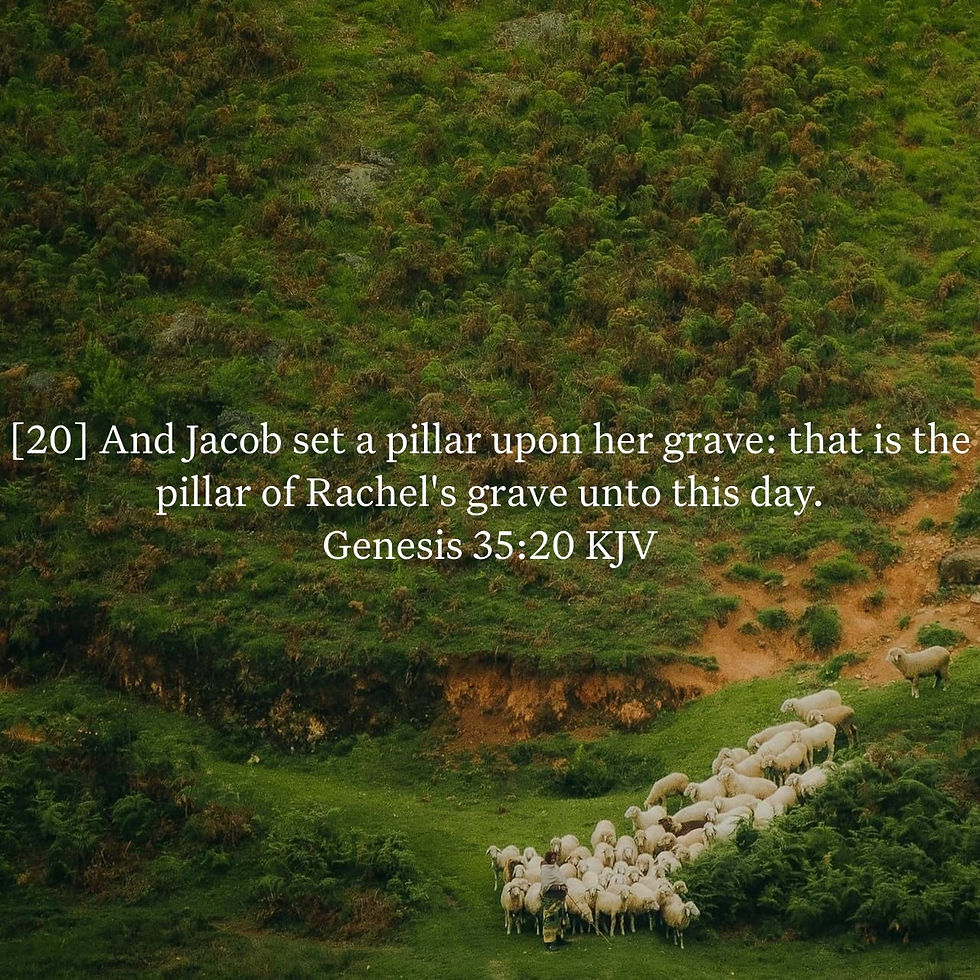
“And Jacob set a pillar upon her grave: that is the pillar of Rachel's grave unto this day.” Jacob has erected pillars before, but this pillar is fundamentally different from the others. At Bethel he erected a pillar because God had spoken to him. Genesis 28:18 says, “And Jacob rose up early in the morning, and took the stone that he had put for his pillows, and set it up for a pillar, and poured oil upon the top of it.” Then, after returning to Bethel many years later, Genesis 35:14 tells us, “And Jacob set up a pillar in the place where he talked with him, even a pillar of stone.” Those pillars marked encounters with God, covenant promises, worship, and divine faithfulness. This pillar marks a grave. The same man who had raised stones to remember moments of revelation now raises a stone to remember someone he loved. Bethel’s pillar said, in effect, “God met me here.” Rachel’s pillar says, “Someone precious to me lies here.” Both kinds of remembrance have a place in the life of faith.
There is something deeply human about Jacob’s action. Rachel has died. He cannot change what happened. He cannot return to the moment when he first saw her approaching the well. He cannot relive the seven years that Genesis 29:20 says “seemed unto him but a few days, for the love he had to her.” He cannot prevent her hard labour. He cannot give Benjamin his mother back. He cannot take Rachel the remaining distance to Ephrath alive. There are some circumstances in life that cannot be repaired by human strength because there is simply nothing left for us to repair. Death places us before a boundary we cannot cross by our own power. Jacob therefore does what he can do: he buries Rachel, and then he marks the place.
The pillar does not deny death. It acknowledges it. Jacob does not pretend Rachel has not died, nor does Scripture attempt to cover the pain with shallow words. Genesis says plainly in the preceding verse, “And Rachel died.” Then Jacob buries her, and now he places a pillar over the grave. This is important because biblical faith is never built upon pretending painful things are not painful. Scripture permits mourning. Abraham mourned Sarah. Genesis 23:2 says, “And Abraham came to mourn for Sarah, and to weep for her.” Joseph mourned Jacob. Genesis 50:1 says, “And Joseph fell upon his father's face, and wept upon him, and kissed him.” David mourned Saul and Jonathan. Jesus Himself wept at Lazarus’s grave. The people of God can believe in the sovereignty of God and still stand beside a grave with tears in their eyes.
Sometimes Christians can feel as though grief demonstrates a lack of faith, but Scripture never teaches that. If grief itself demonstrated unbelief, then Jesus would not have wept in John 11:35. Jesus knew exactly what He was about to do. He knew Lazarus would walk out of the tomb within moments. He knew death would not have the final word, and yet He wept. Knowledge of resurrection does not make love indifferent to separation. Christian hope changes grief, but it does not necessarily eliminate grief. First Thessalonians 4:13 does not command believers not to sorrow. Paul says that we “sorrow not, even as others which have no hope.” The difference is not between grief and no grief. The difference is between grief without hope and grief that knows death will not ultimately win.
Jacob’s pillar is therefore an expression of remembrance, and remembrance has been a major theme throughout Genesis. God establishes signs of His covenant. People build altars where God has appeared. Names are given to locations because of what occurred there. Wells receive names. Stones are erected. These physical objects provide tangible reminders of events that must not be forgotten. Human beings forget easily, and Scripture repeatedly recognizes this weakness. Deuteronomy 8:11 warns Israel, “Beware that thou forget not the LORD thy God.” Psalm 103:2 says, “Bless the LORD, O my soul, and forget not all his benefits.” Remembrance can preserve gratitude, but it can also preserve love. Jacob’s pillar is not merely about remembering what God did. It is about remembering Rachel.
There is nothing ungodly about remembering someone we have lost. God has created us as relational beings, and relationships leave marks upon us. When someone becomes part of our life for years or decades, their death does not erase the history that came before it. Rachel had been woven into Jacob’s story from the day he arrived in Padanaram. She had been present through years of service under Laban, through the birth of Jacob’s children, through his departure from Laban, through the confrontation over the stolen household gods, through the dangerous journey back toward Canaan, and through the reconciliation with Esau. Now suddenly her part of the journey ends while Jacob’s continues.
That is one of the painful realities of losing someone we love: the world keeps moving. Jacob still has children to raise. Benjamin is a newborn. Joseph has lost his mother. The household must continue travelling. The promises of God remain. Jacob still has responsibilities. Yet Rachel will no longer physically walk beside him. Grief often works that way. We may feel as if the world should stop because someone central to our world has died, but the days continue arriving. Meals still need to be prepared. Children still need care. Responsibilities remain. Morning comes again. Jacob cannot remain indefinitely beside Rachel’s grave, but before he leaves, he marks the place.
The pillar allows Jacob to move forward without pretending that what lies behind him no longer matters. That balance is important. There is a difference between remembering the past and living permanently imprisoned by it. Jacob’s memorial does not become his home. He does not build his tent around Rachel’s grave and refuse to move ever again. He establishes a marker and then eventually continues the journey. Faith sometimes requires both remembrance and movement. We remember those we have lost, honor what they meant to us, grieve honestly, and still continue walking the road God has placed before us.
This same balance appears later when Israel crosses the Jordan under Joshua. God commands twelve stones to be taken from the river and established as a memorial. Joshua 4:6-7 says, “That this may be a sign among you, that when your children ask their fathers in time to come, saying, What mean ye by these stones? Then ye shall answer them, That the waters of Jordan were cut off before the ark of the covenant of the LORD.” The memorial preserved a story. Future generations would see stones and ask why they were there. The stones themselves were ordinary; their significance came from the history attached to them.
Rachel’s pillar similarly attaches memory to a location. Someone passing the site could ask why the pillar stood there, and the answer would be Rachel. This was where Rachel died. This was where Israel buried the wife he loved. This was where Benjamin was born. This was where joy and sorrow collided in the same moment. The stone became a witness to the history of one family that would eventually become the nation of Israel.
The words “that is the pillar of Rachel's grave unto this day” reinforce the lasting character of that memory. In biblical narrative, the phrase “unto this day” ordinarily points to the time from which the narrator is speaking. It tells us that the memorial, or at least the memory and identification connected with it, endured well beyond the immediate event. It should not automatically be read as meaning that the exact original pillar necessarily remains standing in our own modern day thousands of years later. Rather, Scripture is telling its original readers that Rachel’s grave remained a known landmark long after Jacob placed the pillar there.
Rachel was not forgotten.
That becomes clear later in Scripture. Many years afterward, when Jacob himself is approaching death, he speaks to Joseph and recalls Rachel’s death with remarkable specificity. Genesis 48:7 says, “And as for me, when I came from Padan, Rachel died by me in the land of Canaan in the way, when yet there was but a little way to come unto Ephrath: and I buried her there in the way of Ephrath; the same is Bethlehem.” Decades had passed, but Jacob remembered exactly where it happened. He remembered that they had not yet reached Ephrath. He remembered burying her along the road. The details remained alive in the old man’s mind.
That moment in Genesis 48 becomes especially moving because Jacob is speaking to Joseph, Rachel’s firstborn son. Joseph had lived much of his life separated from his father. He had been sold into slavery, falsely accused, imprisoned, elevated in Egypt, and eventually reunited with Jacob. Yet now, near the end of Jacob’s life, the memory of Rachel surfaces while Jacob is speaking with the son she had long prayed to receive. One can imagine how emotionally complicated the conversation must have been, although Scripture does not record their emotions in detail. The old man who buried Rachel is speaking to the grown son she never lived to see become ruler in Egypt.
Rachel’s grave appears again in 1 Samuel 10 during the anointing of Saul. Samuel tells Saul in 1 Samuel 10:2, “When thou art departed from me to day, then thou shalt find two men by Rachel's sepulchre in the border of Benjamin at Zelzah.” The fact that Rachel’s tomb could be used as a geographical reference demonstrates how deeply the memory became embedded within Israel’s landscape. Generations after Rachel’s death, Israelites still knew a location as “Rachel’s sepulchre.”
There is particular beauty in the connection with Benjamin. Rachel died giving birth to Benjamin, and later her burial place is described in connection with the territory of Benjamin. The child whose entrance into the world coincided with Rachel’s departure eventually became the father of a tribe, and the land itself carried reminders of the woman who had died giving birth to him. Rachel’s story became embedded not only within Jacob’s family memory but within the geography of Israel.
This is one reason biblical geography can matter so much. The land becomes filled with memory. Bethel recalls Jacob’s encounter with God. Hebron and Machpelah recall Abraham, Sarah, Isaac, Rebekah, Jacob, and Leah. Shechem recalls both covenant history and tragedy. The Jordan will eventually carry memories of miraculous crossings. Jerusalem will become associated with David, the temple, the prophets, the crucifixion, and the resurrection. Bethlehem will carry memories of Rachel, Ruth, David, and ultimately Jesus Christ. Biblical places become layered with generations of history.
Rachel’s burial near Bethlehem is particularly striking because the story connected to that region continues growing long after her death. Rachel could never have imagined the events that would eventually be associated with Bethlehem. Ruth would arrive there with Naomi. Boaz would redeem Ruth there. Obed would be born, leading to Jesse and then David. Samuel would come to Bethlehem and anoint David. Micah would later prophesy in Micah 5:2, “But thou, Bethlehem Ephratah, though thou be little among the thousands of Judah, yet out of thee shall he come forth unto me that is to be ruler in Israel.” Eventually Matthew 2:1 would announce, “Now when Jesus was born in Bethlehem of Judaea.”
Rachel’s grave therefore stands near ground that will become enormously significant in the history of redemption. Jacob erects a pillar because he sees the place as the site where Rachel died. God sees far more history than Jacob could possibly know. Jacob knows that this place holds his grief; God knows that the same region will one day be associated with David and ultimately with Christ.
That does not mean Rachel’s death secretly ceases to be tragic because something wonderful happens nearby centuries later. We should never use God’s sovereignty as a reason to minimize actual suffering. The biblical doctrine of providence is much richer than simply telling grieving people that everything happens for a reason. Scripture allows Jacob’s loss to remain loss. Rachel does not come back. Benjamin grows up without his mother. Joseph never again sees Rachel. Jacob remembers her death decades later. God’s larger purposes do not erase those facts.
Instead, providence means that sorrow does not place history outside God’s hands. Even when Jacob cannot understand what God will do with the generations ahead, God remains sovereign over the whole story. Romans 8:28 says, “And we know that all things work together for good to them that love God, to them who are the called according to his purpose.” Paul does not say that all things are good. Death is called an enemy in 1 Corinthians 15:26. Grief hurts precisely because death has torn apart something that was precious. Yet God is so sovereign that even what is not good in itself cannot finally overthrow His good purposes.
Rachel’s grave proves something else: faithfulness to God does not mean that every person we love will remain with us for as long as we want. Jacob had recently returned to Bethel in obedience. God had appeared to him. The covenant had been reaffirmed. Yet Rachel died. God’s presence did not prevent Jacob from becoming a widower. The biblical faith never promises us permanent earthly possession of the people we love.
This truth should produce gratitude for the people God has given us now. We can easily begin acting as though the people around us will always be there. Familiarity can make us careless. We postpone conversations. We allow small offenses to become bitterness. We neglect expressions of appreciation because we assume there will always be another opportunity. Rachel’s grave reminds us that every earthly relationship exists within the limits of mortality. James 4:14 says, “For what is your life? It is even a vapour, that appeareth for a little time, and then vanisheth away.” Psalm 90:12 therefore prays, “So teach us to number our days, that we may apply our hearts unto wisdom.”
Numbering our days should not make us morbid. It should make us intentional. Tell people you love them while you can. Forgive when forgiveness is required. Be present. Give thanks for the ordinary days because eventually we discover that many of the days we considered ordinary were actually precious. Jacob probably did not imagine during those seven years of service for Rachel that one day he would stand beside a stone marking her grave. None of us knows the number of days God has appointed to those around us.
Yet there is also something beautiful about how Jacob refuses to allow Rachel to vanish anonymously into the landscape. He could have buried her and continued the journey without leaving anything behind, but he chooses to establish a memorial. There is dignity in remembering the dead. Scripture regularly preserves names precisely because individual human lives matter before God. Genesis contains genealogies filled with names. Exodus records names. Chronicles records generations of names. Jesus Himself says in Luke 12:6-7 that not even sparrows are forgotten before God and then tells His followers, “even the very hairs of your head are all numbered.”
Rachel mattered.
She was not merely “Jacob’s wife” in an abstract sense. Scripture remembers her name, her struggles, her failures, her longing for children, her love, her sons, her death, and her grave. She was a real woman whose life became part of God’s covenant history. The pillar reflects on a human level what Scripture itself does on a divine level: it remembers her.
There is also a lesson here about monuments themselves. A monument is useful only when it directs memory toward something true. Israel’s history would later demonstrate that physical objects can become corrupted when people assign spiritual power to the object rather than remembering what it represents. Jacob’s pillar was not meant to be worshipped. Rachel’s grave was not a shrine through which people were instructed to seek spiritual power. Scripture simply records it as a memorial.
That distinction matters because biblical memorials always function best when they point beyond themselves. Samuel later sets up a stone after God delivers Israel from the Philistines. First Samuel 7:12 says, “Then Samuel took a stone, and set it between Mizpeh and Shen, and called the name of it Ebenezer, saying, Hitherto hath the LORD helped us.” The stone was not the helper. God was. The stone helped the people remember who had helped them.
Likewise, Rachel’s pillar does not preserve Rachel’s life in some mystical sense. It preserves memory. It tells subsequent generations that this life mattered and that something important happened here.
Christian remembrance operates similarly. We may keep photographs, letters, objects, places, or traditions associated with people we have lost. There is nothing inherently wrong with that. Such things can help us remember the goodness God allowed us to experience through relationships. The danger comes only when memory prevents us from continuing to live faithfully or when created things assume a place that belongs to God alone.
Jacob grieves Rachel, but Jacob still belongs to God. Rachel was deeply loved, but she was never Jacob’s God. That is an important distinction because grief sometimes reveals just how tightly our hearts have attached themselves to earthly relationships. Every person we love is a gift from God, but no human being can occupy the place of God. People die. God does not. People leave us, sometimes willingly and sometimes through death. God says in Hebrews 13:5, “I will never leave thee, nor forsake thee.”
That does not make human loss painless. Instead, it means there remains Someone who cannot be taken from us even when everything else changes.
Psalm 73:25-26 expresses this beautifully: “Whom have I in heaven but thee? and there is none upon earth that I desire beside thee. My flesh and my heart faileth: but God is the strength of my heart, and my portion for ever.” Our bodies fail. The bodies of those we love fail. Relationships that once seemed permanent within this world eventually meet death. But God remains “my portion for ever.”
Jacob will eventually continue his journey because his story is not finished. Rachel’s earthly journey is finished, but God still has work for Jacob. Benjamin needs a father. Joseph needs a father. The other sons need him. The covenant line continues. This does not mean Jacob should quickly “get over” Rachel. Genesis 48 proves he never simply forgot her. It means grief and responsibility can coexist.
Many people discover this after loss. They may wake up grieving and still need to care for children. They may carry sadness and still go to work. They may remember someone every day and still laugh again. They may experience moments of joy without betraying the person who died. Moving forward is not the same as forgetting.
Jacob’s pillar makes that clear. He can leave Rachel’s grave because he has not erased Rachel from memory.
There is also a theological significance to graves throughout Scripture because graves continually remind humanity of the judgment first announced in Genesis 3. God told Adam in Genesis 3:19, “for dust thou art, and unto dust shalt thou return.” Every burial after that declaration becomes another testimony that the fall has consequences. Abraham buried Sarah. Isaac and Ishmael buried Abraham. Jacob buries Rachel. Joseph will eventually bury Jacob. Genesis itself, which opens with God creating life, ends with Joseph’s body placed in a coffin in Egypt.
Death casts a long shadow across Genesis.
But death is not the final direction of Scripture.
The Bible moves from graves toward resurrection.
Rachel receives a pillar over her grave because, from Jacob’s earthly perspective, death has taken her beyond his reach. But centuries later Jesus Christ will stand before another grave and declare in John 11:25, “I am the resurrection, and the life.” Then He will prove His authority by calling Lazarus out of the tomb.
Even greater than that, Jesus Himself will be buried.
Matthew 27:59-60 tells us that Joseph of Arimathaea “wrapped it in a clean linen cloth, And laid it in his own new tomb.” A stone would mark that burial place too, but unlike Rachel’s grave, the defining truth about Christ’s tomb would soon become that He was no longer there.
Matthew 28:5-6 records the angel saying, “Fear not ye: for I know that ye seek Jesus, which was crucified. He is not here: for he is risen.”
That changes how Christians ultimately view every grave.
A grave still hurts.
A grave still marks separation.
A grave still reminds us that something has gone terribly wrong with the world.
But because Christ rose, the grave does not possess the final claim over those who belong to Him.
First Corinthians 15:20 says, “But now is Christ risen from the dead, and become the firstfruits of them that slept.” Paul then looks toward the final victory and says in 1 Corinthians 15:54, “Death is swallowed up in victory.”
Jacob places a pillar because Rachel’s grave remains occupied. Christians look toward a day when graves themselves will surrender the dead.
First Thessalonians 4:16 says, “For the Lord himself shall descend from heaven with a shout, with the voice of the archangel, and with the trump of God: and the dead in Christ shall rise first.” The Christian hope is not merely that memories survive death. It is resurrection.
Memories are precious, but memory alone cannot satisfy the deepest longing of grief. If someone we love has died, merely remembering them is not the same as having them restored. Christianity promises something far greater than preserving memories. It promises that death itself will be defeated.
Revelation 21:4 gives the final picture: “And God shall wipe away all tears from their eyes; and there shall be no more death, neither sorrow, nor crying, neither shall there be any more pain.”
There will come a day when memorial stones to death are no longer needed because death itself will be gone.
Until then, we remember.
Jacob remembers Rachel.
Israel remembers Rachel’s grave.
Scripture remembers Rachel.
And, remarkably, the prophets later use Rachel’s memory to express the sorrow and hope of an entire nation. Jeremiah 31:15 says, “A voice was heard in Ramah, lamentation, and bitter weeping; Rahel weeping for her children.” Rachel becomes a symbolic mother of Israel grieving over children taken into exile. Matthew 2:18 later applies the same image amid the tragedy surrounding Bethlehem: “Rachel weeping for her children, and would not be comforted, because they are not.”
The woman whose grave Jacob marked becomes an enduring image of human sorrow.
Yet Jeremiah does not leave Rachel weeping forever. Immediately afterward Jeremiah 31:16 says, “Thus saith the LORD; Refrain thy voice from weeping, and thine eyes from tears.” Then Jeremiah 31:17 gives the promise, “And there is hope in thine end, saith the LORD.”
Rachel’s biblical legacy therefore contains both grief and hope.
Her life contained longing.
Her death contained sorrow.
Her grave contained remembrance.
But the biblical story surrounding Rachel ultimately points beyond grief toward hope.
This is why I believe Jacob’s pillar is such a meaningful picture for us. We all accumulate pillars in life, whether physical or not. There are dates we never forget. Places that mean something because someone was there. Songs that suddenly bring memories back. Objects that seem ordinary to everyone else but are precious because of the person connected to them. A memorial does not need to become an idol to be meaningful. It can simply say, “This mattered.”
Jacob’s pillar says Rachel mattered.
His love for her mattered.
Their years together mattered.
Joseph mattered.
Benjamin mattered.
The grief mattered.
And the story God was writing through all of it mattered.
But the pillar also reminds us that even our most meaningful earthly memorials are temporary. Stones weather. Generations pass. Human memory fades. Locations change. The phrase “unto this day” itself reminds us that biblical authors were conscious of history moving forward. What seemed enduring within one generation eventually became ancient history to another.
God alone remembers perfectly.
That provides extraordinary comfort. Hebrews 6:10 says, “For God is not unrighteous to forget your work and labour of love.” Human beings may forget us eventually. Within a few generations even details of our lives may become difficult for descendants to remember. But God does not lose track of anyone.
Jesus told His disciples in Luke 10:20, “rejoice, because your names are written in heaven.”
That is a greater memorial than any pillar.
Jacob could carve out a place in the landscape so that Rachel would be remembered among Israel, but God’s remembrance does not depend upon stones.
This should also shape how we think about our own legacy. We often want to leave something behind that proves we were here. People build monuments, write books, establish organizations, accumulate possessions, place names on buildings, and search for some way to continue being remembered after death. There is nothing inherently wrong with leaving something useful behind, but human remembrance is ultimately fragile.
The greater question is not whether people remember us forever.
The greater question is whether we belonged faithfully to God while we were here.
Jesus says in Matthew 6:19-20, “Lay not up for yourselves treasures upon earth… But lay up for yourselves treasures in heaven.”
Rachel’s pillar remained “unto this day” from the narrator’s perspective, but even a pillar has limits.
God’s kingdom does not.
Jacob sets a pillar over the woman he loved because he recognizes that something significant has ended. Yet from the perspective of God’s covenant, the story has not ended at all. Rachel’s son Benjamin lives. Joseph lives. Israel continues. Generations will come. Eventually the Messiah will be born near Bethlehem.
God is always working with a horizon wider than ours.
When someone we love dies, we often see an ending because that is what death looks like from our side of the grave.
The gospel teaches us that for those who belong to Christ, death is not the final chapter.
Paul says in Philippians 1:21, “For to me to live is Christ, and to die is gain.”
That statement is possible only because Christ conquered the grave.
Genesis 35:20 therefore contains both sorrow and testimony. Jacob places a pillar because Rachel is dead, but the fact that the pillar is remembered reminds us that love leaves a mark. Rachel’s life became permanently woven into Israel’s story. Her grave remained known. Her sons carried her legacy forward. Scripture preserved her name. The prophets remembered her. The Gospel of Matthew remembered her.
Yet even that is not the greatest hope available to us.
The greatest hope is that there is a God stronger than the grave.
Jacob could erect a pillar, but he could not raise Rachel.
We can preserve photographs, stories, graves, names, and memories, but we cannot conquer death.
Jesus can.
That is why Christ must ultimately stand at the center of how we face loss. He does what no memorial can do. A pillar can tell us that someone lived. Christ can give life again.
John 5:28-29 says, “the hour is coming, in the which all that are in the graves shall hear his voice, And shall come forth.”
Rachel’s pillar therefore stands as a reminder of both the beauty and the limitation of human remembrance. Jacob did what love could do: he remembered. But God will ultimately do what only God can do: defeat death.
Until that day, it is right to remember those whom God allowed us to love. It is right to honor them. It is right to grieve them. It is right to tell their stories. It is right to look at the places associated with them and feel the weight of what once happened there. Faith does not require us to erase our pillars.
But we must always look beyond the pillar.
Jacob’s pillar says Rachel was here.
The gospel says the grave does not win.
And because Jesus Christ walked out of His own tomb, every grave reminds the Christian not only that someone has died, but that death itself is living on borrowed time.
If you would like to explore Genesis in a sustained, verse-by-verse way with space to reflect, journal, and trace how these foundational truths unfold through Scripture the Verse by Verse book expands these reflections into a unified reading experience. The book gathers these meditations into a structured journey through Genesis, designed to help readers linger in the text and engage God’s Word more deeply over time.


Comments