Genesis 36:13 Daily Devotional & Meaning – The Sons of Reuel

Daily Verses Everyday! Day 239
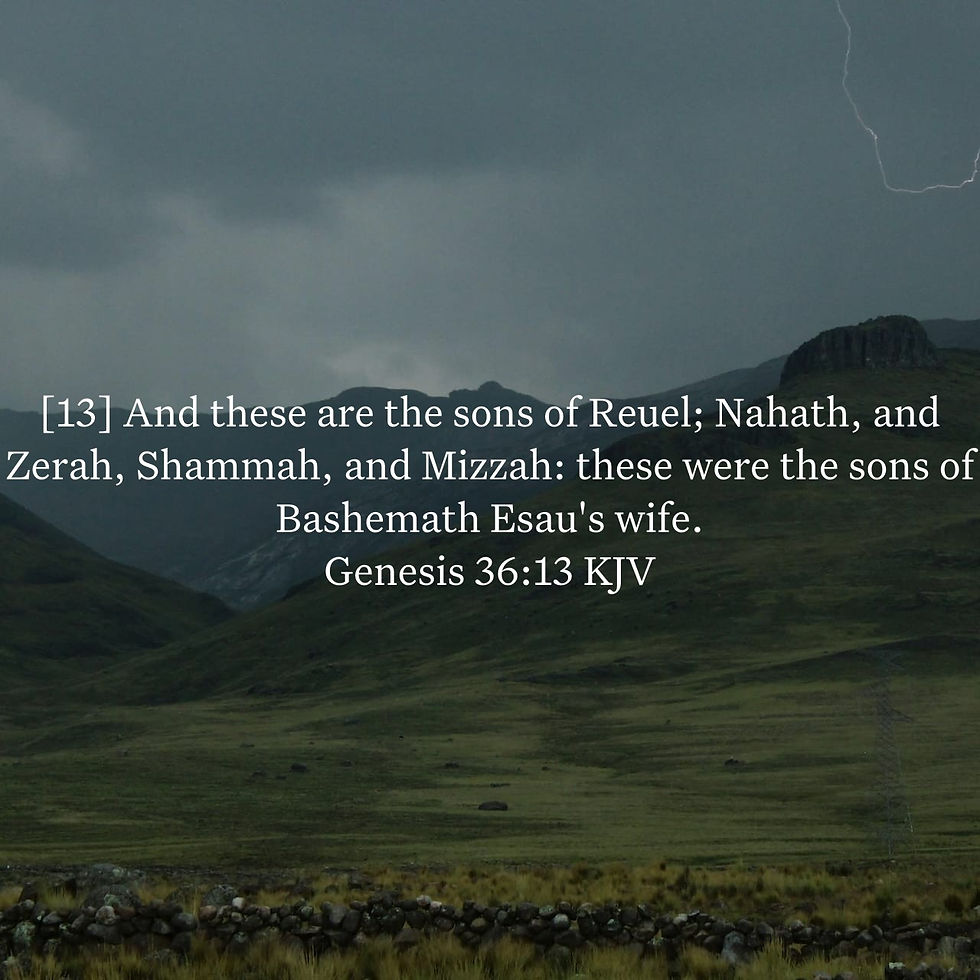
“And these are the sons of Reuel; Nahath, and Zerah, Shammah, and Mizzah: these were the sons of Bashemath Esau's wife.”
Genesis 36:13 continues tracing the family of Esau through his son Reuel: “And these are the sons of Reuel; Nahath, and Zerah, Shammah, and Mizzah: these were the sons of Bashemath Esau's wife.” In the previous verses, Scripture followed the descendants of Eliphaz, Esau’s son through Adah. Now the genealogy turns to the second major branch of Esau’s family, the descendants of Reuel through Bashemath. Reuel has four sons: Nahath, Zerah, Shammah, and Mizzah. These men are Esau’s grandsons, Isaac’s great-grandsons, and Abraham’s great-great-grandsons. Once again, what appears at first to be simply another collection of unfamiliar names is actually showing us the continuing transformation of Esau’s household into the nation of Edom.
The growth is happening remarkably quickly. Only a few chapters earlier, the entire story centered upon Isaac and his two sons, Jacob and Esau. Now Esau himself has sons, and those sons have produced another generation. Eliphaz has Teman, Omar, Zepho, Gatam, Kenaz, and Amalek. Reuel now has Nahath, Zerah, Shammah, and Mizzah. Within only a few generations, one household is branching outward into numerous families that will soon be identified as chiefs and clans. This is how the statement “Esau is Edom” becomes an actual historical reality. Edom is not formed in a single moment. It develops through families multiplying across generations.
Once again this takes us back to the extraordinary word God spoke to Rebekah before Jacob and Esau were born. Genesis 25:23 says, “Two nations are in thy womb, and two manner of people shall be separated from thy bowels.” At the time, Rebekah could not see nations. She could only feel two children struggling within her. Isaac could not see nations when he looked at his two sons growing up. Jacob and Esau themselves probably could not comprehend the full extent of what would eventually come through their descendants. Yet God saw beyond the individuals to the peoples who would arise from them.
By Genesis 36, history is beginning to catch up with what God already knew.
Esau has become Edom.
His sons have become fathers.
His grandsons are appearing.
Soon their names will represent clans and leaders.
The nation once hidden inside Rebekah’s womb is becoming visible one generation at a time.
That is one of the reasons these genealogical passages matter so much. We may instinctively look for dramatic evidence of God fulfilling His word. We expect miracles, visions, angels, or supernatural interventions. Yet sometimes the fulfillment of prophecy looks like children being born, families growing, and decades passing. Nothing miraculous is recorded in Genesis 36:13. Reuel simply has four sons. Yet those four sons are part of the fulfillment of something God spoke generations earlier.
God’s providence does not require every moment to look extraordinary.
Sometimes providence looks like another generation.
This pattern appears throughout Genesis. God promised Abraham descendants when Abraham and Sarah were childless. Genesis 15:5 records God bringing Abraham outside and saying, “Look now toward heaven, and tell the stars, if thou be able to number them: and he said unto him, So shall thy seed be.” At that moment Abraham did not possess even the one promised son through Sarah. Everything depended upon believing what God had spoken despite what circumstances appeared to say.
Then Isaac was born.
Isaac had Jacob and Esau.
Jacob produced the sons who would become Israel’s tribes.
Esau produced the sons whose descendants would become Edomite clans.
What once seemed impossible has become so abundant that Genesis now requires extensive genealogical records simply to keep track of Abraham’s growing family.
There is something beautiful about that progression.
Abraham once asked God in Genesis 15:2, “Lord GOD, what wilt thou give me, seeing I go childless?”
Now his descendants are multiplying in every direction.
Ishmael has produced descendants.
Isaac has produced descendants.
Jacob’s household has become enormous.
Esau’s household has become enormous.
The man who once wondered whether he would have an heir has become the ancestor of families and peoples extending throughout the region.
Genesis 36:13 therefore quietly testifies to the faithfulness of God.
It also reminds us that God’s promises often become fully visible only across generations. Abraham never lived to see everything that would come from him. Isaac did not live to see Israel become a nation. Jacob would not live to see the Exodus, the conquest of Canaan, the monarchy, or the temple. Each generation experienced only one portion of what God was accomplishing.
That requires a very different way of thinking about faithfulness.
We often want to see the complete outcome of what God is doing during our own lifetime. Scripture repeatedly shows people participating in purposes much larger than themselves. Abraham obeyed without seeing the nation Israel. Moses would lead Israel toward Canaan but would not personally lead them into the land. David desired to build the temple, but Solomon would complete it. The prophets spoke of things whose ultimate fulfillment would come generations after they died.
God’s work does not begin and end according to the boundaries of one human lifespan.
Genesis genealogies constantly remind us of this because one generation gives way to another. A person appears, lives, has children, and eventually passes from the narrative. Yet the story continues.
Reuel’s sons demonstrate that reality.
Nahath, Zerah, Shammah, and Mizzah inherit a world shaped by choices made before they were born. Their grandfather Esau had sold his birthright to Jacob. Esau had later lost the blessing Isaac intended for him. He had hated Jacob and planned to kill him. Jacob fled. Decades later the brothers reconciled. Esau eventually established himself in Mount Seir. Now his grandsons are born into that developing Edomite world.
They did not create those circumstances.
They inherited them.
This is one of the realities of human life that genealogies make particularly visible. Every generation enters a story already underway. Children are born into families with histories they did not create. They inherit names, relationships, places, traditions, opportunities, conflicts, and consequences that began before they existed.
Nahath, Zerah, Shammah, and Mizzah did not decide that Esau would move into Mount Seir. By the time their generation developed, Mount Seir was becoming their home.
They did not decide that Esau would become known as Edom. Yet they belonged to the people increasingly known by that name.
They did not participate in the original struggle between Jacob and Esau in Rebekah’s womb, but they were descendants of one of the brothers through whom the prophecy of two nations was being fulfilled.
The same principle operates throughout the Bible. Israel’s later generations would inherit the promises given to Abraham long before they were born. They would also inherit the consequences of decisions made by preceding generations. Children born in Egypt would inherit a condition of slavery that began before them. Later generations would inherit the land promised centuries earlier. Still later generations would experience the consequences of Israel’s repeated idolatry.
Human lives are deeply interconnected across time.
This does not mean Scripture teaches that children automatically bear the personal guilt of every sin committed by their ancestors. Scripture distinguishes personal responsibility from generational consequences. Ezekiel 18:20 later declares, “The son shall not bear the iniquity of the father, neither shall the father bear the iniquity of the son.” Yet it is equally obvious throughout Scripture that one generation’s decisions can create circumstances another generation must live within.
Esau’s grandchildren illustrate this on a national level.
They are entering the identity of Edom.
Jacob’s children are entering the identity of Israel.
Two family lines are increasingly becoming two peoples.
The closing words of the verse, “these were the sons of Bashemath Esau's wife,” also remind us that Genesis is carefully organizing the genealogy according to Esau’s wives. Reuel is Bashemath’s son, so Reuel’s four sons belong to the branch of Esau’s family that comes through her. In the previous verses, Eliphaz and his descendants were associated with Adah. Here Reuel and his descendants are associated with Bashemath. The household is becoming complex enough that Scripture repeatedly identifies the maternal branches so the reader can follow how Edom’s families developed.
Bashemath herself has an important connection to Abraham’s wider family. Genesis 36:3 identifies her as “Ishmael's daughter, sister of Nebajoth.” This means Esau’s marriage to Bashemath joined two branches descending from Abraham. Esau descended from Abraham through Isaac, while Bashemath descended from Abraham through Ishmael. Reuel therefore belongs to a family line connected through both of Abraham’s sons.
This takes us back to Genesis 28, where Esau recognized that his Canaanite wives did not please Isaac. Genesis 28:8–9 says, “And Esau seeing that the daughters of Canaan pleased not Isaac his father; Then went Esau unto Ishmael, and took unto the wives which he had Mahalath the daughter of Ishmael Abraham's son, the sister of Nebajoth, to be his wife.” The naming arrangement between Genesis 28 and Genesis 36 presents questions regarding the names used for Esau’s wives, but Genesis 36 clearly identifies Bashemath with Ishmael’s family. The larger point is that Esau deliberately connected himself with another branch of Abraham’s descendants.
That is historically significant because Abraham’s family is multiplying not merely through one simple line but through numerous interconnected branches. Ishmael’s descendants are developing. Esau’s descendants are developing. Jacob’s descendants are developing. The world surrounding future Israel is increasingly populated by peoples who possess some ancestral relationship to Abraham.
This becomes important later because many of Israel’s neighboring peoples are not simply strangers.
They are relatives.
Edom descends from Esau, Jacob’s brother.
The Ishmaelites descend from Ishmael, Isaac’s brother.
Moab and Ammon descend from Lot, Abraham’s nephew.
The national landscape of the Old Testament is filled with extended family relationships that began in Genesis.
Yet family relationship does not guarantee spiritual unity.
That becomes one of the tragedies of later biblical history.
Esau and Jacob themselves ultimately reconciled. Genesis 33:4 tells us that Esau ran to Jacob, embraced him, kissed him, and wept with him. Genesis 35:29 later shows the brothers together again when they buried Isaac.
But their descendants would frequently clash.
Israel and Edom would become enemies at various points.
The Amalekites, descended from Esau through Eliphaz, would attack Israel after the Exodus.
The Edomites would refuse Israel passage through their territory.
The prophets would eventually condemn Edom for violence against Jacob.
This makes the quiet family scenes of Genesis especially poignant. Here the separation between Israel and Edom is still genealogical and geographical. We can see the branches developing, but the later centuries of warfare have not yet unfolded.
Nahath, Zerah, Shammah, and Mizzah appear simply as grandsons within Esau’s growing family.
They stand near the beginning of a history whose later complexities they could not possibly have foreseen.
That is another reminder of how little any individual sees of the future consequences connected with his own generation.
These four men probably knew Esau as their grandfather.
They may have heard stories about Isaac.
Perhaps the history of Abraham remained part of the family memory.
They belonged to a family only a few generations removed from extraordinary encounters with God.
Abraham had spoken with God.
Isaac had personally received the covenant promises.
Esau himself had grown up within Isaac’s household.
Yet belonging biologically to Abraham’s family did not automatically mean that the covenant promise traveled through every branch equally.
The covenant line continued through Jacob.
That distinction becomes increasingly obvious as the families multiply.
God had told Isaac in Genesis 26:3–4, “unto thee, and unto thy seed, I will give all these countries,” and had reaffirmed the oath sworn to Abraham. Isaac later passed the covenant blessing to Jacob, saying in Genesis 28:4, “And give thee the blessing of Abraham, to thee, and to thy seed with thee.”
God Himself then appeared to Jacob at Bethel and declared in Genesis 28:13, “the land whereon thou liest, to thee will I give it, and to thy seed.”
Esau’s descendants therefore share ancestry with Abraham, but Jacob’s descendants carry the specific covenant promise.
That distinction is not immediately visible through material prosperity.
Esau’s family is flourishing.
He has sons and grandchildren.
He possesses livestock and servants.
He lives in Mount Seir.
Soon his descendants will have chiefs.
Eventually Edom will even have kings before Israel does.
From a purely human viewpoint, Esau’s descendants could appear remarkably successful.
This reinforces a theme we have already encountered throughout Genesis 36: visible prosperity is not the same thing as covenant calling.
God can allow people outside the central covenant line to flourish materially.
Ishmael was blessed and multiplied.
Esau was blessed and multiplied.
Edom gained territory.
Yet God’s redemptive plan continued through Jacob.
This matters because people often interpret present circumstances as though they reveal the entire judgment of God.
If someone prospers, we may assume everything between that person and God must be right.
If someone suffers, we may assume God’s promises must somehow have failed.
Genesis repeatedly overturns that simplistic reasoning.
Jacob carries the promise, yet Jacob experiences enormous suffering.
He flees from his brother.
Laban deceives him.
His family becomes filled with rivalry.
Dinah is violated.
Rachel dies.
Joseph will disappear.
Famine will come.
Eventually Jacob will describe the years of his life to Pharaoh as “few and evil” in Genesis 47:9.
Yet the promise remains with Jacob.
Meanwhile Esau’s family appears to develop rapidly and successfully in Seir.
The difference between them cannot therefore be measured merely through which family appears more comfortable or established at a particular moment.
The Word of God is the determining reality.
That becomes especially important as Genesis soon transitions from Esau’s genealogy back to Jacob’s family and the story of Joseph. Edom will seem to establish itself relatively quickly, while Jacob’s family is about to descend into extraordinary turmoil.
Joseph will be hated by his brothers.
He will be sold into slavery.
He will be carried into Egypt.
He will be falsely accused.
He will be imprisoned.
Eventually God will raise him up and use him to preserve the entire covenant family through famine.
From the perspective of Genesis 36, none of that is visible yet.
We are simply watching two lines develop in different directions.
Esau’s line settles in Seir.
Jacob’s line remains connected with Canaan.
Esau’s descendants organize into clans.
Jacob’s sons remain one complicated household.
But God already knows where both stories are going.
Nahath, Zerah, Shammah, and Mizzah are therefore part of the larger demonstration that history unfolds under God’s sovereign knowledge even when human beings see only the immediate generation.
This verse also invites us to reconsider the value of names that Scripture preserves without giving us extensive stories about them. We know very little personally about Nahath, Zerah, Shammah, or Mizzah. Scripture does not tell us about their childhoods. It does not describe their personalities. We do not read conversations involving them. We are not told about their marriages, individual accomplishments, failures, or deaths.
Yet their names remain.
Thousands of years later, we still read them.
That alone should make us think about the difference between significance and prominence.
Not every person in God’s providential ordering of history receives a long biography.
Some people receive chapters.
Some receive paragraphs.
Some receive one sentence.
Some receive only a name.
But God’s knowledge of a human life is not limited by how much Scripture chooses to record about that person.
Psalm 139 expresses the intimate knowledge God possesses of human beings, declaring that He knows our sitting down and rising up and understands our thoughts afar off. The biblical God is never presented as a distant observer who notices only kings, prophets, and famous figures.
He sees people.
He sees families.
He sees generations.
He sees the well-known and the forgotten.
Nahath may be obscure to us.
Zerah may be obscure to us.
Shammah may be obscure to us.
Mizzah may be obscure to us.
They were not obscure to God.
There is something comforting about that truth. Most human beings will eventually be forgotten by history. Names disappear from public memory remarkably quickly. A few generations after someone's death, even descendants may know little beyond a photograph or a name written in a family record.
But being forgotten by the world is not the same thing as being forgotten by God.
Genesis genealogies quietly push against our obsession with fame. They remind us that an ordinary life can occupy a real place in history without becoming famous.
These men mattered because families came from them.
Their descendants became part of Edom.
Their existence helped form the world in which later biblical events occurred.
The consequences of their lives continued even though the details of their lives disappeared.
This is true for us as well. We rarely understand how far our influence extends. A decision made within one generation may shape the opportunities available to another. A pattern established by parents may be repeated by children. Faithfulness can echo through families. So can bitterness, neglect, generosity, wisdom, foolishness, faith, and unbelief.
The biblical emphasis on generations should therefore encourage us to think beyond ourselves.
We belong to a story that began before us, and unless Christ returns during our lifetime, there will be generations after us.
The question is not only what kind of life we build for ourselves.
It is also what kind of inheritance of example, truth, character, and faithfulness we leave behind.
This becomes especially important when considering the difference between Israel and Edom. The brothers Jacob and Esau once possessed personal experiences that could have shaped their descendants profoundly. Esau knew what hatred toward his brother had done to their family. Jacob knew what deception had cost him. Both knew the pain of decades of separation. Both experienced the joy of reconciliation.
Imagine if every later generation of Israel and Edom had preserved the memory of Genesis 33 above every memory of conflict.
Esau ran to Jacob.
He embraced him.
He kissed him.
They wept.
That was part of their inheritance too.
Yet later generations repeatedly returned to hostility.
This reminds us that healthy spiritual inheritance does not transmit itself automatically. Each generation must decide what it will preserve, what it will imitate, and what it will reject.
A grandfather’s reconciliation does not guarantee a grandson’s peace.
A father’s faith does not automatically become a son’s faith.
A family may possess an extraordinary spiritual history and yet drift from the God known by previous generations.
Israel itself will demonstrate this repeatedly.
After Joshua’s generation passed away, Judges 2:10 speaks of another generation arising “which knew not the LORD, nor yet the works which he had done for Israel.”
The events had happened.
The history existed.
But another generation failed to live in light of it.
That is one of the great dangers of generational faith. We cannot merely assume that because God was central to one generation, He will automatically remain central to the next.
Truth must be taught.
God’s works must be remembered.
Faith must become personal.
Deuteronomy 6 would later command Israel to teach God’s words diligently to their children, speaking of them in the house, on the road, when lying down, and when rising up.
God understood how easily a generation can forget.
Genesis 36 does not tell us what Reuel taught Nahath, Zerah, Shammah, and Mizzah about Abraham, Isaac, Jacob, or the God who had interacted with their family. We should not invent what Scripture does not reveal. But their position within the genealogy naturally reminds us that each generation receives a history and then determines what it will do with that history.
These men were close enough genealogically to Abraham that his story was not some distant legend.
Abraham was their great-great-grandfather.
Isaac was their great-grandfather.
Esau was their grandfather.
They stood only a few generations removed from some of the most extraordinary events recorded in Genesis.
Yet being near sacred history is not the same thing as personally walking with God.
That distinction remains relevant today.
A person can grow up surrounded by Scripture and never submit to the God Scripture reveals.
Someone can come from generations of faithful Christians and still need personal faith in Christ.
A child cannot inherit salvation the way he inherits a surname, property, or family history.
John 1:12–13 describes those who receive Christ as being born “not of blood, nor of the will of the flesh, nor of the will of man, but of God.”
Spiritual life cannot be reduced to genealogy.
That is especially meaningful within a chapter dominated by genealogy.
Genesis 36 records bloodlines with extraordinary care, yet the broader biblical story teaches that ancestry alone never guarantees righteousness before God.
Esau descended from Abraham.
Reuel descended from Abraham.
Nahath, Zerah, Shammah, and Mizzah descended from Abraham.
But the saving promises of God ultimately point beyond physical descent toward faith and toward the promised Seed who would come through the covenant line.
Paul later explains in Galatians 3:16 that the promises ultimately point toward Christ.
That is where the biblical genealogy is moving.
Genesis spends chapter after chapter tracing families because eventually one family line will lead through Judah, David, and ultimately Jesus Christ.
Matthew 1 will open the New Testament with another genealogy, beginning, “The book of the generation of Jesus Christ, the son of David, the son of Abraham.”
The genealogies of Genesis therefore are not disconnected from the gospel.
They are helping us follow the unfolding human history through which God will eventually bring the Savior into the world.
Esau’s line must be distinguished from Jacob’s line because Scripture is tracing that promise.
Edom matters.
Its people matter.
Its history matters.
But the redemptive line continues elsewhere.
Soon Genesis will return to Jacob.
Then attention will fall heavily upon Joseph.
Eventually Judah will emerge with special significance.
Centuries later, kings will come through Judah.
Finally Christ will come through that line.
Genesis 36:13 therefore sits within a much larger movement.
Nahath, Zerah, Shammah, and Mizzah are real members of Abraham’s extended family and foundational members of Edom. Their names demonstrate Esau’s multiplication and the fulfillment of God’s statement that a nation would come from him.
Yet their branch also helps us see the distinction Scripture is making.
Esau is becoming Edom.
Jacob is becoming Israel.
Both families multiply.
Both possess descendants.
Both occupy places within God’s sovereign providence.
But only one carries forward the particular covenant through which the promised Messiah will ultimately come.
This makes the genealogy more than an ancient family record. It is part of the map of redemption.
Every branch helps us see where the promise is going and where it is not.
Every generation brings us further into the world God is preparing.
Every name anchors that story in real human history.
Nahath, Zerah, Shammah, and Mizzah may occupy only one verse here, but their presence shows that Esau’s family continues to flourish. Reuel has become a father of four sons. Bashemath has become a grandmother. Esau has become the patriarch of yet another expanding branch.
The words spoken before his birth continue becoming reality.
“Two nations are in thy womb.”
One of those nations is now filling Mount Seir with children, grandchildren, households, and clans.
The transformation from Esau the man to Edom the nation is happening before our eyes.
And it is happening in the way God so often chooses to accomplish His purposes in history: gradually, faithfully, and generation by generation.
If you would like to explore Genesis in a sustained, verse-by-verse way with space to reflect, journal, and trace how these foundational truths unfold through Scripture the Verse by Verse book expands these reflections into a unified reading experience. The book gathers these meditations into a structured journey through Genesis, designed to help readers linger in the text and engage God’s Word more deeply over time.


Comments