Genesis 24:15 Daily Devotional & Meaning – Rebekah Appears Before the Servant Finished Praying

Daily Verses Everyday! Day 102
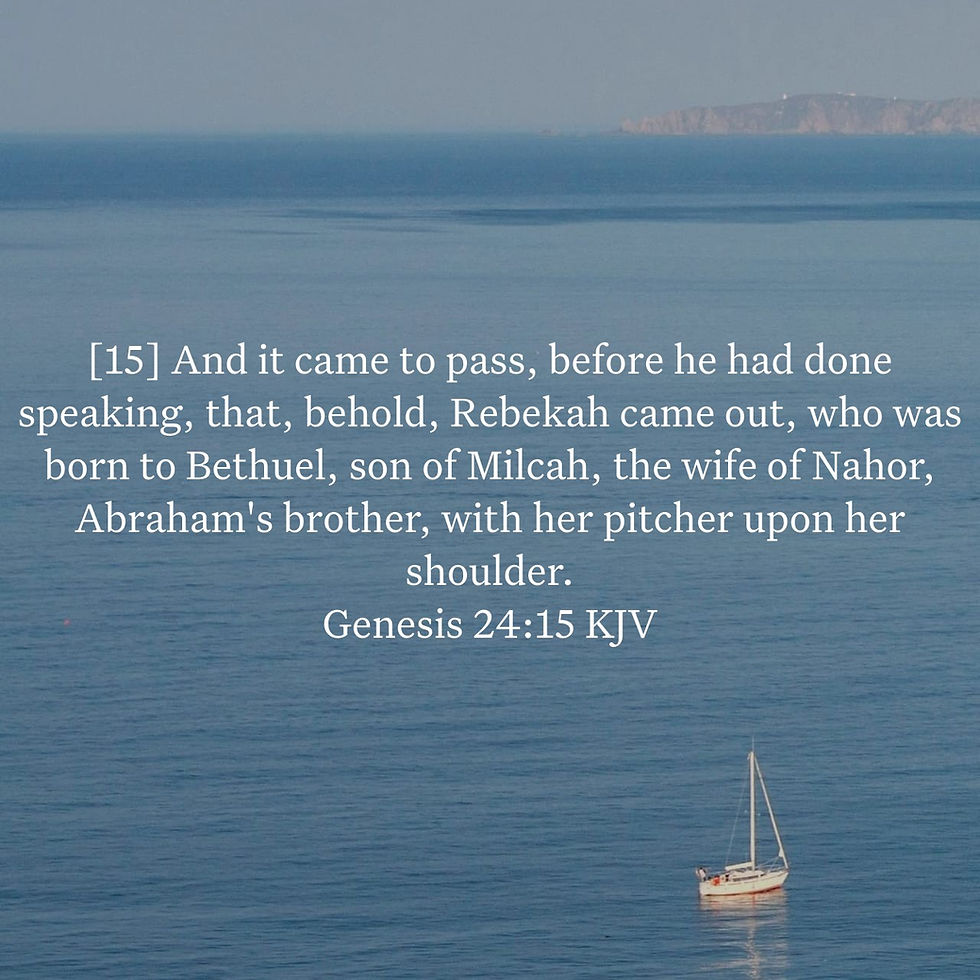
“And it came to pass, before he had done speaking, that, behold, Rebekah came out, who was born to Bethuel, son of Milcah, the wife of Nahor, Abraham's brother, with her pitcher upon her shoulder.”
This verse shows the wonderful kindness and providence of the Lord. Abraham’s servant is still praying. He has not even finished speaking yet. He has asked God to show kindness to Abraham, to guide him to the woman appointed for Isaac, and to reveal her through a specific act of service. Then, before the prayer is even complete, Rebekah comes out. This is not an accident. This is not random timing. This is the Lord answering before the servant has even finished asking.
There is something deeply comforting about that. The servant was standing at the well with a mission too great for his own wisdom. He could travel to the right city. He could stand at the right well. He could ask the right question. But he could not arrange God’s providence. He could not make the chosen woman appear. He could not control her family line. He could not prepare her heart. He could not decide the timing. Yet while he was still praying, God was already answering.
This reminds us that the Lord is never late. From the servant’s perspective, he is asking God to begin working. But from God’s perspective, the answer is already walking toward the well. Rebekah was already on her way before the servant finished his prayer. God did not need to rush. God did not need to react. God had already gone before him. The servant prayed in time, but God had prepared the answer in eternity. That is how wonderful our Lord is. He hears us, but He is not limited by the moment in which we speak. He knows our need before we ask. He sees the answer before we understand the problem. He is already working before we know what words to say.
This verse should strengthen our faith in prayer. Sometimes we imagine prayer as if God is distant until we speak, and then He begins to notice us. But Scripture shows us a God who is already near, already aware, already wise, and already merciful. The servant prays, and before he is done speaking, Rebekah appears. The answer was not delayed by distance. It was not confused by uncertainty. It was not hindered by the servant’s limited understanding. God knew exactly what was needed, and He brought the right woman at the right time.
This does not mean God always answers every prayer immediately. Abraham himself waited many years for Isaac. Some prayers are answered quickly, and some are answered after long seasons of waiting. But Genesis 24:15 shows us that God is able to answer before the prayer is finished. He is able to move faster than our fear. He is able to prepare what we could never arrange. He is able to bring His will to pass in ways that reveal His kindness and wisdom. Whether the answer comes quickly or slowly, the Lord is always working with perfect knowledge.
The phrase “before he had done speaking” is especially beautiful because it shows how closely God was attending to the servant’s prayer. The servant did not need a long speech to gain God’s attention. He did not need to impress God with many words. His prayer was humble, specific, and dependent. He asked God to show kindness, and God answered. This should encourage believers who feel weak in prayer. The power of prayer is not in how eloquent we sound. The power of prayer is in the God who hears.
Many times, we do not know how to pray as we ought. We feel the burden, but we do not have the words. We know there is a need, but we do not fully understand what the best answer would be. We may pray with trembling, confusion, or incomplete understanding. Yet the Lord is merciful. Romans 8 teaches that “we know not what we should pray for as we ought,” but the Spirit helps our infirmities. The Holy Spirit intercedes for the saints according to the will of God. That means believers are not left alone in prayer. Even when our words are weak, the Spirit carries our prayers according to the perfect will of God.
That truth fits beautifully with this verse. Abraham’s servant prayed wisely, but even his wisdom was limited. He knew to ask for guidance, but he did not know Rebekah’s name. He did not know her face. He did not know her heart. He did not know that she was already coming. God knew. And for believers today, the Holy Spirit helps us in that same place of weakness. We pray from limited knowledge, but God hears with unlimited wisdom. We pray from the present moment, but God knows the whole story. We may not know exactly what to ask, but the Spirit intercedes according to God’s will.
This is one of the greatest comforts in the Christian life. Prayer does not depend on our perfect understanding. If it did, we would be in trouble. We often ask for things without knowing what they would bring. We often fear things that God may use for good. We often want answers quickly when God may be doing something deeper through waiting. We often do not know whether to ask for a door to open or close, whether a desire is wise or dangerous, whether a burden should be removed or endured. But the Holy Spirit helps us. He brings our prayers into harmony with the will of God. He intercedes beyond the limits of our words.
The servant’s prayer was answered before he finished speaking because God had already prepared Rebekah. She was not merely a woman at the well. She was the daughter of Bethuel, the son of Milcah, the wife of Nahor, Abraham’s brother. This detail matters. The verse immediately identifies her family line because the servant had been sent to Abraham’s kindred. Abraham had commanded him not to take a wife for Isaac from the daughters of the Canaanites, but to go to his country and his kindred. Now, before the servant even knows it, the very woman coming toward the well belongs to the family line Abraham had specified.
This shows the precision of God’s providence. God did not merely send “a woman.” He sent Rebekah. He sent the woman connected to Abraham’s family. He sent the woman who would become Isaac’s wife. He sent the woman through whom Jacob would later be born. He sent the woman who would become part of the covenant line leading eventually to Israel, to David, and ultimately to Jesus Christ. The servant sees a young woman with a pitcher upon her shoulder, but God sees the next step in the unfolding plan of redemption.
That is often how God works. We see ordinary details. God sees eternal purpose. The servant sees a woman coming to draw water. God sees the appointed wife for Isaac. Rebekah may simply be doing her daily task. God is bringing her into the covenant story. The scene looks ordinary from the outside, but heaven is moving through it. A woman comes out with a pitcher, and the future of the promise is being guided by the hand of God.
This should cause us to worship. The Lord is not only sovereign over grand events. He is sovereign over timing, location, family lines, daily chores, conversations, and footsteps to a well. Rebekah came out at the exact moment the servant prayed. She came with her pitcher upon her shoulder, prepared to draw water. She came from the right family. She came before the servant even finished speaking. Every detail was under the Lord’s care.
This reminds us that God’s answers often arrive in ordinary clothing. Rebekah did not descend from the sky. There was no thunder. There was no visible angel pointing her out. She simply came out with a pitcher upon her shoulder. Yet this ordinary arrival was God’s answer. Sometimes we miss God’s providence because we expect it to look dramatic. But many of the Lord’s answers come through ordinary people, ordinary responsibilities, and ordinary moments. A conversation. A meeting. A message. A task. A door. A delay. A person arriving at the right time. God’s hand is often seen most clearly when we look back and realize how perfectly He arranged what seemed normal.
The servant had asked for kindness, and God’s kindness arrived in the form of Rebekah. This is important. God’s kindness does not always come in the form we expect, but it always comes wisely. Here, kindness came through a woman carrying a pitcher. It came through the daily rhythm of drawing water. It came through a family connection the servant had not yet discovered. The answer was already there, but it had to be recognized. That is why prayer and watchfulness belong together. The servant prayed, and now he must pay attention.
This verse also shows that God’s will is not fragile. Abraham’s servant did not need to manipulate the situation to make God’s will happen. He prayed, and Rebekah came. He did not need to search through every house in the city. He did not need to scheme. He did not need to panic. The Lord brought the answer to the place of prayer. This does not mean obedience was unnecessary. The servant still had to travel. He still had to stop at the well. He still had to pray. He still had to speak to Rebekah. But the provision itself came from God.
This is a helpful balance for believers. We are called to obey, but we are not called to control providence. We are called to pray, but we are not called to force the answer. We are called to take the next faithful step, but we are not responsible for seeing the entire path. The servant obeyed Abraham’s command, and God did what only God could do. That is how faith works. We bring our limited obedience, and God supplies sovereign wisdom.
There is also a wonderful encouragement here for moments when we feel overwhelmed by decisions. The servant had a serious decision before him. Isaac’s future was connected to this mission. Abraham’s trust was resting on him. The covenant line was involved. From a human perspective, the pressure was enormous. Yet the servant did not have to figure it out alone. He prayed, and God guided. In the same way, believers can bring serious decisions before the Lord. We may not receive an answer as immediate as the servant did, but we can trust that God knows how to lead His people.
This is especially comforting because we do not always know what the “right Rebekah” looks like in our situation. We may not know which path is wise. We may not know which opportunity is from the Lord. We may not know which door should open. We may not know what God is preparing. But the Holy Spirit helps us in prayer. The Father knows what we need. Christ intercedes for us. We are not abandoned to our own understanding.
The connection to the Holy Spirit is especially meaningful. Romans 8 says that the Spirit helps our infirmities. That word “infirmities” reminds us that weakness is part of our present life. We are weak in knowledge, weak in wisdom, weak in patience, weak in discernment, and often weak in words. But the Spirit helps. He intercedes according to the will of God. This means that when believers pray, there is divine help beneath and beyond their words. Our prayers may feel small, but they are carried by the Spirit before the Father in accordance with God’s will.
That should make us pray more, not less. Some people avoid prayer because they think, “I do not know what to say.” But God already knows that. He has given the Holy Spirit to help us precisely because we do not know how to pray as we ought. The answer is not to remain silent in fear. The answer is to come honestly. The servant did not know everything, but he prayed what he knew to pray. He asked for guidance, kindness, and confirmation. God took care of what he did not know. The same is true for believers. Pray what you know. Bring the need honestly. Ask for God’s will. Trust the Spirit to help your weakness.
This does not mean every desire we pray will be granted exactly as stated. The Holy Spirit does not help us force our will onto God. He intercedes according to the will of God. That is better. Sometimes God answers by giving what we ask. Sometimes He answers by changing what we ask. Sometimes He answers by withholding what would harm us. Sometimes He answers by delaying until the right time. Sometimes He answers before we finish speaking. But in every case, His will is wiser than ours.
In Genesis 24:15, the servant’s request and God’s will align beautifully. He asks for the woman appointed for Isaac, and God brings Rebekah. That is the best kind of prayer: not merely asking God to bless our plan, but asking Him to reveal His plan. The servant’s desire is not just to succeed; it is to find the one God has appointed. When we pray, we should desire the same thing. “Lord, not merely what I want, but what You have appointed. Not merely what seems good to me, but what is good according to Your wisdom. Not merely the easiest answer, but the answer that fits Your will.”
Rebekah’s arrival also shows that God’s kindness to Abraham continues beyond Abraham’s immediate presence. Abraham is not at the well. Isaac is not at the well. The servant is far from Canaan. Yet God is still faithful to His promise. Distance does not weaken the Lord’s hand. Abraham’s servant can pray in Mesopotamia, and the God of Abraham can answer there. This matters because God is not local or limited. He is the Lord God of heaven and earth. He can guide in Canaan. He can guide in Mesopotamia. He can guide at a well. He can guide in a household. He can guide wherever His people call upon Him.
This points forward to the fuller access believers have in Christ. Because of Jesus, we do not approach God as strangers hoping He might listen. We come as children through the Son. Christ is our High Priest and Advocate. The Spirit helps us pray. The Father hears us with love. The whole life of prayer is wrapped in the grace of the triune God. The servant prayed to the God of Abraham; believers pray to the Father through the Son by the Spirit. That is an astonishing privilege.
And one day, prayer will become sight. For now, we pray without seeing everything. We pray from weakness. We pray with incomplete knowledge. We pray while waiting for answers to appear. But one day, the people of God will see the Lord face-to-face. Then we will understand how many times He was answering before we knew it. We will see how many “Rebekah moments” He had prepared before we finished speaking. We will see how often the Spirit helped us when our words were weak. We will see how perfectly the Father governed our lives according to His wisdom and love.
Genesis 24:15 is therefore a verse of worship. “Before he had done speaking,” the answer came. What a wonderful Lord. He is not slow to hear. He is not confused by our weakness. He is not limited by our lack of knowledge. He had already prepared Rebekah. He had already arranged the timing. He had already connected the family line. He had already guided the servant to the well. The servant’s prayer did not awaken a sleeping God; it aligned his need with the God who was already working.
This should encourage us to pray with confidence and humility. Confidence, because God hears. Humility, because God knows better than we do. We can come to Him even when we do not fully know what to ask. We can trust the Holy Spirit to help us in our weakness. We can believe that God is able to answer before we are finished speaking, and we can also trust Him when He asks us to wait. The timing belongs to Him. The wisdom belongs to Him. The kindness belongs to Him.
Rebekah came out with her pitcher upon her shoulder, and the servant’s prayer began to be answered. What looked like a young woman doing an ordinary task was actually the providence of God unfolding. The Lord had heard. The Lord had guided. The Lord had shown kindness. And in this moment, we are reminded that prayer is never wasted when placed before the God who knows the end from the beginning.
If you would like to explore Genesis in a sustained, verse-by-verse way with space to reflect, journal, and trace how these foundational truths unfold through Scripture the Verse by Verse book expands these reflections into a unified reading experience. The book gathers these meditations into a structured journey through Genesis, designed to help readers linger in the text and engage God’s Word more deeply over time.


Comments