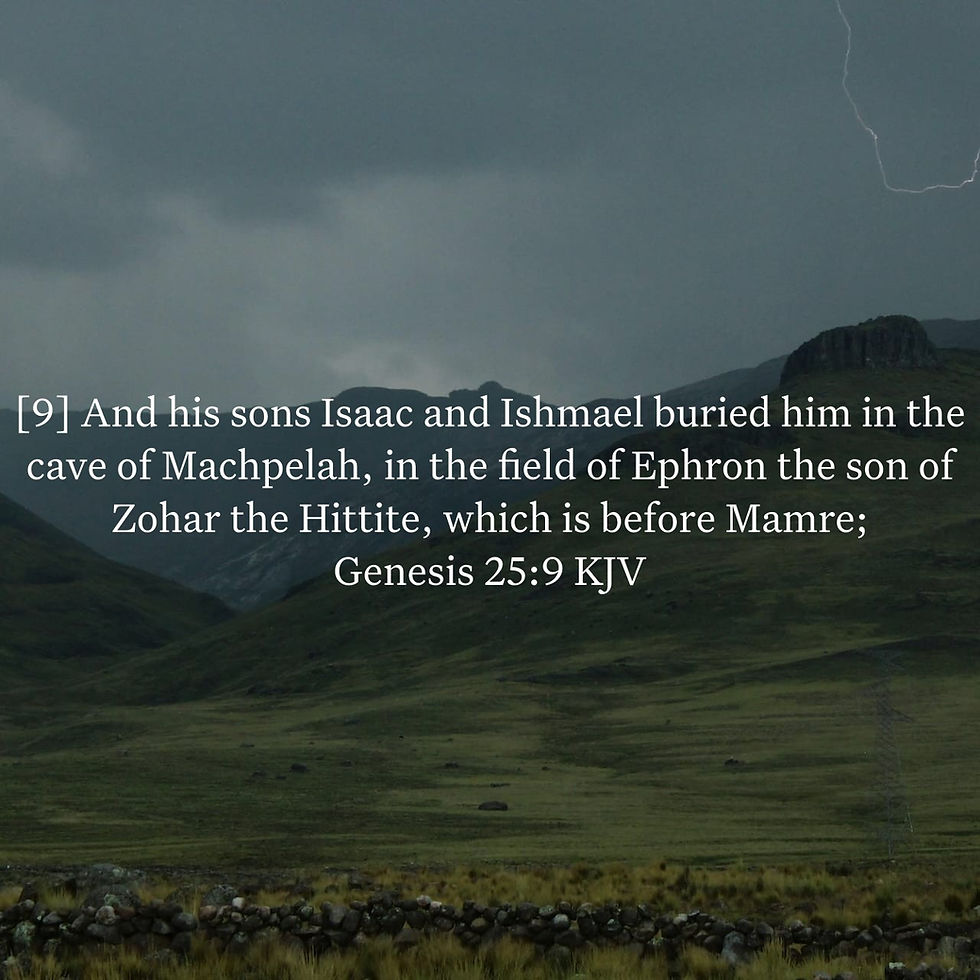
Genesis 25:9 Daily Devotional & Meaning – Isaac and Ishmael Bury Abraham at Machpelah

Daily Verses Everyday! Day 116
“And his sons Isaac and Ishmael buried him in the cave of Machpelah, in the field of Ephron the son of Zohar the Hittite, which is before Mamre;”
Genesis 25:9 is a deeply meaningful verse because it brings Isaac and Ishmael together again at the burial of their father Abraham. The verse says, “And his sons Isaac and Ishmael buried him.” That detail is easy to pass over, but it carries emotional, historical, and spiritual weight. We have not heard much from Ishmael for a while in the Genesis narrative. After he and Hagar were sent away in Genesis 21, the main focus of the story shifted almost entirely to Isaac, because Isaac was the child of promise. Yet here, at Abraham’s death, Ishmael appears again.
This is important because it reminds us that Ishmael did not disappear from history. He was not the covenant son, but he was still Abraham’s son. He was not the heir through whom the promise would continue, but he was still part of Abraham’s household story. Genesis has been following Isaac because God had already said, “In Isaac shall thy seed be called” (Genesis 21:12). But that did not mean Ishmael ceased to matter. God had also made promises concerning Ishmael.
Back in Genesis 16:10, the angel of the Lord told Hagar, “I will multiply thy seed exceedingly, that it shall not be numbered for multitude.” Then in Genesis 17:20, God told Abraham, “And as for Ishmael, I have heard thee: Behold, I have blessed him, and will make him fruitful, and will multiply him exceedingly.” So Ishmael was not the covenant heir, but he was still the recipient of divine mercy. God saw Hagar. God heard Ishmael. God preserved them in the wilderness. God promised that Ishmael would become a great nation.
That is why his appearance here matters. Ishmael is still alive. Ishmael is still Abraham’s son. Ishmael still has a place in the family story, even if the covenant line belongs to Isaac. His presence at Abraham’s burial reminds us that being outside the chosen covenant line did not mean being outside the notice of God. God had not forgotten him.
There is also something very human and emotional in this verse. Isaac and Ishmael had a complicated family history. Ishmael was born first, through Hagar, because Abraham and Sarah tried to bring about God’s promise through human planning. Genesis 16 tells us how Sarai gave Hagar to Abram, and Hagar conceived. That decision brought tension into the household almost immediately. Hagar despised Sarai after conceiving, Sarai dealt harshly with Hagar, and Hagar fled. Later, after Isaac was born, conflict rose again. Genesis 21:9 says Sarah saw Ishmael mocking, and she demanded that Hagar and Ishmael be cast out. Genesis 21:10 says, “Cast out this bondwoman and her son: for the son of this bondwoman shall not be heir with my son, even with Isaac.”
This was painful to Abraham. Genesis 21:11 says, “And the thing was very grievous in Abraham's sight because of his son.” That verse reminds us that Abraham loved Ishmael. Ishmael was not merely a theological problem or a family complication. He was Abraham’s son. Abraham had watched him grow. Abraham had circumcised him. Abraham had prayed for him. In Genesis 17:18, Abraham even said to God, “O that Ishmael might live before thee!”
So when Genesis 25:9 says Isaac and Ishmael buried Abraham together, it brings all of that history back into view. These two sons had been separated for years. Isaac remained with Abraham as the covenant heir. Ishmael had been sent away with Hagar. Yet when Abraham died, both sons were present to honor him.
This shows that the family bond had not been completely erased. There may have been distance. There may have been pain. There may have been years of separation. But at Abraham’s death, Isaac and Ishmael stand together at the cave of Machpelah. They bury the father they both shared.
That is significant because death often brings people back to the foundational relationships of life. Whatever tensions existed between Isaac and Ishmael, Abraham was still their father. The burial of a parent can become a moment where separated family lines briefly meet again. Scripture does not tell us what they said to each other. It does not tell us whether they reconciled deeply or simply fulfilled their duty respectfully. But it does tell us they were both there. That alone is meaningful.
This verse also reminds us that Isaac’s chosen status did not erase Ishmael’s sonship. Isaac was the son of promise. Ishmael was not. Isaac received the inheritance. Ishmael did not. Isaac remained in the covenant line. Ishmael was sent away. Yet the Bible still says, “his sons Isaac and Ishmael.” Both are called Abraham’s sons.
That matters because Genesis is careful with family identity. Ishmael was not the promised heir, but he was not treated as though he never existed. His presence at Abraham’s burial shows that he still belonged to Abraham in a real historical and familial sense. God’s election of Isaac did not require pretending Ishmael was nothing. The biblical story is more honest and more complex than that. Isaac is chosen, but Ishmael is still seen.
It is also interesting that Isaac is mentioned first: “Isaac and Ishmael.” Ishmael was older, but Isaac is named first because Isaac is the covenant heir. In terms of birth order, Ishmael came first. In terms of covenant priority, Isaac comes first. This follows the pattern already established by God. Genesis 17:21 says, “But my covenant will I establish with Isaac.” So even in the burial scene, the order of the names quietly reinforces the order of promise.
Still, Ishmael’s inclusion is important. The story could have simply said, “Isaac buried Abraham.” But it does not. It says “Isaac and Ishmael.” That means God wants us to remember Ishmael at this moment. The son who had been sent away returns to bury his father. The one who had been absent from the main storyline is still alive, still connected, and still part of Abraham’s larger legacy.
The burial location is also important. Abraham is buried “in the cave of Machpelah, in the field of Ephron the son of Zohar the Hittite, which is before Mamre.” This is the same burial place Abraham purchased after Sarah died. Genesis 23 records how Abraham bought the cave of Machpelah from Ephron the Hittite. That purchase mattered because it was the first piece of the promised land that Abraham legally possessed. God had promised the land of Canaan to Abraham and his descendants, yet during Abraham’s lifetime, he lived as a stranger and pilgrim in the land. Genesis 23:4 records Abraham saying, “I am a stranger and a sojourner with you.”
That is remarkable. God had promised Abraham the land, but Abraham’s first actual possession in that land was a grave. He bought a burial place for Sarah, and now he himself is buried there. This shows that Abraham died still waiting for the fullness of the promise. He owned a cave, but not the whole land. He had Isaac, but not yet a nation. He had the promise, but not yet the complete fulfillment.
Hebrews 11:13 says of Abraham and others, “These all died in faith, not having received the promises, but having seen them afar off.” Abraham’s burial in Machpelah is a testimony to that. He died in the land of promise, but as one still waiting for the full inheritance God had sworn to give. His grave in Canaan was an act of faith. It said, in effect, “This is the land God promised. My body will rest here because God’s word concerning this land is true.”
The cave of Machpelah also becomes a family burial place. Sarah was buried there. Abraham is buried there. Later Isaac and Rebekah, Jacob and Leah would also be connected to this burial place. It became a kind of physical witness to the covenant family’s hope in God’s promise. They were buried in the land because they believed the land belonged to the promise of God.
So this verse brings together several major themes: family, promise, grief, memory, covenant, and hope. Isaac and Ishmael stand together at Abraham’s burial, but the location itself reminds us that Abraham’s faith looked forward. His death did not end the promise. His burial in Canaan testified that God’s word would continue.
There is also a lesson here about unresolved pain in family stories. Abraham’s family was not simple. There was Sarah. There was Hagar. There was Ishmael. There was Isaac. There was Keturah and her sons. There were blessings, gifts, inheritances, separations, promises, and tensions. The family of Abraham was chosen by God, but it was not free from human complexity. God’s chosen people were never presented as a flawless family with no conflict. They were people of faith living in the middle of real human consequences.
Ishmael’s presence at the burial reminds us that decisions made earlier in life can echo for decades. Abraham and Sarah’s decision concerning Hagar created a family line that could not simply be undone. Ishmael was born. Ishmael grew. Ishmael was sent away. Ishmael became a nation. And now, at Abraham’s death, Ishmael returns. The past is still present.
But the verse also gives a small picture of dignity. Whatever had happened before, Ishmael comes to bury his father. He is not shown here as an enemy. He is not shown attacking Isaac. He is shown participating in the burial of Abraham. For one brief moment, the two sons are together.
This can remind us that distinction does not always have to mean hatred. Isaac and Ishmael had different roles in God’s plan. Isaac was the covenant son. Ishmael was not. But that distinction did not mean Ishmael had no value as a person, no connection to Abraham, or no place in the broader story. God can choose one line for a specific redemptive purpose while still showing mercy and care to others.
That is very important. Sometimes people hear that Isaac was chosen and assume Ishmael was simply rejected in every possible sense. But Scripture is more nuanced. Ishmael was not chosen to carry the covenant line, but God still heard him. In fact, the name Ishmael means “God hears.” Genesis 16:11 says, “Thou shalt call his name Ishmael; because the LORD hath heard thy affliction.” God heard Hagar’s affliction. Later, in Genesis 21:17, when Ishmael was in the wilderness, Scripture says, “God heard the voice of the lad.”
So Ishmael’s life is marked by the mercy of the God who hears. He was not the covenant heir, but he was not invisible to God. His return in Genesis 25:9 reinforces that he remained alive under God’s providence.
This verse also prepares us for the genealogy of Ishmael that follows shortly after. Genesis 25 will go on to list the generations of Ishmael, showing that God’s promise concerning him was fulfilled. Genesis 25:12 introduces it by saying, “Now these are the generations of Ishmael, Abraham's son, whom Hagar the Egyptian, Sarah's handmaid, bare unto Abraham.” Then Genesis 25:16 says his sons became “twelve princes according to their nations.” That connects directly back to Genesis 17:20, where God promised, “twelve princes shall he beget, and I will make him a great nation.”
So Genesis 25:9 is not random. It reintroduces Ishmael before his genealogy appears. It reminds us that he is still present, still living, and still part of the broader fulfillment of God’s word. God had made promises concerning Isaac, and God had made promises concerning Ishmael. The covenant belonged to Isaac, but God’s providential blessing toward Ishmael also came to pass.
This helps us see the faithfulness of God in multiple directions. God was faithful to Abraham through Isaac. God was faithful to Hagar through Ishmael. God was faithful to Sarah by giving her the promised son. God was faithful to His covenant by preserving the chosen line. God was faithful even amid human weakness, family conflict, and painful separation.
When we read this verse devotionally, we can see that God does not lose track of people just because the main storyline moves elsewhere. For many chapters, the focus has been Isaac. The narrative followed Abraham’s test with Isaac, Sarah’s death, the purchase of Machpelah, and the securing of Rebekah as Isaac’s wife. Ishmael has been off to the side. Yet he returns here. Scripture has not forgotten him because God had not forgotten him.
That is comforting. Sometimes people feel as though they have been pushed to the margins of the story. They are not the center. They are not the chosen instrument in the way someone else is. They are not receiving the main inheritance. They feel unseen. But Ishmael’s story reminds us that God sees those in the wilderness. God hears those outside the tent. God remembers those who have been sent away.
At the same time, the verse preserves the truth that God’s covenant plan has order. Ishmael is present, but Isaac is first. Ishmael helps bury Abraham, but Isaac carries the promise. Ishmael is Abraham’s son, but Isaac is the covenant heir. Scripture holds both truths together without confusion.
This is important for understanding the whole flow of Genesis. God’s plan often narrows through a chosen line. Not all of Adam’s descendants are followed equally. The story narrows through Seth. Not all of Noah’s descendants are followed equally. The story narrows through Shem. Not all of Abraham’s sons are followed equally. The story narrows through Isaac. Not all of Isaac’s sons are followed equally. The story narrows through Jacob. Not all of Jacob’s sons carry the royal promise equally. The story narrows toward Judah. Eventually, the line leads to David, and then to Jesus Christ.
So Isaac’s priority is not favoritism in the petty human sense. It is covenant selection for the sake of God’s redemptive plan. God chose Isaac because through Isaac the promised line would continue. Yet Ishmael’s presence shows that the non-covenant line is still real, still remembered, and still under God’s providence.
There is also a picture of responsibility here. Isaac and Ishmael bury their father. Burial was an act of honor. In the ancient world, caring for the dead was a solemn family duty. By burying Abraham, both sons acknowledge their connection to him. They honor him as father. They participate in laying him to rest in the place Abraham had chosen and purchased.
This is meaningful because Abraham had arranged his household before death. He gave all that he had to Isaac, gave gifts to the sons of the concubines, and sent them away. Yet when the time came for Abraham’s burial, Ishmael still came. Abraham’s earlier separation did not prevent Ishmael from honoring him at the end. The family lines were distinct, but the fatherhood of Abraham remained.
The verse also quietly shows the mercy of God in allowing Abraham’s sons to be present. Abraham had once been grieved over Ishmael. He had watched Hagar and Ishmael depart into the wilderness. He had to trust God’s promise that Ishmael would survive and become a nation. Now, at his burial, Ishmael is alive and present. This itself is proof that God kept Ishmael alive, just as He promised.
Genesis 21:20 says, “And God was with the lad; and he grew, and dwelt in the wilderness, and became an archer.” By Genesis 25:9, that lad is still alive. He has grown. He has endured. He has become the father of a line of his own. God was with him, though not in the same covenantal role as Isaac. The presence of Ishmael at Abraham’s burial is a living testimony that God’s word concerning him did not fail.
For Isaac, this burial must have also been significant. Isaac had lost his mother Sarah earlier. Genesis 24:67 says that Isaac “was comforted after his mother's death” when he received Rebekah as his wife. Now Isaac loses his father Abraham. Isaac stands at Machpelah, the same burial place where his mother was laid, and he buries his father there too. The generation before him is now gone. Isaac must now carry forward the covenant line as the next patriarch.
This is a major transition. Abraham’s life has ended. Isaac’s role now becomes more prominent. The promises given to Abraham will now be reaffirmed to Isaac. Genesis 26:3 says, “Sojourn in this land, and I will be with thee, and will bless thee.” God’s promise continues, but Isaac must now walk with God himself. He cannot live only on Abraham’s faith. He must become the next bearer of the covenant promise.
Ishmael’s presence at the burial, then, highlights both connection and separation. He is connected to Abraham by blood and memory. He is separated from Isaac in covenant role and inheritance. He stands with Isaac to bury their father, but afterward their lines will continue in different directions. Isaac remains central to the covenant story. Ishmael’s descendants are listed and then the narrative moves on.
This is how Genesis often works. It acknowledges the broader family line, then returns to the chosen line. The genealogy of Ishmael will be given, but the main narrative will continue with Isaac and then Jacob. This shows that God is sovereignly guiding history toward His promised purpose.
Devotionally, Genesis 25:9 teaches several important lessons.
First, it teaches that God remembers people even when the story seems to move on without them. Ishmael had been absent from the main narrative, but he was not absent from God’s care. His return here reminds us that silence in the story does not mean abandonment by God.
Second, it teaches that family history can be complicated, but honor still matters. Isaac and Ishmael had a painful shared past, yet they buried Abraham together. Sometimes people who have been separated by conflict, distance, or different life paths are brought together by the death of a loved one. In such moments, there can be an opportunity for dignity, honor, and remembrance.
Third, it teaches that God’s covenant plan has a chosen line. Isaac and Ishmael are both sons, but Isaac is the son of promise. God’s purposes are not determined merely by birth order or human expectation. They are determined by His sovereign word.
Fourth, it teaches that earthly death does not stop divine promise. Abraham is buried, but the promise continues. The cave of Machpelah becomes a testimony that Abraham believed God concerning the land, even though he died before seeing the full fulfillment.
Fifth, it teaches that God’s mercy is wider than the main covenant line. Ishmael is not ignored. God hears him, preserves him, blesses him, and allows him to stand again in the story at his father’s burial.
The phrase “in the cave of Machpelah” also reminds us of Sarah. Abraham is now buried with his wife. Genesis 25:10 will say, “There was Abraham buried, and Sarah his wife.” Their story, with all its faith, laughter, fear, waiting, and promise, now rests together in the land God swore to give. They had wandered as pilgrims, but their bodies were planted in Canaan like a testimony to future fulfillment.
Abraham’s burial also points us to the truth that the people of God live and die by faith. Abraham bought a grave because he believed the land promise. He buried Sarah there because he believed God’s word. Isaac and Ishmael bury Abraham there because Abraham had chosen that place as the family tomb. The burial place becomes a physical confession of faith.
In the larger biblical picture, this verse reminds us that God’s plan moves through generations. Abraham’s sons bury him, but Abraham’s God continues His work. The death of the patriarch is not the death of the promise. God is not finished. Isaac will carry the covenant forward. Jacob will come. Israel will be formed. Judah’s line will lead to David. David’s line will lead to Christ. And through Christ, the blessing promised to Abraham will reach the nations.
So Genesis 25:9 is not merely a burial detail. It is a family reunion, a covenant transition, and a testimony of God’s faithfulness. Ishmael appears again, showing that he is still alive and still Abraham’s son. Isaac appears as the covenant heir, showing that the promise continues. Machpelah appears again, showing that Abraham’s faith in the land promise remained even in death.
The verse says, “And his sons Isaac and Ishmael buried him.” Those few words carry years of history. They remind us of Sarah and Hagar, promise and conflict, wilderness and covenant, grief and honor. They show that Ishmael had not vanished from the world and that God had preserved him just as He said. They show that Isaac, though chosen, was not Abraham’s only son. They show that Abraham’s household story was larger and more complex than a simple line of inheritance.
Yet above all, this verse shows that God’s word stands. Isaac is there because God kept His promise to Sarah. Ishmael is there because God kept His promise to Hagar. Abraham is buried in Machpelah because God had brought him to the land of promise. And the story continues because God’s covenant cannot be buried with any man.
Abraham dies. Isaac and Ishmael bury him. The grave receives the patriarch. But the promise remains alive.
If you would like to explore Genesis in a sustained, verse-by-verse way with space to reflect, journal, and trace how these foundational truths unfold through Scripture the Verse by Verse book expands these reflections into a unified reading experience. The book gathers these meditations into a structured journey through Genesis, designed to help readers linger in the text and engage God’s Word more deeply over time.


Comments