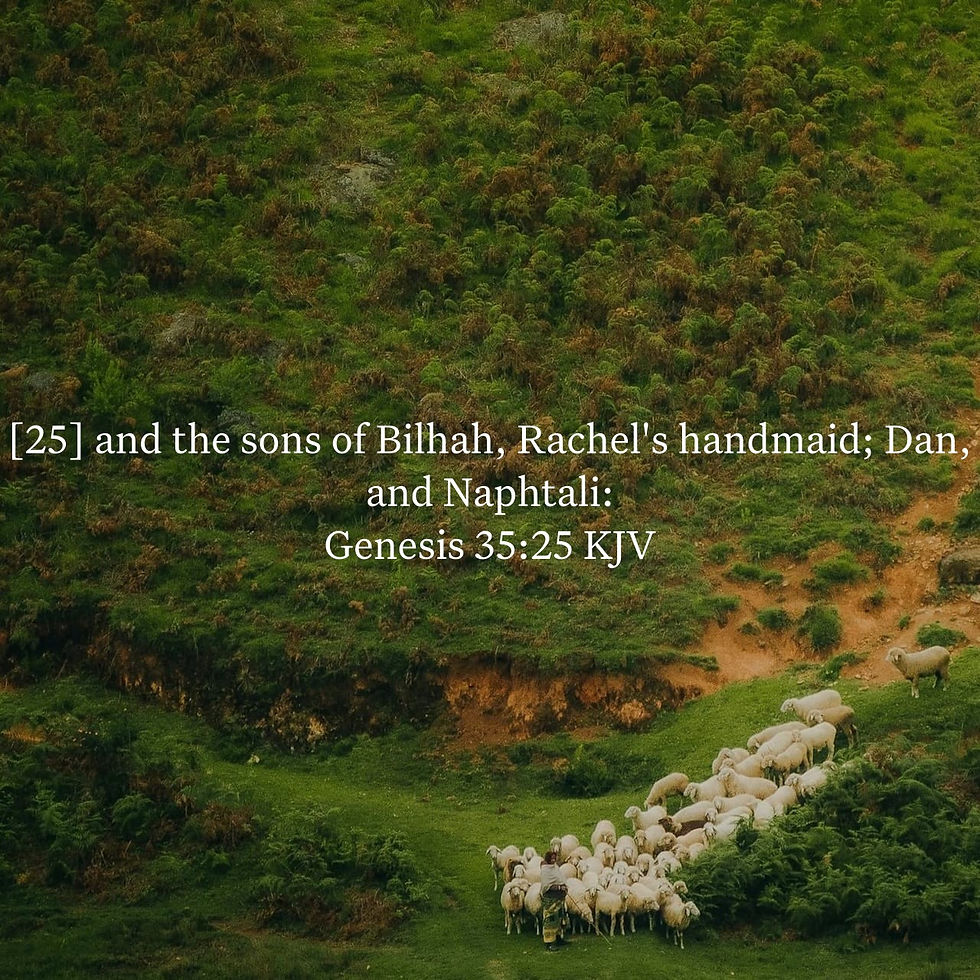
Genesis 35:25 Daily Devotional & Meaning – The Sons of Bilhah

Daily Verses Everyday! Day 233
“And the sons of Bilhah, Rachel's handmaid; Dan, and Naphtali:”
“And the sons of Bilhah, Rachel's handmaid; Dan, and Naphtali:” This verse may appear to be a simple continuation of Jacob’s genealogy, but the mention of Bilhah and her sons forces us to remember just how complicated the formation of Israel really was. Dan and Naphtali were not born through an ideal family arrangement. Bilhah had been Rachel’s handmaid, and Rachel gave her to Jacob because of her own anguish over barrenness. Genesis 30:3 records Rachel saying, “Behold my maid Bilhah, go in unto her; and she shall bear upon my knees, that I may also have children by her.” Dan and Naphtali therefore entered Jacob’s family through a situation shaped by jealousy, competition, cultural custom, and human impatience. Yet despite the brokenness surrounding their births, God did not erase them from the covenant family. Their names stand among the twelve sons of Jacob, and their descendants became two recognized tribes of Israel.
This is one of the repeated lessons of Genesis: God’s sovereign purposes are not dependent upon human beings creating perfect circumstances first. That does not mean God approves of every decision through which those circumstances develop. Jacob’s household is filled with rivalry and dysfunction precisely because human beings repeatedly attempt to solve problems according to their own wisdom. Rachel cannot bear children, so rather than simply resting in God’s timing, she gives Bilhah to Jacob. Leah later responds in kind by giving Zilpah. The family becomes increasingly complicated, and the names of the children themselves reveal the competition between the women. Yet God remains sovereign above it all. Human weakness does not become divine weakness, and human disorder does not cause God to lose control of His promise.
Bilhah herself entered the story when Laban gave her to Rachel. Genesis 29:29 says, “And Laban gave to Rachel his daughter Bilhah his handmaid to be her maid.” Scripture does not give us much information about Bilhah’s personal thoughts or desires, and we should not invent details the text does not reveal. What we can say is that her status was socially subordinate within the household. She belonged initially to Rachel’s household as a servant and later became Jacob’s concubine through Rachel’s decision. Yet her sons were not ultimately excluded from Israel’s tribal identity because of their mother’s status. Dan and Naphtali stood alongside Reuben, Simeon, Levi, Judah, Joseph, Benjamin, and the other sons as fathers of tribes.
That is significant because human beings have always been tempted to determine worth according to social rank, ancestry, wealth, status, or circumstances of birth. Scripture repeatedly demonstrates that God is not bound by those categories. First Samuel 16:7 says, “for man looketh on the outward appearance, but the LORD looketh on the heart.” Dan and Naphtali did not cease to matter because Bilhah had been a handmaid. God’s covenant purposes incorporated them completely into the nation that would eventually bear the name of Israel.
There is an important distinction here. The Bible does not tell us that every difference in social position disappears immediately within ancient society, nor does it pretend Jacob’s household structure was ideal. What it does show is that God’s redemptive purposes repeatedly cross human boundaries of status. A handmaid’s sons can become tribal patriarchs. A younger brother can be exalted over an older one. A shepherd can become king. A Moabitess named Ruth can enter the ancestry of David. A woman like Rahab can be incorporated into Israel’s story. God continually demonstrates that human beings do not get to decide who is useful to Him based merely upon origin or status.
Dan was Bilhah’s first son. His birth is recorded in Genesis 30:5-6: “And Bilhah conceived, and bare Jacob a son. And Rachel said, God hath judged me, and hath also heard my voice, and hath given me a son: therefore called she his name Dan.” The name Dan is connected with judgment or vindication. Rachel interpreted the child’s birth as God judging her case and hearing her voice. From Rachel’s perspective, Dan represented an answer to her pain and competition with Leah.
Yet the circumstances are complicated because Rachel speaks as though Dan were hers in a special sense even though Bilhah physically bore him. This reflects the social arrangement Rachel had proposed when she said Bilhah would “bear upon my knees.” The child was incorporated into Rachel’s household and family claim, but Scripture still preserves Bilhah’s identity as his mother here in Genesis 35:25: “the sons of Bilhah… Dan, and Naphtali.” Bilhah is not erased from the record.
That matters because Scripture often preserves the names of people whom the surrounding culture might have considered socially minor. Bilhah did not become as prominent in the biblical narrative as Rachel or Leah, but God still records her name. Her sons’ tribal identities are connected to her. Human society may create hierarchies of importance, but God sees every person fully.
Dan’s descendants would eventually receive an inheritance in the promised land. Joshua 19 records the territory assigned to the tribe, although the Danites later struggled to possess all of it. Judges 1:34 says, “And the Amorites forced the children of Dan into the mountain: for they would not suffer them to come down to the valley.” This difficulty eventually contributed to one of the more troubling developments in Dan’s history.
Judges 18 describes a group of Danites seeking additional territory. They travel north, capture the city of Laish, rename it Dan, and establish an idolatrous religious system there. Judges 18:30 says, “And the children of Dan set up the graven image.” The tribe whose name originally recalled Rachel’s claim that God had judged or vindicated her eventually became associated with a place of false worship.
That tragedy becomes even more significant later in Israel’s history. After the kingdom divides, Jeroboam establishes golden calves at Bethel and Dan. First Kings 12:29 says, “And he set the one in Bethel, and the other put he in Dan.” Dan therefore became one of the major centers of idolatrous worship in the northern kingdom.
This is a sobering reminder that a godly heritage or meaningful name does not guarantee future faithfulness. Dan’s name had been connected with God’s judgment and Rachel’s belief that God had heard her, but generations later the tribe became associated with idolatry. Spiritual heritage is valuable, but it must be personally embraced and faithfully maintained by each generation.
The same principle applies to us. We can inherit Christian teaching, grow up around Scripture, hear testimonies of God’s faithfulness, belong to a faithful church, or come from a family that has served God for generations, but none of that substitutes for personal obedience. Joshua 24:15 says, “choose you this day whom ye will serve.” Every generation must make that choice for itself.
Dan’s later history should therefore humble us. It is possible to begin with a heritage connected to God and drift into something completely different if devotion is not guarded. Churches can drift. Families can drift. Ministries can drift. Individuals can drift. Hebrews 2:1 warns, “Therefore we ought to give the more earnest heed to the things which we have heard, lest at any time we should let them slip.”
Dan’s story also reminds us that sin can become institutionalized. The idolatry at Dan was not merely one individual making one private mistake. It eventually became a religious system supported by leadership and practiced publicly. Once sin becomes normal within a community, people can stop recognizing how far they have moved from God.
Jeroboam’s calves at Bethel and Dan are a perfect example. He did not simply abandon religion; he created an alternative version of worship that looked religious while directly violating God’s commands. This is often more dangerous than open atheism because counterfeit worship can convince people they are serving God while actually disobeying Him.
Jesus warns about this principle in Matthew 15:8 when He says, “This people draweth nigh unto me with their mouth, and honoureth me with their lips; but their heart is far from me.” Dan’s history teaches us that using religious language does not automatically make something faithful.
Yet Dan’s tribal history is not entirely defined by idolatry. One of the most famous judges of Israel, Samson, came from Dan. Judges 13:2 introduces “a certain man of Zorah, of the family of the Danites, whose name was Manoah.” His wife was barren, and an angel announced that she would bear a son who would begin to deliver Israel from the Philistines.
Samson’s own story is deeply complicated. God gave him extraordinary strength and used him against Israel’s enemies, yet Samson repeatedly demonstrated poor judgment, especially in his relationships and personal desires. His life becomes another example of how God can use a deeply flawed person while still taking sin seriously.
Judges 13:24-25 says, “And the woman bare a son, and called his name Samson: and the child grew, and the LORD blessed him. And the Spirit of the LORD began to move him at times in the camp of Dan.” The tribe that would later become associated with idolatry also produced a judge through whom God struck Israel’s enemies.
Again, biblical history refuses to give us simple categories. Tribes are not uniformly righteous or uniformly wicked. Individuals are not always easy to classify. God works through flawed people while still condemning their sin.
Jacob’s later blessing over Dan in Genesis 49:16 says, “Dan shall judge his people, as one of the tribes of Israel.” This fits beautifully with the meaning associated with Dan’s name. Jacob continues in Genesis 49:17 with more difficult imagery: “Dan shall be a serpent by the way, an adder in the path.” The tribe would possess a dangerous, strategic character within Israel.
Then Jacob abruptly turns to God in Genesis 49:18 and says, “I have waited for thy salvation, O LORD.” The placement is striking. Whatever complexities existed within the future of Dan and the other tribes, Jacob’s ultimate hope was not in any tribe. It was in the salvation of God.
That is an important lesson from all these genealogies. Reuben cannot save Israel. Simeon cannot save Israel. Levi cannot save Israel. Judah, despite being the messianic tribe, cannot save Israel through ordinary human strength. Joseph cannot save Israel eternally. Dan cannot. Naphtali cannot. Benjamin cannot. Each tribe contributes to the nation’s history, but Jacob’s deepest hope must remain in the LORD.
The same is true for us. We may appreciate pastors, teachers, ministries, families, churches, theologians, or Christian leaders, but none of them can occupy the place of Christ. Psalm 146:3 says, “Put not your trust in princes, nor in the son of man, in whom there is no help.” Our confidence must ultimately rest in God.
Naphtali, Bilhah’s second son, was born immediately after Dan. Genesis 30:7-8 says, “And Bilhah Rachel's maid conceived again, and bare Jacob a second son. And Rachel said, With great wrestlings have I wrestled with my sister, and I have prevailed: and she called his name Naphtali.”
Naphtali’s name is associated with wrestling or struggle. Rachel understood the child through the ongoing rivalry with Leah. She said she had wrestled with her sister and believed she had prevailed. Once again, a child is born into a family atmosphere dominated by comparison.
This is one of the saddest elements of Jacob’s household. Children who should have been received primarily as gifts from God often became symbols in an emotional competition between Leah and Rachel. Each birth became part of the question of who was more favored, who had more children, and who held greater status within Jacob’s household.
The children themselves were not responsible for that rivalry, but they were born into its consequences.
Families can place burdens upon children that children were never meant to carry. Parents can consciously or unconsciously use children to prove something, compete with others, repair relationships, fulfill personal ambitions, or establish their own sense of worth. Scripture shows us how destructive such dynamics can become.
Children are gifts from God, not instruments for adult competition. Psalm 127:3 says, “Lo, children are an heritage of the LORD: and the fruit of the womb is his reward.” They should be loved because they are people created in the image of God, not because of what they prove about their parents.
Naphtali’s birth name reflected struggle, but his tribe’s later history includes moments of courage and blessing. Jacob says in Genesis 49:21, “Naphtali is a hind let loose: he giveth goodly words.” Moses later blesses Naphtali in Deuteronomy 33:23, saying, “O Naphtali, satisfied with favour, and full with the blessing of the LORD: possess thou the west and the south.”
The language is striking when compared with Naphtali’s origin. He was named in the middle of Rachel’s rivalry and “wrestlings,” yet Moses later describes his descendants as “satisfied with favour, and full with the blessing of the LORD.” Human struggle did not become the only word over Naphtali’s future.
Naphtali also plays an important role during the period of the judges. Barak, who fought alongside Deborah against Sisera, came from Kedesh in Naphtali. Judges 4:6 records Deborah calling “Barak the son of Abinoam out of Kedeshnaphtali.” When Israel faced oppression under Jabin and Sisera, Naphtali joined Zebulun in the battle.
Judges 5:18 praises their courage: “Zebulun and Naphtali were a people that jeoparded their lives unto the death in the high places of the field.” The descendants of Bilhah’s son became known in that moment for risking their lives in Israel’s deliverance.
That is a significant transformation from the circumstances surrounding Naphtali’s birth. Rachel had named him during her struggle with Leah, but generations later his tribe’s story included people willing to risk themselves for the nation.
The territory of Naphtali becomes even more significant when we reach the New Testament. The prophet Isaiah had spoken concerning the regions of Zebulun and Naphtali. Isaiah 9:1 refers to “the land of Zebulun and the land of Naphtali,” and the following verse announces, “The people that walked in darkness have seen a great light.”
Matthew identifies the fulfillment in connection with Jesus.
Matthew 4:13-16 says that Jesus came and dwelt in Capernaum “upon the sea coast, in the borders of Zabulon and Nephthalim,” and then quotes Isaiah: “The land of Zabulon, and the land of Nephthalim… The people which sat in darkness saw great light.”
That means the territory associated with Naphtali became part of the region where Jesus Christ publicly ministered.
The descendant of a handmaid received a tribal inheritance, and centuries later the Messiah walked through that land preaching the kingdom of God.
There is something beautiful in that.
Human beings might have looked at Bilhah and considered her less important than Rachel or Leah because of her social status. Yet God knew that through one of her sons would come a tribe whose land would eventually witness the ministry of Jesus.
God does not need human status to create eternal significance.
This principle appears throughout Christ’s own ministry. Jesus repeatedly gave attention to people society overlooked. He spoke with Samaritans. He touched lepers. He welcomed children. He ate with tax collectors and sinners. He praised the faith of people outside the expected religious establishment.
James later warns Christians against showing favoritism based upon status. James 2:1 says, “My brethren, have not the faith of our Lord Jesus Christ, the Lord of glory, with respect of persons.” He then describes the sinful tendency to honor wealthy people while treating the poor as less important.
Bilhah’s sons remind us that the kingdom of God does not operate according to the social ladders human beings construct.
Dan and Naphtali were sons of a handmaid, but they were still sons of Jacob.
Their descendants were still tribes of Israel.
Their names were still preserved in Scripture.
Their inheritances were still part of Canaan.
Their histories still mattered.
This also helps us understand grace. We do not determine our place before God through social pedigree. The gospel is not reserved for the powerful, educated, wealthy, prestigious, or socially respected.
Galatians 3:28 says, “There is neither Jew nor Greek, there is neither bond nor free… for ye are all one in Christ Jesus.” Paul is not claiming that every earthly distinction vanishes immediately, but he is declaring that such distinctions do not establish superior access to salvation or greater standing in Christ.
Bilhah’s social position did not prevent God from including her sons within Israel. In the New Testament, slave and free alike could become brothers and sisters in Christ.
There is also a larger lesson in how these tribal lists preserve the full complexity of Jacob’s family. Scripture could have simplified the story. It could have ignored Bilhah and Zilpah and spoken only of Jacob’s sons collectively. Instead, the text carefully identifies which sons came from Leah, Rachel, Bilhah, and Zilpah.
God does not need to rewrite history to make His people look better.
The Bible openly records the complicated way Israel’s twelve tribes came into existence.
This should increase our confidence in Scripture because the biblical writers rarely sanitize their heroes. Abraham fails. Isaac fails. Jacob fails. Rachel fails. Leah fails. Their children fail. Yet God remains faithful.
The glory belongs to God precisely because the human beings involved are so obviously imperfect.
The church should remember this as well. We sometimes imagine God can use us only after every part of our lives looks orderly and impressive. Certainly we should pursue holiness, repentance, wisdom, and obedience. But God’s grace is not limited to people who come from ideal backgrounds.
Some believers come from stable families.
Others come from deeply broken families.
Some were raised in church.
Others encountered Christ after years of rebellion.
Some have impressive education.
Others have little formal education.
Some begin serving God early.
Others come to faith late in life.
God is capable of using all who genuinely belong to Him and surrender themselves to His purposes.
First Corinthians 1:27 says, “But God hath chosen the foolish things of the world to confound the wise.” Verse 29 explains the purpose: “That no flesh should glory in his presence.”
If God worked only through people whose circumstances looked perfect, human beings would quickly begin taking credit.
Instead, Scripture gives us sons born through servants, kings who began as shepherds, apostles who began as fishermen, and a persecutor named Saul who became one of Christianity’s greatest missionaries.
God consistently ensures that the glory returns to Him.
There is another important lesson in Rachel’s role in the births of Dan and Naphtali. Rachel believed Dan demonstrated that she had been vindicated, and with Naphtali she declared that she had wrestled with Leah and prevailed. Yet Rachel’s interpretation of success was still heavily influenced by comparison.
This exposes how easily even blessings can become distorted when received through a competitive heart.
We can receive something genuinely good from God and immediately use it to measure ourselves against another person. We can turn ministry into competition, family into competition, careers into competition, finances into competition, education into competition, even spiritual accomplishments into competition.
The blessing remains good, but our heart can misuse it.
Paul warns against this spirit in Galatians 5:26: “Let us not be desirous of vain glory, provoking one another, envying one another.” Philippians 2:3 similarly says, “Let nothing be done through strife or vainglory.”
Rachel looked at Naphtali and saw evidence that she had prevailed against Leah. God saw a person.
That difference matters.
Our blessings are not trophies proving we are better than someone else. They are trusts from God for which we are responsible.
Dan and Naphtali eventually became far more than pieces in Rachel’s rivalry. They became men with families, descendants, tribes, territories, and histories of their own.
This should warn parents especially against defining children primarily through adult conflicts. A child should not be “the one who proves me right,” “the one who makes my family proud,” or “the one who succeeds where someone else’s child failed.” Children are not weapons in adult emotional battles.
Each person belongs ultimately to God.
The verse also reminds us that identity in Scripture can contain both origin and calling. Dan and Naphtali never stop being identified as Bilhah’s sons. Their origin is not erased. Yet their future becomes much larger than the circumstances of their birth.
Likewise, the gospel does not require us to pretend our histories never happened. We may come from brokenness, poverty, loss, dysfunction, or failure. Those realities may remain part of our testimony.
But they do not have to become the limit of what God can do with us.
Second Corinthians 5:17 says, “Therefore if any man be in Christ, he is a new creature.” Becoming new in Christ does not mean losing every memory of the past. It means the past no longer possesses ultimate authority over our identity and destiny.
Naphtali could trace his name to Rachel’s wrestling.
Yet his descendants could be described as “full with the blessing of the LORD.”
Dan could trace his birth to Rachel’s desperate attempt to overcome barrenness.
Yet his descendants became one of Israel’s tribes.
God writes forward.
We often remain obsessed with where something started.
God knows where He intends to take it.
This genealogical verse therefore fits beautifully within the larger structure of Genesis 35. God has just reaffirmed Jacob’s name as Israel and repeated the covenant promises. Rachel has died. Reuben has sinned terribly. Then Scripture lists the sons from each mother.
Why?
Because despite grief, sin, rivalry, death, and family disorder, the twelve sons are there.
Israel is being formed.
God promised descendants, and descendants have come.
The family is far from perfect, but the promise is moving forward.
That is one of the strongest themes in Genesis. God’s faithfulness continues despite human instability.
The flood did not end the promise.
Abraham’s failures did not end it.
Sarah’s impatience did not end it.
Isaac’s favoritism did not end it.
Jacob’s deception did not end it.
Laban’s manipulation did not end it.
Rachel and Leah’s rivalry did not end it.
Reuben’s sin did not end it.
The tribes’ later failures would not end it.
God remains faithful because His character does not change.
Malachi 3:6 says, “For I am the LORD, I change not.”
That should produce enormous confidence, but never arrogance. God’s faithfulness does not mean our choices are irrelevant. Dan’s later idolatry had consequences. Israel suffered terribly because of rebellion. God disciplines His people precisely because He is holy.
But human failure cannot ultimately overthrow the redemptive plan God has established.
Eventually that plan leads to Jesus Christ.
The territory of Naphtali hears His preaching.
The tribes of Israel become part of the historical world into which He comes.
Christ calls twelve apostles, deliberately echoing the twelve-tribe structure of Israel.
The Gospel goes outward from Israel to the nations.
The story that began with a complicated household becomes part of the story through which God brings salvation to the world.
When Genesis 35:25 says, “the sons of Bilhah, Rachel's handmaid; Dan, and Naphtali,” we therefore should not pass over the names too quickly. These are sons born through a woman of low social status within a deeply imperfect family arrangement, yet God gave them a place among the tribes of Israel.
Dan’s history warns us that heritage does not guarantee faithfulness and that religious corruption can grow when generations drift from God.
Naphtali’s history reminds us that origins marked by struggle do not determine the whole future and that God can bring blessing through circumstances initially shaped by rivalry.
Bilhah’s place reminds us that God sees people human society may treat as secondary.
And the entire verse reminds us that the unfolding purposes of God are far greater than the broken circumstances through which human beings often stumble.
Jacob’s family did not become Israel because Jacob constructed a perfect household.
Israel existed because God had made a promise.
Dan and Naphtali stood among the evidence that He was keeping it.
Their mother had been called “Rachel’s handmaid,” but her sons became patriarchs.
Their beginnings were entangled in competition, but their names became part of Israel.
Their descendants experienced both failure and faithfulness, judgment and blessing.
And through it all, the God who had promised Abraham, Isaac, and Jacob that their descendants would become a nation continued doing exactly what He said He would do.
That is ultimately where this verse directs our attention. The genealogy is not primarily a monument to the greatness of Jacob’s sons. Their later histories will prove repeatedly that they were not great enough to carry God’s purposes by their own righteousness. It is a monument to the greatness of the God who can take even a fractured family and, through grace and sovereignty, continue moving His plan toward redemption.
The names are Dan and Naphtali, but the glory belongs to God.
If you would like to explore Genesis in a sustained, verse-by-verse way with space to reflect, journal, and trace how these foundational truths unfold through Scripture the Verse by Verse book expands these reflections into a unified reading experience. The book gathers these meditations into a structured journey through Genesis, designed to help readers linger in the text and engage God’s Word more deeply over time.


Comments