Genesis 35:26 Daily Devotional & Meaning – The Sons of Zilpah

Daily Verses Everyday! Day 233
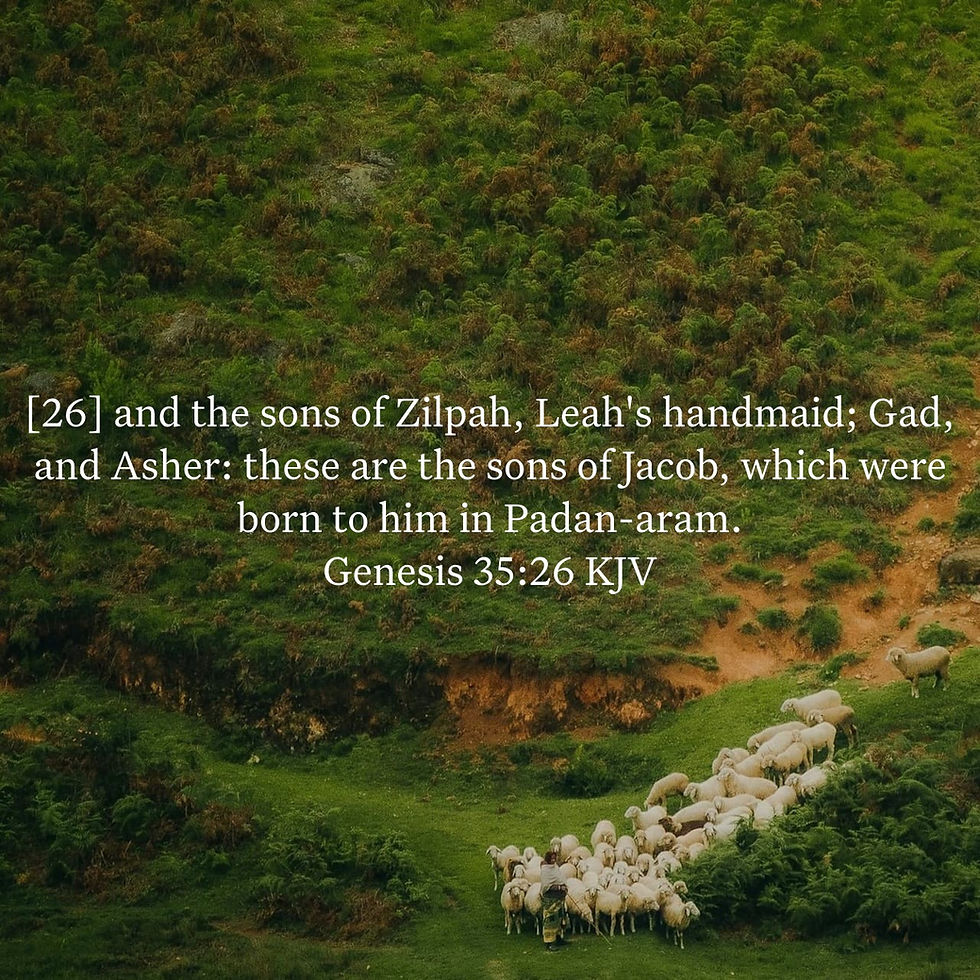
“And the sons of Zilpah, Leah's handmaid: Gad, and Asher: these are the sons of Jacob, which were born to him in Padanaram.”
“And the sons of Zilpah, Leah's handmaid: Gad, and Asher: these are the sons of Jacob, which were born to him in Padanaram.” With Gad and Asher, Scripture completes the naming of Jacob’s twelve sons according to their mothers, and once again two sons born through a handmaid are placed fully within the family that will become Israel. Zilpah had entered the story as Leah’s servant, just as Bilhah had been Rachel’s servant. Genesis 29:24 says, “And Laban gave unto his daughter Leah Zilpah his maid for an handmaid.” Yet the woman introduced merely as Leah’s handmaid becomes the mother of two patriarchs whose descendants will possess land in Canaan, fight in Israel’s wars, receive prophetic blessings from Jacob and Moses, and remain identifiable tribes centuries later. Scripture does not allow their mother’s social position to make her sons less truly sons of Jacob. Gad and Asher stand beside Reuben, Judah, Joseph, Benjamin, and every other son as part of the twelve through whom the nation of Israel will be formed.
Their births, however, came through the same deeply complicated household rivalry that produced Dan and Naphtali. Leah had initially borne four sons, but Genesis 30:9 says, “When Leah saw that she had left bearing, she took Zilpah her maid, and gave her Jacob to wife.” Leah had watched Rachel use Bilhah in an attempt to overcome her barrenness, and Leah responded by doing something similar when she temporarily ceased conceiving. What had begun as grief over Jacob’s unequal affection had developed into a competition in which children increasingly became measures of status between two sisters. The household of the man whom God had renamed Israel was growing, but it was growing through circumstances saturated with jealousy, insecurity, comparison, and attempts by human beings to control outcomes.
Once again, Scripture shows us an important distinction between what God sovereignly accomplishes and the human behavior through which He sometimes permits His purposes to unfold. God’s ability to bring Israel’s tribes from this household does not mean the household arrangement itself should be treated as an ideal. Genesis has already displayed the painful consequences of Jacob’s multiple marriages. Leah feels unloved. Rachel envies Leah. Bilhah and Zilpah are brought into the marriage structure. Children become part of competition between sisters. Reuben later violates Bilhah. Joseph becomes the object of favoritism, contributing to his brothers’ hatred. The narrative is not promoting this family structure; it is showing us that God remains sovereign even when human beings create extraordinary disorder.
That pattern runs throughout Genesis. Abraham and Sarah attempted to resolve their lack of an heir through Hagar, producing conflict within the household. Isaac and Rebekah each favored a different son, producing division between Jacob and Esau. Jacob’s marriages were shaped by Laban’s deception, and favoritism again damaged the next generation. Human beings repeatedly complicate what God has promised by attempting to manage His plan according to their own wisdom. Yet God does not surrender His sovereignty every time people make a mess.
Psalm 115:3 says, “But our God is in the heavens: he hath done whatsoever he hath pleased.” This does not excuse human wrongdoing; it reveals that human wrongdoing is never powerful enough to dethrone God. Jacob’s family is broken, but God’s covenant is not broken. Leah and Rachel compete, but God remains faithful. Laban deceives, but God remains faithful. Reuben sins, but God remains faithful. The sons themselves will later commit terrible acts against Joseph, but God will remain faithful. The repeated instability of the family only makes the stability of God more obvious.
Zilpah’s first son was Gad. Genesis 30:10-11 says, “And Zilpah Leah's maid bare Jacob a son. And Leah said, A troop cometh: and she called his name Gad.” The KJV connects Gad’s name with Leah’s exclamation, “A troop cometh,” while the Hebrew name also carries associations that have been understood in relation to fortune or good fortune. Within the narrative, Leah receives Gad as another addition to the growing company of sons around Jacob. What began with one promised descendant is rapidly becoming a household filled with children.
That is especially important when we remember the promise God gave Jacob when he was fleeing toward Padanaram. Jacob arrived at Bethel alone and vulnerable. Genesis 28:13-14 records God saying to him, “The land whereon thou liest, to thee will I give it, and to thy seed; And thy seed shall be as the dust of the earth.” At that moment Jacob had no children. He did not even have a wife. He was travelling toward an uncertain future with little visible evidence that such a promise could ever become reality.
Now Genesis 35 lists twelve sons.
What God promised while Jacob was alone has become visible in his household.
Gad is part of that fulfillment.
Jacob could not have imagined when he slept with his head upon a stone at Bethel that one day he would return with sons whose descendants would become tribes. He could not have seen Reuben, Simeon, Levi, Judah, Dan, Naphtali, Gad, Asher, Issachar, Zebulun, Joseph, and Benjamin. God saw them before Jacob knew any of their mothers.
This is one of the recurring themes of the patriarchal narratives. God speaks promises when the circumstances appear too small to contain them. Abraham was childless when God promised descendants like the stars. Sarah was barren when God promised Isaac. Jacob was alone when God promised that his seed would spread abroad. God repeatedly begins where human ability is insufficient so that the eventual fulfillment clearly demonstrates His power.
Romans 4:20-21 says of Abraham that he “staggered not at the promise of God through unbelief; but was strong in faith, giving glory to God; And being fully persuaded that, what he had promised, he was able also to perform.” That same God is now performing what He promised through Jacob’s expanding family.
Gad would eventually become much more than the child Leah celebrated at birth. His descendants became one of Israel’s twelve tribes, and when Israel approached the promised land after the Exodus, the tribe of Gad possessed enormous numbers of livestock. Alongside Reuben, the Gadites saw that the land east of the Jordan was particularly suitable for their herds. Numbers 32:1 says, “Now the children of Reuben and the children of Gad had a very great multitude of cattle: and when they saw the land of Jazer, and the land of Gilead, that, behold, the place was a place for cattle.”
They requested that this territory become their inheritance rather than land west of the Jordan. Moses initially reacted strongly because he feared that they were attempting to avoid fighting alongside the rest of Israel. Numbers 32:6 records Moses asking, “Shall your brethren go to war, and shall ye sit here?” Moses remembered how the unbelief of the previous generation had discouraged Israel at Kadeshbarnea, and he would not allow Gad and Reuben to repeat that failure.
The Gadites, however, promised that their fighting men would cross the Jordan and fight beside their brothers before returning to their own inheritance. Numbers 32:17 says, “But we ourselves will go ready armed before the children of Israel, until we have brought them unto their place.” Moses accepted the arrangement on the condition that they fulfill that promise.
This becomes an important part of Gad’s tribal character. Though their inheritance lay east of the Jordan, they still had obligations toward the rest of Israel. Their geographical separation did not remove their responsibility to their brothers. They could not settle comfortably into their own possession while the remainder of Israel still faced enemies in Canaan.
There is a lesson in that for the people of God. God may give each of us different responsibilities, possessions, opportunities, and places of service, but our personal blessing should never make us indifferent to the needs of others. Philippians 2:4 says, “Look not every man on his own things, but every man also on the things of others.” Gad could have said, “We have found what we need; the rest of you can fight your own battles.” Instead, they were required to cross over and fight alongside their brethren.
Christianity is not intended to be lived as though each believer were an isolated kingdom. First Corinthians 12 describes the church as one body with many members. Verse 26 says, “And whether one member suffer, all the members suffer with it.” When God has given us strength, that strength can be used to help someone who is still fighting. When He has given us knowledge, we can teach. When He has given us resources, we can give. When He has brought us through a battle, we may be able to stand beside someone currently walking through a similar one.
Gad’s descendants also developed a reputation for military strength. First Chronicles 12:8 describes Gadites who joined David, calling them “men of might, and men of war fit for the battle, that could handle shield and buckler, whose faces were like the faces of lions, and were as swift as the roes upon the mountains.” This is extraordinary language. The descendants of Zilpah’s son became renowned warriors.
Jacob’s later prophetic words over Gad anticipate conflict and victory. Genesis 49:19 says, “Gad, a troop shall overcome him: but he shall overcome at the last.” There is almost a play upon Gad’s name and the idea of troops or raiders. Gad would experience attack, but defeat would not be the final word. “He shall overcome at the last.”
That is a fitting theme for a tribe whose territory east of Jordan placed it particularly near hostile peoples and vulnerable frontiers. Gad would know warfare, pressure, and danger. Yet Jacob’s blessing looks beyond temporary difficulty toward eventual victory.
There is a spiritual principle in that which extends far beyond Gad. God’s people can experience seasons when they appear to be overcome without being ultimately defeated. Paul says in 2 Corinthians 4:8-9, “We are troubled on every side, yet not distressed; we are perplexed, but not in despair; Persecuted, but not forsaken; cast down, but not destroyed.” Christianity does not promise that believers will never be struck down. It promises that in Christ our final outcome is not determined by the temporary battles of this world.
Romans 8:37 says, “Nay, in all these things we are more than conquerors through him that loved us.” Notice again that Paul says “in all these things,” not by escaping all these things. Trouble can come. Persecution can come. Loss can come. Yet none can finally separate believers from Christ.
Moses later blesses Gad in Deuteronomy 33:20, saying, “Blessed be he that enlargeth Gad: he dwelleth as a lion.” The lion-like imagery fits the warriors later described in Chronicles as having “faces… like the faces of lions.” A son born through Zilpah becomes the ancestor of people known for courage and strength.
Then comes Asher, Zilpah’s second son. Genesis 30:12-13 says, “And Zilpah Leah's maid bare Jacob a second son. And Leah said, Happy am I, for the daughters will call me blessed: and she called his name Asher.” Asher’s name is associated with happiness or blessedness. Leah looks at what has happened within her household and declares, “Happy am I.”
Again, the statement must be understood within the complicated rivalry between Leah and Rachel. Leah is still conscious of how other women will view her. “The daughters will call me blessed.” Her sense of blessing remains connected partly with visible evidence that others can recognize.
Yet the name Asher becomes appropriate in ways Leah could never foresee. Jacob’s later blessing says in Genesis 49:20, “Out of Asher his bread shall be fat, and he shall yield royal dainties.” Asher becomes associated with abundance, rich food, and agricultural prosperity.
Moses later expands this blessing in Deuteronomy 33:24-25: “And of Asher he said, Let Asher be blessed with children; let him be acceptable to his brethren, and let him dip his foot in oil. Thy shoes shall be iron and brass; and as thy days, so shall thy strength be.”
The imagery of dipping his foot in oil has often been understood in connection with the agricultural richness of Asher’s territory, especially olive production. Asher’s inheritance lay in the fertile northern coastal region of Canaan, an area capable of producing agricultural abundance. Leah named him “happy” or “blessed,” and generations later Moses specifically says, “Let Asher be blessed.”
There is a beautiful continuity there. The infant once held in Zilpah’s arms eventually becomes the ancestor of a tribe dwelling within a rich inheritance of the promised land. Once again, the mother and family could see only the child before them. God could see territory, generations, and centuries of history.
Asher also gives us one of the most beautiful connections between the tribes of Genesis and the New Testament. Centuries after Genesis, after the kingdom, exile, and return, Luke introduces an elderly prophetess named Anna. Luke 2:36 says, “And there was one Anna, a prophetess, the daughter of Phanuel, of the tribe of Aser.”
“Aser” is the New Testament form of Asher.
That means that centuries after Zilpah gave birth to Asher in Padanaram, a woman descended from his tribe was present in Jerusalem when the infant Jesus was brought to the temple.
Luke tells us that Anna was a widow of great age who “departed not from the temple, but served God with fastings and prayers night and day.” When she saw Jesus, Luke 2:38 says, “And she coming in that instant gave thanks likewise unto the Lord, and spake of him to all them that looked for redemption in Jerusalem.”
What an extraordinary journey from Genesis 30 to Luke 2.
Zilpah gives birth to Asher.
Asher becomes a tribe.
Generations pass.
Israel enters Canaan.
Judges rise.
Kings reign.
The kingdom divides.
Assyria conquers the northern kingdom.
Judah goes into exile.
The Jewish people return.
Centuries pass.
Then a faithful elderly woman from the tribe of Asher stands in the temple and recognizes the arrival of Israel’s Redeemer.
That detail is especially remarkable because Asher was one of the northern tribes affected by the Assyrian conquest. Yet centuries later Luke can still identify Anna specifically as belonging to Asher. The tribe had not disappeared from God’s knowledge or completely from Israel’s remembered identity.
Anna represents a faithful remnant waiting for God’s redemption. Her ancestry reaches all the way back to the child named because Leah said, “Happy am I.” Now a daughter of that tribe experiences a happiness far greater than anything Leah imagined: she sees the Messiah.
There is something profoundly fitting about a descendant of Asher being present at that moment. Leah associated Asher with blessedness, and Anna stands in the temple giving thanks because God’s greatest blessing has arrived in Jesus Christ.
Luke 2 is filled with people waiting faithfully. Simeon had been waiting for “the consolation of Israel.” Anna speaks to those “that looked for redemption in Jerusalem.” Neither is presented as politically powerful or socially impressive. They are simply faithful people who have spent years trusting God.
Anna in particular reminds us that a life may appear quiet without being insignificant. She served through prayer, fasting, worship, and patient expectation. Scripture does not record her commanding armies or governing nations. She does not become famous in the way David, Moses, or Paul becomes famous. Yet God ensured that her name, her tribe, and her faithfulness were preserved in the Gospel account of Christ’s infancy.
That connects beautifully back to Zilpah. Both women could easily be overlooked in comparison with more prominent biblical figures. Zilpah stands in the shadow of Leah and Rachel. Anna appears briefly beside Simeon and the Holy Family. Yet God remembers both.
Human significance is not determined by how many chapters Scripture gives someone.
God sees faithful lives.
The inclusion of Gad and Asher also strengthens a theme running through these final genealogical verses: the sons of the handmaids are not treated as illegitimate outsiders to Israel. Dan, Naphtali, Gad, and Asher all become tribal patriarchs. Later biblical lists may arrange the tribes differently depending upon context, but these men remain part of Israel.
This is important in the development of the biblical theme that God’s purposes are not controlled by social status. Zilpah was called “Leah’s handmaid,” yet her sons inherited within the promised nation. Human beings might have created distinctions based upon who their mothers were, but God incorporated the sons into the twelve.
We should never confuse this with saying that every son received precisely the same historical role. They did not. Judah received royal prominence. Levi received priestly service. Joseph received a double portion through Ephraim and Manasseh. Gad and Asher received their own territories and functions. Equality of belonging did not require sameness of calling.
That principle becomes important in the New Testament church as well. Galatians 3:28 says, “There is neither Jew nor Greek, there is neither bond nor free… for ye are all one in Christ Jesus.” Paul is declaring equality of standing in Christ, not the elimination of every distinction in gifting, responsibility, or life circumstance.
First Corinthians 12:4 says, “Now there are diversities of gifts, but the same Spirit.” God creates unity without demanding uniformity.
Gad did not need to become Judah.
Asher did not need to become Levi.
Dan did not need to become Joseph.
Each tribe had its place.
The same is true for believers. We often create unnecessary disappointment by believing that being used by God means being used exactly like someone else. God may call one person to preach, another to teach children, another to serve through hospitality, another to write, another to give, another to pray, another to raise a family faithfully, another to serve quietly for decades in ways few people ever see.
The question is not whether our assignment looks impressive beside someone else’s.
The question is whether we are faithful to God within it.
The final words of Genesis 35:26 then broaden the perspective: “these are the sons of Jacob, which were born to him in Padanaram.” This phrase closes the enumeration of Jacob’s sons and directs our attention backward toward the long period Jacob spent away from Canaan.
There is an apparent difficulty here that is worth acknowledging because the preceding narrative has explicitly told us Benjamin was born near Ephrath in Canaan, not in Padanaram. Genesis 35:16-18 has just described Benjamin’s birth after Jacob left Bethel. Therefore the closing statement should not be understood in a way that contradicts what Genesis itself has plainly narrated only a few verses earlier. It functions as a broad summary of the family that was formed during Jacob’s Padanaram era, with Benjamin’s exceptional birth in Canaan already clearly established in the immediate context. Scripture has not forgotten where Benjamin was born; it has just spent several verses telling us.
The emphasis remains historically important because Padanaram was the place where nearly all of Jacob’s sons were born and where his household expanded from one man into the beginnings of Israel.
Think about who Jacob was when he first went there.
He was fleeing.
He was afraid of Esau.
He had left his father and mother behind.
He possessed no wife.
He had no children.
He had no tribe.
He had no large household.
He had no visible nation.
He was simply Jacob travelling toward his uncle Laban.
Yet before he reached Padanaram, God met him at Bethel.
Genesis 28:15 contains the promise that hangs over the entire period: “And, behold, I am with thee, and will keep thee in all places whither thou goest.”
God did not promise that Padanaram would be easy.
It was not.
Laban deceived Jacob concerning Leah and Rachel.
Laban repeatedly changed Jacob’s wages.
The household became filled with rivalry.
Jacob spent years laboring under difficult circumstances.
Eventually tension between Jacob and Laban became severe enough that Jacob left secretly.
But through all of that, God kept saying yes to the central promise: “I am with thee.”
By the time Jacob returns, he is no longer alone.
Genesis 32:10 contains Jacob’s own recognition of this transformation. He prays, “I am not worthy of the least of all the mercies, and of all the truth, which thou hast shewed unto thy servant; for with my staff I passed over this Jordan; and now I am become two bands.”
That may be one of the most important verses for understanding Genesis 35:26.
“With my staff I passed over this Jordan.”
Jacob remembers how little he had.
“And now I am become two bands.”
He sees how much God has done.
Padanaram had been difficult, but it had also been the place where God multiplied him.
Sometimes we look back upon difficult seasons and see only the difficulty because that is what hurt most while we were inside them. Yet years later we may recognize that God was doing things there we could not appreciate at the time. A difficult season can still be a fruitful season. A painful place can still be a place where God grows us. A chapter we would never voluntarily repeat can still contain blessings we would never willingly surrender.
Jacob probably would not have chosen Laban.
He would not have chosen the deception involving Leah.
He would not have chosen years of wage disputes.
He would not have chosen the rivalry within his household.
Yet when he left Padanaram, he carried children, possessions, experiences, and evidence of God’s faithfulness that he did not possess when he entered.
God had been with him there.
This is not the same as saying every painful circumstance is secretly good. Laban’s deception was still wrong. Family jealousy was still damaging. Human sin remains sin. But God can work within difficult circumstances without approving the wrongdoing that helped create them.
Joseph will later articulate this truth magnificently in Genesis 50:20: “ye thought evil against me; but God meant it unto good.” Human beings can intend evil while God remains capable of sovereignly bringing good through the very history they attempted to corrupt.
Padanaram becomes an example of that principle in Jacob’s life.
Laban tried to manipulate Jacob.
God multiplied Jacob.
Laban changed his wages.
God prospered Jacob.
Jacob arrived alone.
God brought him back surrounded by descendants.
What looked like exile became preparation.
What looked like delay became multiplication.
What looked like years spent away from the promised land became the years during which the family destined to inherit that land was born.
That is providence.
God did not merely preserve Jacob until he could return to Canaan. God was building Israel while Jacob was outside Canaan.
That is a profound thought.
The nation that would one day possess the promised land was being formed while its father lived away from that land.
This demonstrates that God’s promise was never dependent upon geography alone. Canaan mattered because God had promised it, but the God who promised Canaan was just as sovereign in Padanaram.
Jacob learned this at Bethel before ever arriving there. Genesis 28:16 records Jacob awakening and saying, “Surely the LORD is in this place; and I knew it not.” Jacob was beginning to learn that God was not confined to the places Jacob expected to find Him.
That lesson continued throughout his travels.
God was at Bethel.
God was with Jacob in Padanaram.
God was with him when he fled Laban.
God was with him at Peniel.
God protected him from Esau.
God called him back to Bethel.
God remained God everywhere Jacob travelled.
We need to remember that because we sometimes attach God’s presence too strongly to ideal circumstances. We can think, consciously or unconsciously, that God is most active when everything is going according to plan. Yet some of the clearest evidence of His faithfulness may eventually come from the seasons we least enjoyed.
God is not confined to our version of Canaan.
He is also God in Padanaram.
He is God in uncertainty.
He is God in delay.
He is God when other people treat us unfairly.
He is God when family relationships are complicated.
He is God when we cannot yet see how the promise will be fulfilled.
Jacob’s twelve sons become physical evidence of that truth.
When God first said that Jacob’s descendants would become numerous, there were none.
Now Genesis can list them by name.
Reuben.
Simeon.
Levi.
Judah.
Issachar.
Zebulun.
Joseph.
Benjamin.
Dan.
Naphtali.
Gad.
Asher.
The promise has names now.
That is one of the most beautiful transitions in Genesis. God’s words spoken over Jacob at Bethel are beginning to become people standing around him.
Yet even twelve sons are only the beginning.
God had promised in Genesis 28:14, “thy seed shall be as the dust of the earth.” Twelve men are nowhere near dust-like multitudes. God has begun fulfilling the promise, but much remains ahead.
Those twelve will have children.
Their children will have children.
The family will go into Egypt.
Exodus 1:7 will eventually say, “And the children of Israel were fruitful, and increased abundantly, and multiplied, and waxed exceeding mighty.”
The household becomes a people.
The people become a nation.
The nation receives the law.
The nation enters Canaan.
Kings arise.
Prophets speak.
And eventually from Israel comes Jesus Christ.
Galatians 4:4 says, “But when the fulness of the time was come, God sent forth his Son.”
Genesis 35:26 therefore sits much earlier in a story whose destination God already knows.
Gad and Asher seem like two more names in a family list, but God sees generations through them. Through Gad He sees warriors crossing the Jordan with their brothers. Through Asher He sees fertile territory and, centuries later, an elderly prophetess named Anna worshipping in the temple as the infant Christ is brought before the Lord.
Jacob sees sons.
God sees history.
That is why these genealogies matter so much. They teach us to respect beginnings. The person standing before us now may be connected with things we cannot imagine. The child being raised today may serve God in ways no parent can presently see. The small act of obedience we perform now may have effects beyond our lifetime.
We are tempted to judge significance too early because we see only what something is now.
God sees what it will become.
Zilpah was a handmaid.
Gad and Asher were children born inside a complicated household arrangement.
Yet Gad became a tribe.
Asher became a tribe.
A daughter of Asher eventually stood in the temple and proclaimed the arrival of redemption.
Their beginnings did not limit God.
Neither do ours.
This verse ultimately closes the account of Jacob’s sons by pointing us back to the faithfulness of the God who promised them. Jacob could have looked at his household and seen confusion, rivalry, differing mothers, painful histories, and deeply flawed sons. God could look at the same household and see Israel.
That does not mean God ignored the flaws.
Reuben would face consequences.
Simeon and Levi would face consequences.
Dan’s descendants would fall into idolatry.
The tribes would repeatedly rebel.
Eventually Israel itself would suffer judgment and exile.
Yet the covenant purpose of God would continue advancing because its ultimate foundation was not the righteousness of Jacob’s sons but the faithfulness of the God who called Abraham.
Second Timothy 2:13 says, “he abideth faithful: he cannot deny himself.”
Genesis 35:26 is therefore both a genealogy and a testimony. Gad and Asher remind us that God can give significant places within His purposes to people whose beginnings appear socially insignificant. Their tribal histories remind us that blessing brings responsibility and that every generation must choose whether it will walk faithfully. Asher reminds us through Anna that God can preserve a faithful witness across centuries of national upheaval. Gad reminds us that God’s people are called not merely to enjoy their own inheritance but to stand beside their brothers in the battle.
The closing reference to Padanaram reminds us where Jacob came from and what God did there. He entered that land with a staff in his hand and promises in his heart. He left with wives, children, servants, possessions, and the beginnings of the nation God had promised.
Padanaram was not where Jacob ultimately belonged, but God still worked there.
It was not the promised destination, but it was part of the promised journey.
It contained deception, hardship, rivalry, labor, and uncertainty, but it also contained marriages, births, multiplication, provision, and unmistakable evidence that God had never abandoned Jacob.
Perhaps that is one of the greatest lessons with which this list of sons can leave us. We should be very careful about declaring a difficult season wasted simply because we would not have chosen it. Sometimes we do not know what God produced there until we are standing years later looking backward.
Jacob went into Padanaram as one man.
He came out as the father of Israel.
And when Scripture finishes listing Gad and Asher and then looks back over the sons born during that long season, the entire genealogy quietly testifies that the promise God made to Jacob when he was alone was already becoming exactly what God said it would become.
If you would like to explore Genesis in a sustained, verse-by-verse way with space to reflect, journal, and trace how these foundational truths unfold through Scripture the Verse by Verse book expands these reflections into a unified reading experience. The book gathers these meditations into a structured journey through Genesis, designed to help readers linger in the text and engage God’s Word more deeply over time.


Comments