Genesis 36:15 Daily Devotional & Meaning – The Dukes of Eliphaz

Daily Verses Everyday! Day 239
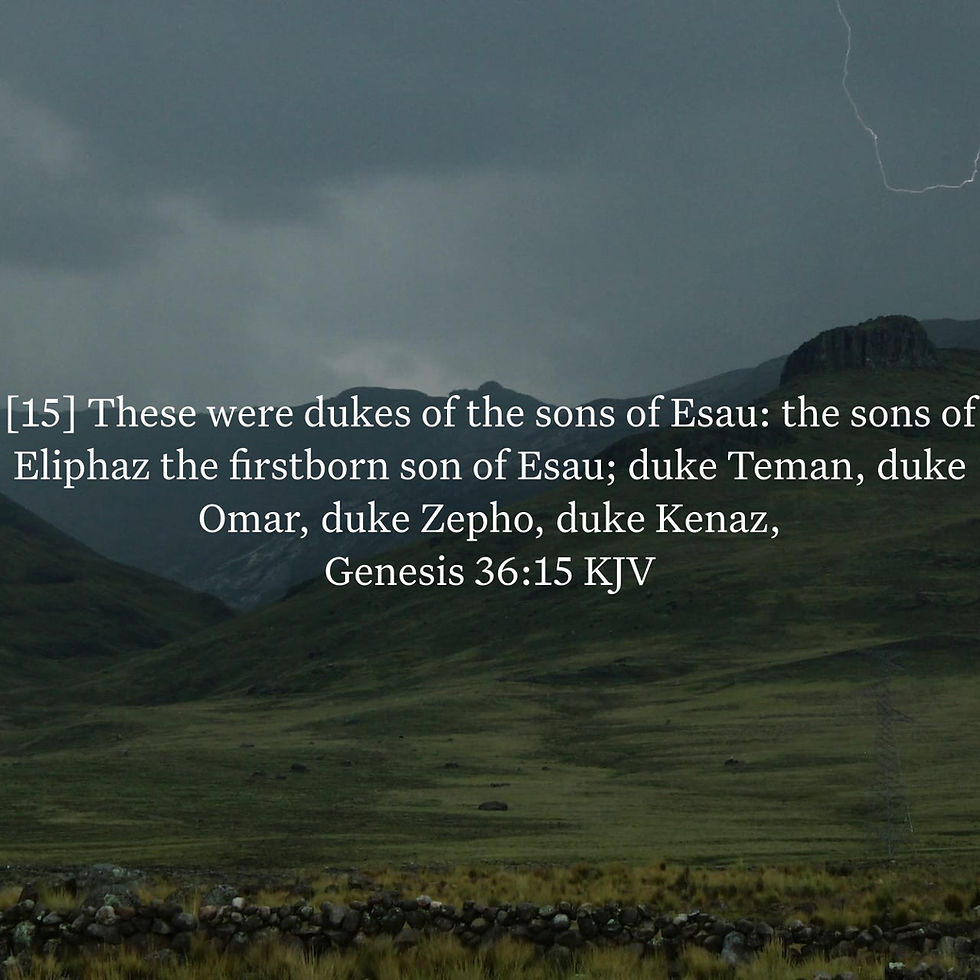
“These were dukes of the sons of Esau: the sons of Eliphaz the firstborn son of Esau; duke Teman, duke Omar, duke Zepho, duke Kenaz,”
Genesis 36:15 marks another important transition in the development of Esau’s descendants: “These were dukes of the sons of Esau: the sons of Eliphaz the firstborn son of Esau; duke Teman, duke Omar, duke Zepho, duke Kenaz.” Until this point, Genesis 36 has primarily been identifying marriages, sons, grandsons, and family relationships. Now the language changes. The descendants are no longer being presented merely as members of Esau’s household. Certain men are identified as “dukes,” showing that the family has begun developing recognizable structures of leadership. Esau has become Edom, his sons have produced families, and those families are now becoming clans with leaders of their own. The nation God had told Rebekah would come from Esau is becoming increasingly organized before our eyes.
The word “duke” can sound unusual to modern readers because today we normally associate a duke with European nobility, castles, hereditary titles, and a formal aristocratic system. That is not what Genesis means here. The Hebrew word behind the KJV translation is connected with the idea of a clan leader, chief, or tribal head. These men should therefore be understood as recognized leaders among the families descending from Esau rather than as medieval-style nobles. The KJV’s “duke Teman,” “duke Omar,” “duke Zepho,” and “duke Kenaz” identifies men whose families had developed enough importance and organization that they could be recognized as distinct leadership groups within Edom.
This is a major development from the earlier portions of Esau’s story. When Esau first appeared in Genesis, he was simply one of two sons born to Isaac and Rebekah. Genesis 25:25 describes his birth, and Genesis 25:27 tells us that “Esau was a cunning hunter, a man of the field.” There was no Edom yet, no Mount Seir filled with Edomite clans, no chiefs, and no kings. There was only Esau. Yet God had already told Rebekah before his birth, “Two nations are in thy womb” in Genesis 25:23. Genesis 36:15 allows us to see just how much of that prophecy has now become visible. Esau has gone from being one child within Isaac’s household to becoming the patriarch of an increasingly organized people.
The progression has been gradual, but it is unmistakable. Esau married and had children. His children had children. His household increased in possessions and livestock until Genesis 36:7 said that the land could not support both him and Jacob together. Esau settled in Mount Seir. His descendants multiplied throughout the territory. Now individual branches of the family are being identified according to their leaders. The structure of a nation is beginning to emerge from what had once been a single household.
The verse particularly focuses upon the descendants of Eliphaz, whom Scripture again identifies as “the firstborn son of Esau.” Eliphaz was the son of Esau and Adah, as Genesis 36:10 established. His position as the firstborn helps explain why his descendants receive substantial attention within the genealogy. Through Eliphaz came Teman, Omar, Zepho, Gatam, Kenaz, and Amalek. Now several of these sons are identified as chiefs, demonstrating that the descendants of Eliphaz had developed into recognizable clans within the larger Edomite population.
The repeated identification of Eliphaz as Esau’s firstborn also reminds us of the enormous importance that firstborn status carried within the world of Genesis. The firstborn son normally occupied a position of prominence within the family and was associated with inheritance, leadership, and family responsibility. That makes the wording particularly interesting in the family of Esau because Esau himself had been Isaac’s firstborn son. Genesis 25:25 records that Esau came out first, while Jacob followed holding his brother’s heel. Yet Esau famously sold his birthright to Jacob for food, and the larger covenant blessing ultimately passed through Jacob.
Now Esau’s own firstborn son is being identified as the ancestor of important Edomite chiefs. Eliphaz’s firstborn status matters within Esau’s family structure even though Esau himself did not become the bearer of the Abrahamic covenant. This once again demonstrates that ordinary patterns of family inheritance and God’s particular covenant purposes are not always identical. Esau could establish a prosperous household in which his firstborn son occupied an important position while God’s redemptive promise continued through Jacob.
This distinction runs throughout Genesis. Ishmael was Abraham’s firstborn son, but God said in Genesis 17:21, “But my covenant will I establish with Isaac.” Esau was Isaac’s firstborn son, but the covenant continued through Jacob. Human expectations based upon birth order repeatedly give way to God’s sovereign choice concerning the line through which His redemptive purposes will continue. The biblical story eventually follows that line through Jacob and then through Judah, even though Judah himself was not Jacob’s firstborn son.
God is therefore not constrained by human customs concerning who appears naturally entitled to a particular role. He may work through the younger rather than the elder, through the unlikely rather than the obvious, and through someone whom human convention would not have placed first. This does not mean birth order was meaningless within ancient families. Genesis clearly shows that it mattered enormously. Rather, it means God’s purposes remain sovereign over human expectations.
Eliphaz’s descendants nevertheless prospered. Teman, Omar, Zepho, and Kenaz are now called chiefs. Their names have already appeared in Genesis 36:11, where they were simply identified as sons of Eliphaz. Only a few verses later their status within Edom is emphasized. What began as a list of children has become a list of leaders.
This helps us understand how rapidly the Edomite family was developing. A family does not remain one undifferentiated household forever as it multiplies. Sons establish households of their own. Those households produce children and grandchildren. Different branches become associated with different locations or clans. Leadership structures emerge because large populations require organization. Genesis 36 is showing this transition without pausing to narrate every intermediate step.
A modern comparison would be watching a single family-owned operation grow into something far larger than the founder ever managed personally. At the beginning, one man might supervise everything himself. As children and grandchildren become involved, however, separate divisions develop. One descendant oversees one region, another oversees another group, and each branch eventually acquires its own structure and leadership. The original family connection remains, but the organization has become too large for everyone to function as one household. Something similar is occurring with Esau’s descendants. Esau remains the common patriarch, but Edom now consists of developing clans under recognized chiefs.
Teman is particularly noteworthy because his name becomes one of the most enduring names associated with Edom. In Genesis 36:11 he appeared simply as one of Eliphaz’s sons. Now he is “duke Teman.” Later Scripture uses Teman not merely for an individual but for a region or people associated with Edom. Jeremiah 49:7 asks, “Is wisdom no more in Teman? is counsel perished from the prudent? is their wisdom vanished?” The name of one grandson of Esau eventually becomes associated with a place sufficiently significant that the prophets can use Teman as a representative part of Edom.
This illustrates one of the fascinating transitions contained within biblical genealogies. A name can begin with an individual and eventually identify an entire clan, territory, or people. We have already seen the largest example in Esau himself. Esau becomes Edom. Jacob becomes Israel. Now smaller branches of those nations undergo similar developments. Teman begins as a man and becomes associated with a clan and region within Edom.
Omar is likewise identified as a chief. Scripture tells us very little about him personally. Genesis does not preserve stories about his leadership, his decisions, his personality, or the events of his life. Yet his identification as a chief tells us that the family branch connected with him possessed recognized importance within Edom. The absence of a detailed biography should not cause us to assume that his life lacked consequence. Much of ancient history consisted of people whose decisions shaped families and communities even though only their names survive in written records.
Zepho receives the same designation. He was introduced as another son of Eliphaz and is now recognized as a chief. Again, Scripture does not tell us exactly what his leadership looked like. We do not know how many people belonged to his clan, where every member lived, how authority was exercised, or what events marked his life. Genesis is interested primarily in preserving the structure of Esau’s descendants rather than giving biographies of every leader.
Kenaz also appears among these chiefs, and his name would continue to carry significance in the biblical world. As with several names in Genesis, however, we should not assume that every later occurrence of the same name refers to the same individual or even necessarily to the same family branch without evidence from the text. Ancient people reused names just as families do today. What matters here is that this Kenaz belongs to the line of Eliphaz and is recognized among the chiefs of Edom.
One name from Genesis 36:11 is noticeably absent from the portion of the list contained in this verse: Gatam. This does not mean Gatam was excluded from leadership entirely, because the following verse continues the list and identifies “duke Korah, duke Gatam, and duke Amalek.” Genesis 36:15 and 36:16 therefore belong together. Verse 15 begins the chiefs descending from Eliphaz, while verse 16 completes that group. The division between verses is useful for reading, but the genealogy itself is continuous.
This is worth remembering whenever we study individual verses closely. Verse divisions were not part of the original Hebrew composition of Genesis. They are tremendously useful for locating and discussing Scripture, but sometimes a thought begins in one verse and continues immediately into another. Genesis 36:15 does not give the entire list of Eliphaz’s chiefs; it begins the list, and the next verse completes it. Reading surrounding verses protects us from drawing conclusions based solely upon where a later verse number happens to appear.
The emergence of chiefs among Esau’s descendants also fulfills another dimension of the blessing Isaac pronounced over him. Although Jacob received the central covenant blessing, Esau was not left without a future. Genesis 27:39–40 records Isaac speaking concerning Esau’s dwelling and life. Whatever difficulties exist in interpreting every detail of that blessing, the later narrative clearly demonstrates that Esau did become the father of a substantial and powerful people.
Esau’s life therefore did not end in the despair of Genesis 27. That chapter records one of his darkest moments. After discovering that Jacob had received Isaac’s blessing, Esau “cried with a great and exceeding bitter cry” according to Genesis 27:34. He pleaded with his father, “Bless me, even me also, O my father.” His anguish eventually turned into hatred toward Jacob, and Genesis 27:41 records his intention to kill his brother.
If we stopped reading Esau’s story there, we might imagine the rest of his life as nothing but bitterness and loss. Genesis does not allow that conclusion. Esau eventually becomes wealthy. He develops a huge household. He reconciles with Jacob. He settles in Mount Seir. His sons and grandsons multiply. His descendants become chiefs. Eventually Edom will have kings.
This does not reverse God’s covenant choice of Jacob, but it does show that losing the covenant birthright did not mean Esau ceased to experience every form of earthly blessing. God’s providence was much broader than that.
This is important theologically because Scripture does not present God’s relationship with human beings in a simplistic equation where material prosperity automatically indicates covenant faithfulness or hardship automatically indicates divine rejection. Esau prospers considerably. Jacob, who carries the covenant promise, experiences decades of hardship. He is deceived by Laban, endures family conflict, loses Rachel, believes Joseph has died, and eventually moves into Egypt because of famine.
If outward circumstances alone revealed everything about God’s purposes, Esau’s line might sometimes appear to be doing better than Jacob’s.
Edom has territory.
Edom has chiefs.
Later Edom will have kings.
Israel has not yet become a nation at all.
Jacob’s sons are still one troubled family.
Soon Joseph will be sold into slavery.
Eventually the Israelites themselves will become slaves in Egypt.
Yet none of that means God’s covenant promise has failed.
God works according to a timeline much larger than what can be seen in one generation.
This is one of the great lessons of Genesis 36. Edom appears to establish recognizable political structures surprisingly early. Genesis 36:31 will even tell us that kings reigned in Edom “before there reigned any king over the children of Israel.” Edom will therefore possess kings while Israel is still far from establishing its monarchy.
Someone living during that period might easily conclude that Edom had advanced farther than Israel.
But divine promise cannot be measured merely by visible speed.
Some things develop quickly.
Other things develop slowly.
God’s purpose remains secure in either case.
Jacob’s family will endure generations of waiting before possessing Canaan as a nation. Abraham himself was promised the land but lived there as a stranger. Isaac lived there as a stranger. Jacob lived there as a stranger. Centuries would pass before Joshua led Israel into the land.
Edom, by comparison, appears to establish itself in Seir more immediately.
Yet the speed of Edom’s development does not alter the destiny of Israel.
There is a valuable spiritual principle here. We often compare our progress with what we can see happening around other people. Someone else appears established sooner. Their opportunities develop more quickly. Their plans come together while ours seem delayed. It is easy to interpret speed as proof of greater favor or delay as proof that something has gone wrong.
Scripture repeatedly shows that God does not work according to such simplistic comparisons.
Joseph spends years as a slave and prisoner before becoming ruler in Egypt.
David is anointed king long before he actually sits securely upon the throne.
Israel spends centuries waiting for promises made to Abraham.
The Messiah Himself comes after generations of expectation.
God is never late simply because His purposes take longer than human beings expect.
Genesis 36:15 also reminds us that leadership itself is not evidence of covenant righteousness. Teman, Omar, Zepho, and Kenaz are recognized chiefs. Their authority is real. Their clans are real. Their significance within Edom is real. Yet leadership does not automatically reveal a person’s spiritual relationship with God.
That distinction appears throughout Scripture. Pharaoh possesses enormous authority, but authority does not make him righteous. Nebuchadnezzar rules an empire, but his throne does not place him beyond God’s judgment. Saul is king of Israel, yet his title does not guarantee obedience. David is chosen by God, but even David’s kingship does not make every decision righteous.
Position and character are not the same thing.
A person can lead others while still desperately needing to submit to God.
That is especially worth recognizing here because the text shifts from genealogy to leadership. These men have moved from being sons within Eliphaz’s household to chiefs within Edom. With increased authority comes increased responsibility. Scripture repeatedly teaches that leadership creates accountability because the decisions of leaders affect more than themselves.
A poor decision by one ordinary individual may have limited reach. A poor decision by a clan chief, king, priest, or ruler can shape an entire community. The history of Israel will demonstrate this repeatedly. When kings lead toward idolatry, whole populations suffer. When leaders act unjustly, the vulnerable are harmed. When leaders fear God, their faithfulness can bless many others.
The Edomite chiefs would likewise exercise influence over families and clans. Genesis does not tell us enough to evaluate the personal leadership of each man named here, so we should not invent judgments Scripture does not make. But the transition from son to chief should cause us to recognize the growing responsibility carried by these descendants of Esau.
There is also a broader biblical pattern in which God recognizes the existence of governmental and social structures among nations beyond Israel. Edom has chiefs. Other nations have kings. Egypt has Pharaoh. Later Moab, Ammon, Philistia, Syria, Babylon, Persia, Greece, and Rome will all have rulers and systems of authority. The Bible never implies that God is sovereign only over Israel’s government while other rulers exist outside His authority.
Psalm 22:28 declares, “For the kingdom is the LORD'S: and he is the governor among the nations.” Daniel will later make this truth unmistakable when earthly empires rise and fall under the sovereignty of God. Romans 13 will speak of governing authority as existing under God’s ultimate ordering. Human governments differ dramatically in righteousness, structure, and behavior, but none exists beyond God’s sovereign rule.
The chiefs of Edom therefore possess genuine human authority, but they remain under divine authority.
That truth becomes especially important later because Edom’s position and strength will become sources of pride. The prophet Obadiah addresses Edom’s confidence in its mountainous strongholds, saying in Obadiah 3, “The pride of thine heart hath deceived thee, thou that dwellest in the clefts of the rock.” Edom would eventually look at its position and believe itself secure.
But political organization, strong leaders, and defensible territory could never make Edom independent of God.
The same danger exists wherever human beings experience success. Something begins as a blessing and gradually becomes a source of self-sufficiency. Wealth becomes confidence. Position becomes confidence. Intelligence becomes confidence. Military strength becomes confidence. Leadership becomes confidence. A person begins to act as though what has been received can sustain itself independently of the One who ultimately governs life.
Genesis 36 does not yet portray these particular chiefs in that way. The later history simply shows where Edom’s national pride can eventually lead. The chiefs introduced here belong near the beginning of a national development that will one day become strong enough to imagine itself secure against judgment.
There is therefore a subtle warning in watching any family or nation move from growth into power.
Growth itself is not evil.
Organization is not evil.
Leadership is not evil.
Prosperity is not evil.
But every increase creates a greater opportunity either for gratitude and responsible stewardship or for pride.
Esau’s family has now moved beyond survival. They possess abundance. They possess territory. They possess leaders. Soon they will possess kings.
The question confronting every generation is what they will do with what they have been given.
This was true of Israel as well. God would eventually give Israel the land of Canaan, cities they had not built, vineyards they had not planted, and houses filled with good things. Yet Deuteronomy repeatedly warned Israel not to forget the LORD when prosperity arrived. Deuteronomy 8:11 says, “Beware that thou forget not the LORD thy God.” The danger often becomes greatest not when people have nothing, but when they have enough to imagine they no longer need God.
Edom would face the same fundamental human temptation.
The verse also reminds us that Esau’s descendants developed leadership before Jacob’s descendants had anything comparable. Jacob had twelve sons, but they were not yet tribal chiefs governing an established nation. They were members of one household under their father. Their internal relationships were so troubled that they would soon conspire against Joseph.
The contrast is striking.
Esau’s descendants are organizing externally.
Jacob’s household is struggling internally.
Yet Jacob’s line remains the covenant line.
This again demonstrates how misleading appearances can be when viewed only in the short term.
Genesis 37 will soon begin, “And Jacob dwelt in the land wherein his father was a stranger, in the land of Canaan.” Jacob will still be a stranger in the promised land while Esau’s descendants are already chiefs in Seir.
What an extraordinary contrast.
The chosen covenant family looks unsettled.
The non-covenant branch looks established.
But God has not forgotten His word.
This pattern will repeat throughout redemptive history. Egypt will look powerful while Israel looks enslaved. Pharaoh will sit on a throne while Hebrew children are oppressed. Yet God will deliver Israel and bring Pharaoh’s army down in the sea. Goliath will look powerful while David looks insignificant, yet the outcome will reveal that appearances were incomplete. Babylon will appear victorious when Jerusalem falls, yet Babylon itself will eventually fall under God’s judgment.
The Bible continually trains us not to confuse present power with ultimate destiny.
Genesis 36:15 begins teaching that lesson quietly through genealogy.
Edom has chiefs.
Israel does not yet have kings.
But the story is nowhere near finished.
Another interesting feature of the verse is the connection between individual names and collective identities. “Duke Teman” likely represents more than Teman functioning as one isolated ruler. The title can indicate the chief associated with the clan descending from him. These chiefs therefore show how personal genealogies become tribal structures. A descendant’s name comes to identify the group connected with him.
That process is fundamental to the Old Testament world. The sons of Jacob eventually become tribes bearing their names: Reuben, Simeon, Levi, Judah, Dan, Naphtali, Gad, Asher, Issachar, Zebulun, Joseph through Ephraim and Manasseh, and Benjamin. The individual becomes the ancestral identity of a larger population.
Edom develops similarly.
Teman becomes more than Teman.
Kenaz becomes more than Kenaz.
Families become clans.
Personal names become collective identities.
This helps modern readers understand why biblical language can sometimes move fluidly between speaking of a person and speaking of the descendants associated with that person. “Israel” can mean Jacob personally, the descendants of Jacob, the nation, or even particular political entities depending upon context. “Edom” can mean Esau or the nation descending from him. Understanding genealogy allows us to recognize how those identities developed.
The verse therefore functions almost like a bridge between family history and political history.
At the beginning of Esau’s story, everything was personal.
Jacob deceived Esau personally.
Esau hated Jacob personally.
Jacob fled personally.
The brothers reconciled personally.
Now their descendants are moving beyond personal family relationships into national identities.
That change will have enormous consequences because conflicts that once involved two brothers will eventually involve armies.
The prophecy “two nations are in thy womb” is not merely being fulfilled biologically.
It is being fulfilled socially and politically.
There are now leaders.
There are clans.
There will soon be kings.
The transformation is becoming complete.
Yet Genesis takes care to preserve the family origins underneath the politics. Edom may later become a nation with chiefs and kings, but Genesis refuses to let the reader forget that Edom began with Esau.
Likewise Israel may later become a kingdom under David and Solomon, but Israel began with Jacob.
This matters because later conflicts between the two nations remain family conflicts at their deepest historical level.
Deuteronomy 23:7 commands Israel, “Thou shalt not abhor an Edomite; for he is thy brother.” Centuries after Jacob and Esau, the law still reaches backward to the relationship between the twins.
Edom may have chiefs.
Israel may have tribes.
National boundaries may develop.
Political disputes may arise.
But the ancient brotherhood remains morally significant.
That makes Edom’s later hostility toward Israel particularly tragic. Obadiah condemns Edom specifically for violence against “thy brother Jacob.” The political enemy is still a brother according to the history Genesis preserves.
Genesis 36 therefore provides more than background information. It establishes the theological and relational context needed to understand later biblical judgment.
If we skipped the genealogy and began reading Edom’s later history without it, we might see only two neighboring peoples in conflict.
Genesis tells us to look deeper.
These peoples came from twins.
Their history began in one womb.
That perspective gives enormous weight to the identification of Edomite chiefs. Teman, Omar, Zepho, and Kenaz are not merely administrators within some unrelated foreign nation. They belong to the developing household of Esau, Jacob’s brother.
The verse also demonstrates once again that God’s word can produce visible consequences far beyond the lifetime of the person who first receives it. Rebekah received the prophecy concerning two nations. She did not live to see every stage of its fulfillment. Isaac heard God’s covenant promises concerning his descendants. He died before Israel became a nation. Abraham received promises about nations and kings long before those political structures developed.
God’s promises frequently exceed one lifetime.
This requires faith that thinks generationally.
Abraham had to believe God while seeing only Isaac.
Isaac had to believe while seeing only Jacob and Esau.
Jacob had to believe while seeing his twelve sons.
Each generation saw a fragment.
God saw the whole.
Now Genesis 36 allows the reader to see connections the individuals themselves could not fully see.
The chiefs of Edom are evidence that God’s statement concerning Esau was becoming reality.
Later the twelve tribes will demonstrate the same regarding Jacob.
Still later kings will emerge.
Still later the promised Messiah will come.
The history of redemption advances through generation after generation, often without any single generation seeing the complete picture.
That has a practical implication for faithfulness today. Much of what matters most may not mature within our own lifetime. Parents plant truths whose fruit may appear in children years later. Faithful ministry may influence people long after the original work is forgotten. Decisions made quietly today can shape households and communities in ways we cannot predict.
Scripture encourages us to evaluate faithfulness by obedience rather than by whether we personally live long enough to see every outcome.
Abraham never saw Israel possess Canaan.
His obedience still mattered.
Moses never entered the promised land.
His leadership still mattered.
David never built the temple.
His preparations still mattered.
One generation often prepares what another generation receives.
The Edomite genealogy demonstrates this principle in a different context. Esau establishes the household. Eliphaz fathers the next generation. Teman, Omar, Zepho, and Kenaz become chiefs. Each generation moves the developing nation one stage farther.
There is also something humbling about the title “duke” appearing beside men about whom we know almost nothing. Human beings can possess significant status in their own generation and still become little more than a name to later generations. Teman’s name remained particularly prominent, but we know almost nothing about the daily leadership of Omar, Zepho, or Kenaz.
This reveals the temporary nature of human prominence.
A person may be powerful in one century and nearly forgotten in another.
A title that once commanded attention can become a line in a genealogy.
Leaders die.
Clans change.
Kingdoms rise and fall.
Names fade.
God remains.
Psalm 90:1 says, “Lord, thou hast been our dwelling place in all generations.” That statement provides the proper perspective for Genesis 36. Human generations continually change, but the God overseeing them does not.
Esau ages.
His sons become fathers.
His grandchildren become chiefs.
Eventually they too will die.
Another generation will follow.
But the word God spoke continues through all of them.
This is why human leadership must always be approached with humility. Whatever title a person carries is temporary. Chief, king, governor, pastor, employer, parent, teacher, or any other position of influence lasts only for a season. Authority is stewardship, not immortality.
The chiefs of Edom would eventually pass away.
Even Edom itself would not last forever.
But God’s kingdom does.
Daniel 2:44 later speaks of a kingdom God will establish that “shall never be destroyed.” Earthly kingdoms appear and disappear, while God’s sovereignty extends beyond every generation.
Genesis 36:15 therefore simultaneously recognizes human leadership and places it within a much larger divine story.
Teman is a chief.
Omar is a chief.
Zepho is a chief.
Kenaz is a chief.
But God is Lord over Edom.
God is Lord over Israel.
God is Lord over every chief and every king who will ever arise.
The increasing organization of Esau’s descendants does not move them beyond His authority. It simply shows another stage in the history He already foresaw.
There is one final contrast worth recognizing. Esau’s firstborn son Eliphaz produces chiefs, while Jacob’s family will eventually produce something far greater than political leadership. Through Jacob’s descendants will come Moses, the prophets, David, and ultimately Jesus Christ. That outcome is completely invisible if we look only at Genesis 36.
At this moment, Eliphaz’s descendants seem organized and established.
Jacob’s family seems troubled and unstable.
Yet God is working through generations nobody can fully see.
This is the danger of judging a story before God has finished writing it.
Genesis itself is only the beginning.
The chiefs of Edom are not the conclusion.
Egypt is not the conclusion.
The Exodus is not the conclusion.
Canaan is not the conclusion.
David is not the conclusion.
Even the exile is not the conclusion.
The covenant promises ultimately move toward Christ.
That is why the genealogy must be understood within the whole sweep of Scripture. Esau’s line is being established clearly before Genesis turns its attention back toward Jacob’s household. Scripture records Edom faithfully, but the redemptive storyline continues through Israel.
Genesis 36:15 therefore represents a significant milestone in the transformation of Esau’s family. Teman, Omar, Zepho, and Kenaz have moved from names within a household to recognized chiefs within Edom. The descendants of Eliphaz, Esau’s firstborn son, now possess identifiable leadership structures. What began with one hunter named Esau has become a prosperous family, then a collection of clans, and now an increasingly organized people.
The verse quietly demonstrates the faithfulness of God’s earlier word. Rebekah was told that two nations were within her. Decades later, one of those nations now has territory, families, clans, and chiefs. God saw all of this before Esau took his first breath.
At the same time, the verse warns us not to confuse visible establishment with covenant destiny. Edom’s chiefs are real, its prosperity is real, and its growing strength is real, but the particular promise given to Abraham continues through Jacob. God can allow one family to develop quickly while His deeper redemptive purpose unfolds slowly through another.
The appearance of these chiefs therefore reminds us both of God’s providence and of the limitations of human perspective. We see one generation at a time. God sees the whole story. We see sons becoming leaders. God sees nations rising and falling. We see Teman, Omar, Zepho, and Kenaz. God sees everything that will come afterward.
The household of Esau is becoming Edom exactly as the earlier chapters prepared us to expect. Another stage has been reached. The children have become clans, the clans have acquired chiefs, and the nation hidden in Rebekah’s womb generations earlier is now standing visibly in history. The process has been ordinary in its individual steps, but extraordinary in its fulfillment, because behind every generation stands the God whose word remains true long after the generation that first heard it has passed away.
If you would like to explore Genesis in a sustained, verse-by-verse way with space to reflect, journal, and trace how these foundational truths unfold through Scripture the Verse by Verse book expands these reflections into a unified reading experience. The book gathers these meditations into a structured journey through Genesis, designed to help readers linger in the text and engage God’s Word more deeply over time.

Comments