Genesis 27:12 Daily Devotional & Meaning – Jacob Fears the Curse

Daily Verses Everyday! Day 139
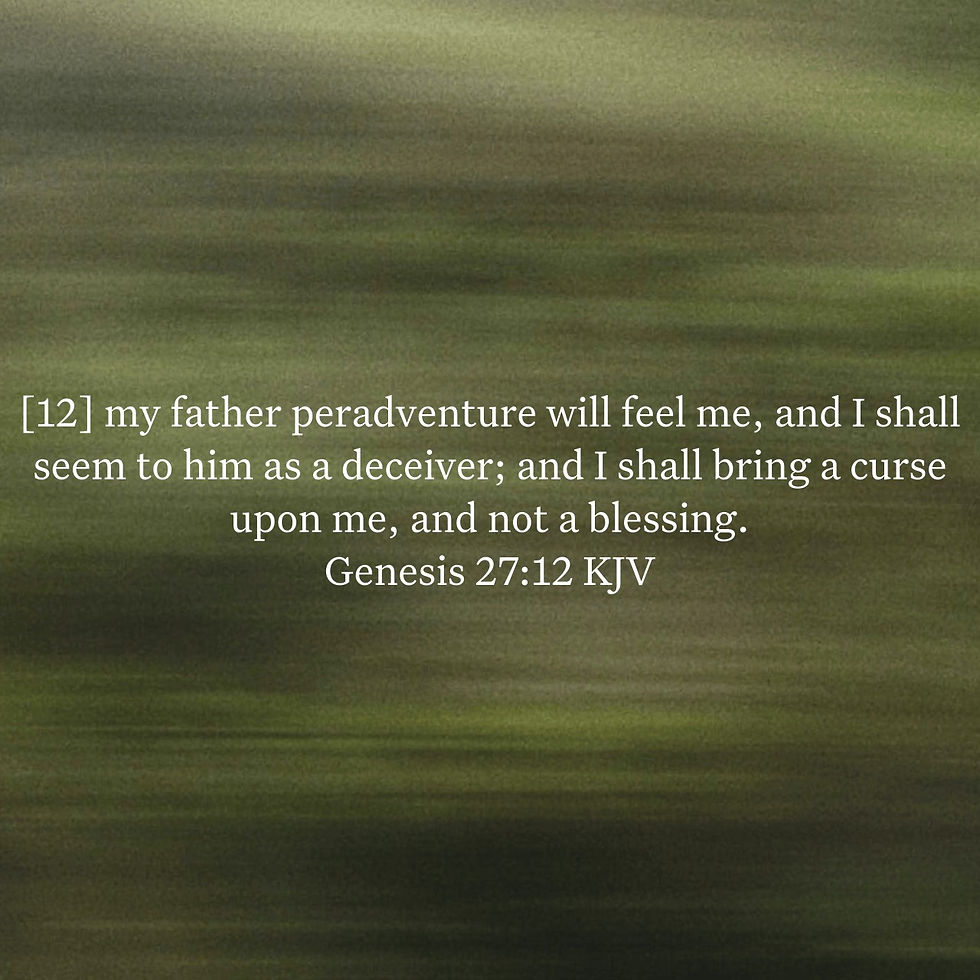
“My father peradventure will feel me, and I shall seem to him as a deceiver; and I shall bring a curse upon me, and not a blessing.”
This verse reveals Jacob’s fear as Rebekah’s plan becomes more serious. Rebekah has commanded him to bring two young goats from the flock so that she can prepare savory meat for Isaac. Her goal is clear: Jacob will bring the food to his father, pretend to be Esau, and receive the blessing before Isaac dies. But Jacob sees a problem. Esau is hairy, and Jacob is smooth. Isaac may be blind, but he is not without the ability to discern. Jacob knows that if his father reaches out and touches him, the deception may be exposed.
So Jacob says, “My father peradventure will feel me.”
The word “peradventure” means perhaps, maybe, or it might happen. Jacob is imagining the possibility that Isaac will not merely listen to him or eat the food, but physically touch him. This is a reasonable fear. Isaac already knows the difference between his sons. Esau is a man of the field. Jacob is a man dwelling in tents. Esau is hairy. Jacob is smooth. If Isaac feels Jacob’s arms or neck, he may realize that something is wrong.
But Jacob’s concern is revealing. He does not say, “My father may discover that I have sinned.” He says, “I shall seem to him as a deceiver.” Jacob is not first concerned that he will be a deceiver. He is concerned that he will seem to be one.
That difference matters.
Jacob’s fear is not mainly moral. It is practical. He is not troubled by the fact that the plan requires deception. He is troubled by the possibility that the deception will be discovered. He does not say, “This would dishonor God.” He says, in effect, “What if my father catches me?” His conscience is active, but not yet tender in the right way. It is awake enough to recognize danger, but not humble enough to reject sin.
This is one of the most searching lessons in the passage: it is possible to fear being exposed more than we fear doing wrong.
Jacob knows enough to understand that the plan is deceptive. He even uses the word “deceiver.” Yet his concern is how Isaac will perceive him. He says, “I shall seem to him as a deceiver.” But the truth is, if Jacob follows through with Rebekah’s plan, he will not merely seem to be a deceiver. He will be acting as one.
Sin often tries to separate appearance from reality. It asks, “How will this look?” before it asks, “What is this before God?” It worries about reputation more than righteousness. It fears being seen more than being guilty. It is concerned with what people may think if they find out, rather than with what God already knows.
This is a serious danger. A person can become more afraid of looking sinful than of being sinful. A person can be more afraid of losing respect than of grieving the Lord. A person can be more afraid of consequences than of corruption. When that happens, the conscience has become misdirected. It is not dead, but it is aiming at the wrong target.
Jacob fears Isaac’s touch. But he should have feared God’s sight.
Isaac’s hands might discover him. But God already sees him. Isaac might touch his skin and realize he is not Esau. But the Lord already knows Jacob’s heart. Isaac’s blindness creates an opportunity for deception, but God is not blind. Every part of this plan is open before Him. Rebekah’s whisper, Jacob’s hesitation, the goats from the flock, the prepared meal, the garments, the skins, the false words—all of it is seen by God.
That is something the human heart easily forgets. We can become very focused on what people can detect while forgetting what God already knows. We ask, “Will anyone notice?” “Will anyone find out?” “Will this hurt my reputation?” “Can I explain this away?” But the deeper question is always, “Is this right before the Lord?”
Jacob’s words show a conscience measuring risk, not righteousness.
He continues, “and I shall bring a curse upon me, and not a blessing.” This is the second part of his fear. Jacob wants the blessing, but he fears the curse. He understands that if Isaac discovers the deception, the result may be the opposite of what Rebekah intends. Instead of blessing him, Isaac may curse him. Instead of receiving favor, Jacob may receive judgment. Instead of securing the future, he may bring disaster upon himself.
Again, this is a reasonable practical concern. Jacob knows that the plan could backfire. If Isaac realizes he is being deceived, he may respond with anger and pronounce a curse. Jacob fears losing the very thing he is trying to gain. He wants blessing, but he does not want the risk attached to the deception.
This shows another common feature of sin: sin promises blessing but threatens curse.
Rebekah’s plan is designed to obtain blessing. But Jacob recognizes that the same plan could bring a curse. That is how sinful shortcuts work. They often hold out something desirable while hiding danger beneath the surface. They say, “You can get what you want quickly.” But they do not tell the whole truth. They do not show the guilt, the broken trust, the fear, the consequences, the spiritual damage, and the pain that may follow.
Jacob sees some of that danger. But he still does not respond rightly. He does not reject the plan because it is wrong. He only fears that it may fail.
That is why this verse is so convicting. Jacob is close to the truth, but not fully surrendered to it. He recognizes the deception, but not enough to repent. He recognizes the possibility of a curse, but not enough to trust God. He recognizes the danger of the plan, but not the deeper danger of sinning against the Lord.
This is a place many people know well. They feel uneasy about something. They know something is not right. They sense the warning signs. Their conscience speaks. But instead of stopping, they begin trying to manage the risk. They do not ask, “Should I do this?” They ask, “How can I do this without consequences?” That is exactly the wrong question.
An analogy may help.
Imagine a young man is told by his mother to sneak into his father’s office and sign his brother’s name on an important document. The mother says, “This is the only way to make sure you receive what should be yours.” The young man hesitates and says, “But Father knows my handwriting. If he checks the signature closely, he will know it was me, and then I will be in trouble.” Notice what he is not saying. He is not saying, “It is wrong to forge my brother’s name.” He is saying, “What if the forgery is discovered?” His concern is not the dishonesty itself, but the danger of being caught.
That is Jacob in this verse. His objection is not, “Mother, we cannot lie.” His objection is, “What if Father feels me? What if I seem like a deceiver? What if I receive a curse instead of a blessing?”
This is a warning to us. When our conscience raises a concern, we should listen carefully. Sometimes the first feeling of hesitation is a mercy from God. The Lord may use uneasiness, obstacles, risk, or fear to slow us down before we enter sin. Jacob’s concern could have become a turning point. He could have said, “This plan is deception. We should not do it.” But instead, he treats the danger as a problem to be solved.
Rebekah will soon offer a solution. She will tell him to let the curse fall upon her. She will then cover his hands and neck with goat skins. In other words, Jacob’s moral hesitation will be answered with practical adjustments. That is often how sin progresses. The conscience raises an alarm, and the flesh replies with strategy.
The conscience says, “This is dangerous.”
The flesh says, “Then hide it better.”
The conscience says, “This is dishonest.”
The flesh says, “Then make the story more convincing.”
The conscience says, “You may be exposed.”
The flesh says, “Then build a stronger disguise.”
But the right response is not to improve the disguise. The right response is to repent.
Jacob’s fear of the curse also reveals something important about the blessing. He knows the blessing is powerful. He knows words spoken by Isaac in this covenantal context carry weight. He believes a curse would matter. He is not treating this as a game. He knows the blessing and curse are serious realities.
Yet because he wants the blessing so badly, he is willing to enter dangerous territory. This is another warning: even good things can become temptations when we desire them apart from God’s way.
The blessing itself is not evil. Jacob’s desire for covenant blessing is not wrong in itself. God had already declared that the elder would serve the younger. Jacob was the chosen son through whom the covenant line would continue. But a promised blessing must still be received in faith, not stolen through deception. The problem is not that Jacob wants blessing. The problem is that he is willing to pursue blessing by lying.
That is a danger for believers in every generation. We may desire things that are good: marriage, family, ministry, provision, recognition, justice, opportunity, fruitfulness, stability, or peace. But if we pursue those things through sin, then our desire has become disordered. A good desire becomes dangerous when it becomes more important than obedience.
Jacob wants the blessing, but he should have wanted God more.
If he had wanted God more, he would have said, “The Lord has promised. I do not need to deceive.” If he had trusted God more, he would have said, “Even if Isaac intends to bless Esau, God is able to fulfill His word without my sin.” If he had feared God more than consequences, he would have said, “I would rather wait for God in truth than gain blessing through a lie.”
But Jacob is not there yet. His heart is still calculating.
This verse also reminds us how easily family dysfunction can shape moral compromise. Jacob calls Isaac “my father.” He calls Esau “my brother” in the previous verse. Rebekah is “his mother.” This is not a conflict among strangers. This is happening inside the covenant household. The people involved are father, mother, son, and brother. The deception is not happening in some faraway pagan court. It is happening in the family of promise.
That should humble us. Spiritual privilege does not automatically remove family sin. A household can know the promises of God and still be filled with favoritism, secrecy, manipulation, fear, and dishonesty. Isaac favors Esau. Rebekah favors Jacob. Esau despised his birthright. Jacob is willing to deceive. Each person contributes something to the brokenness of this chapter.
And yet God remains faithful.
This is one of the remarkable truths of Genesis. God’s covenant does not continue because the patriarchal family is morally flawless. It continues because God is faithful to His own promise. Abraham failed at times. Isaac failed. Rebekah failed. Jacob failed. Yet the Lord’s word did not fail. His faithfulness is not dependent on the perfection of His people.
But that should not make us careless about sin. God’s ability to work through human failure does not make failure good. God can redeem a broken situation, but the brokenness still hurts. Jacob will receive the blessing, but he will not receive it without consequences. Esau will hate him. Rebekah will send him away. Jacob will flee from home. He will later be deceived by Laban. The blessing will stand, but sorrow will surround it.
This is another important lesson: God’s sovereignty does not erase the earthly consequences of sinful choices.
A person may still belong to God and yet experience painful results from their sin. God may forgive, restore, and continue His work, but sin can still fracture trust, damage relationships, and create long seasons of grief. Jacob’s life will be marked by the mercy of God, but also by the painful harvest of deception.
Jacob says, “I shall bring a curse upon me, and not a blessing.” That phrase is also deeply theological. The fear of curse runs throughout Scripture. Blessing is life under God’s favor. Curse is the misery of being under judgment. In Genesis 3, the curse enters the world because of sin. The serpent is cursed. The ground is cursed. Humanity lives under the sorrow and death that come from rebellion. Later, in the law, blessing and curse will be set before Israel. Obedience is connected with blessing, and disobedience with curse.
Jacob fears a curse from Isaac. But the greater issue is that deception itself belongs to the world of the curse. Sin always carries death in it. It may look like the path to blessing, but it comes from the same unbelief that brought curse into the world.
This points us forward to Christ. Jacob fears bringing a curse upon himself instead of a blessing. But the gospel tells us that Jesus Christ willingly bore the curse so that His people might receive the blessing. Galatians 3:13 says, “Christ hath redeemed us from the curse of the law, being made a curse for us.” Jacob feared a curse he deserved if exposed. Christ bore a curse He did not deserve in order to redeem exposed sinners.
That contrast is beautiful.
Jacob tries to avoid the curse while walking into deception. Christ embraces the curse in perfect obedience.
Jacob seeks blessing by pretending to be the firstborn. Christ, the true Son, secures blessing by offering Himself.
Jacob fears being discovered by his father. Christ willingly stands exposed on the cross before heaven and earth.
Jacob covers himself to obtain blessing. Christ is stripped, crucified, and cursed so that believers may be clothed in righteousness.
This is the difference between human scheming and divine grace. Jacob’s way says, “I must disguise myself to get blessing.” The gospel says, “Christ bore the curse so that sinners may receive blessing honestly by faith.” God is not deceived into blessing us. He blesses us because Christ has truly dealt with our sin.
That means we do not have to live like Jacob in this moment. We do not have to hide behind costumes, false identities, religious performance, or carefully managed appearances. We can come into the light. We can confess our sin. We can admit where our fear of consequences has been stronger than our fear of God. We can receive mercy, not because we successfully deceived the Father, but because the Son truthfully and fully paid for sinners.
This verse therefore calls us to examine the kind of fear that governs us. Jacob fears Isaac’s touch. What do we fear?
Do we fear being found out more than being false?
Do we fear losing reputation more than losing integrity?
Do we fear consequences more than sin?
Do we fear man more than God?
Proverbs 29:25 says, “The fear of man bringeth a snare: but whoso putteth his trust in the Lord shall be safe.” Jacob is caught in the snare of fearing man. He is afraid of what Isaac may do if he is discovered. But true safety is found in trusting the Lord. If Jacob had trusted God, he would not have needed deception. If he had feared God rightly, he would not have feared Isaac’s discovery in the same way.
The fear of the Lord does not make a person reckless. It makes a person honest. It frees us from the need to manipulate. It teaches us that obedience is safer than sin, even when sin looks like the quickest way to blessing.
This verse also exposes the danger of partial conviction. Jacob knows something is wrong enough to fear being seen as a deceiver. But he does not let that conviction lead him all the way to obedience. He feels the warning, but he does not stop. Partial conviction can become dangerous when it only makes us more careful sinners rather than repentant ones.
A person may feel guilty, but instead of confessing, they hide better.
A person may know they are lying, but instead of telling the truth, they refine the lie.
A person may sense they are manipulating, but instead of stopping, they make the manipulation more subtle.
A person may fear consequences, but instead of repenting, they shift blame.
Jacob’s concern could have been the doorway to repentance. Instead, it becomes the doorway to a better disguise.
This is why we must respond quickly when the Lord pricks the conscience. When we sense the wrongness of a path, we should not debate with conviction until it becomes quiet. We should not ask others to help us make sin workable. We should not look for coverings that allow us to continue. We should stop and return to truth.
Jacob’s fear of being felt by Isaac is also symbolic. He does not want his true self to be recognized. He wants to appear as Esau, but he fears that contact will reveal reality. That is how deception works. It fears closeness. It fears examination. It fears being touched by truth. It can survive only if no one looks too closely.
But the Christian life is not meant to be lived under the fear of being discovered. God calls His people to walk in the light. 1 John 1:7 says, “But if we walk in the light, as he is in the light, we have fellowship one with another.” Light may feel frightening when we have been hiding, but light is where fellowship and cleansing are found. Darkness protects sin. Light heals.
Jacob is still trying to manage darkness. He is asking, “What if my father feels me?” But the better question would be, “How can I stand before God truthfully?”
This verse is sobering because Jacob’s fear is reasonable, but incomplete. He is right that the plan could bring a curse. He is right that Isaac may discover him. He is right that he may appear as a deceiver. But he has not yet reached the deepest truth: he should not deceive at all.
So Genesis 27:12 teaches us that the fear of consequences is not the same as repentance. It teaches us that recognizing danger is not the same as choosing righteousness. It teaches us that wanting blessing is not enough if we are willing to pursue it through sin. It teaches us that a troubled conscience must be brought fully under the authority of God.
The verse also reminds us of the mercy of God. Jacob is flawed here. He is fearful, calculating, and willing to be led into deception. Yet God’s covenant purpose will not be destroyed. The Lord will discipline Jacob, shape him, humble him, and eventually rename him Israel. The deceiver will become a man who wrestles with God. Grace will not leave him as he is.
That is hope for us. God does not save people because they have never schemed. He saves sinners. He saves deceivers. He saves those who have feared man more than God. He saves those who have wanted blessing but pursued it wrongly. He saves those who have hidden. But His grace brings them into the light and changes them.
Genesis 27:12 leaves Jacob at a crossroads. He sees the danger. He knows the risk. He fears the curse. But he has not yet refused the sin. The tragedy is that he will continue. The warning is that we must not do the same.
When God lets us see the danger of a sinful path, that is mercy. When our conscience trembles, that is mercy. When we fear what may come from dishonesty, that is mercy. But we must not stop at fear. We must move to repentance, trust, and obedience.
Jacob says, “My father peradventure will feel me.” But the greater truth is this: God already sees him.
Jacob says, “I shall seem to him as a deceiver.” But the greater danger is becoming one.
Jacob says, “I shall bring a curse upon me, and not a blessing.” But the greater lesson is that blessing must never be pursued through sin.
The way of faith is better. It says, “I will not lie for blessing. I will not hide for blessing. I will not pretend for blessing. I will trust the God who blesses. If He has promised, He can fulfill it in truth. And if I have sinned, I will come into the light, because the true Son has borne the curse and opened the way for sinners to receive the blessing of grace.”
That is the hope beneath this warning. Jacob feared a curse, but Christ bore the curse. Jacob sought blessing through deception, but Christ gives blessing through redemption. Jacob tried to cover himself, but Christ clothes His people in righteousness.
Therefore, we do not need Jacob’s disguise. We need Christ’s grace.
If you would like to explore Genesis in a sustained, verse-by-verse way with space to reflect, journal, and trace how these foundational truths unfold through Scripture the Verse by Verse book expands these reflections into a unified reading experience. The book gathers these meditations into a structured journey through Genesis, designed to help readers linger in the text and engage God’s Word more deeply over time.


Comments