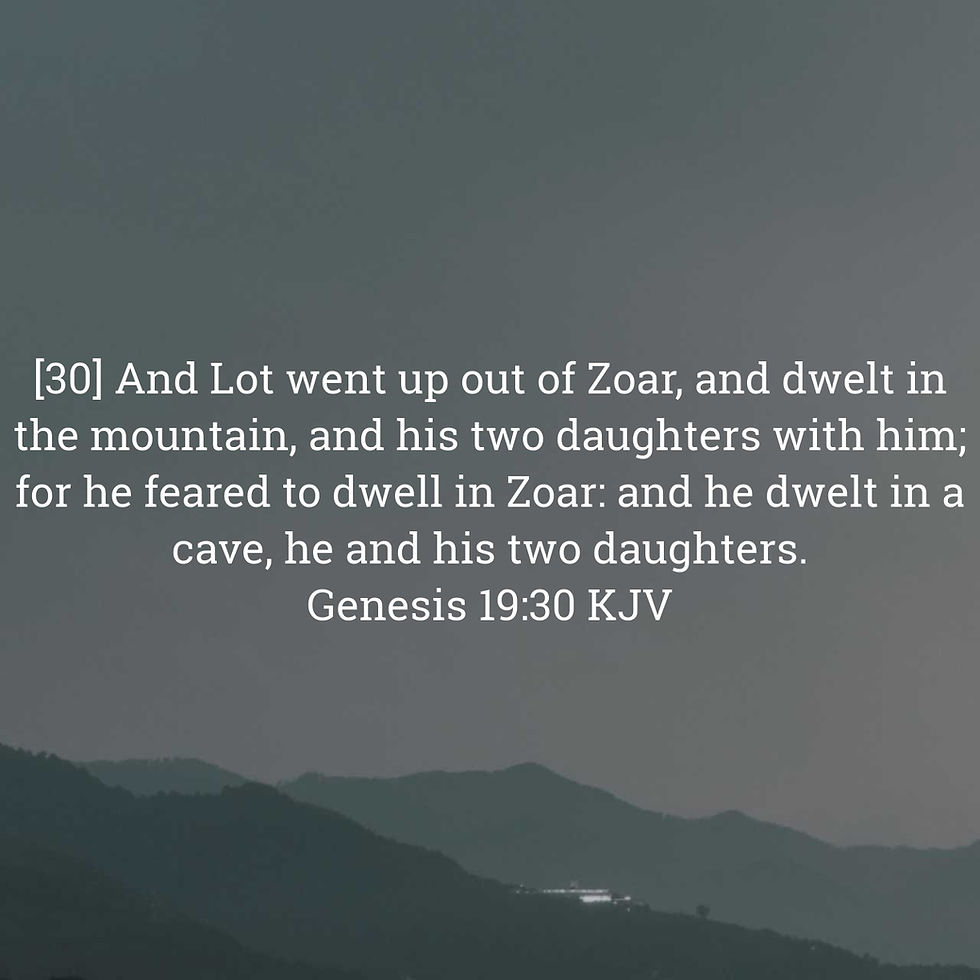
Genesis 19:30 Daily Devotional & Meaning – Lot in the Cave, the Cost of Compromise, and Fear After Sodom

Daily Verses Everyday! Day 81
“And it came to pass, when God destroyed the cities of the plain, that God remembered Abraham, and sent Lot out of the midst of the overthrow, when he overthrew the cities in the which Lot dwelt.”
This verse marks a tragic turning point in Lot’s life, a moment that shows the full collapse of a man who had once stood beside Abraham, prospered under God’s blessing, and lived with every opportunity to flourish spiritually. Now, after the destruction of Sodom and Gomorrah, we find him leaving the small city he pleaded to escape to, climbing into the mountains he originally rejected, and ultimately retreating into a cave with nothing left but fear and the company of his two daughters. What unfolds in this single sentence is the unraveling of a life shaped over time by compromise, proximity to sin, and the slow erosion of spiritual conviction.
Lot’s decision to leave Zoar because “he feared to dwell there” reveals the deep psychological and spiritual damage he had endured. He no longer moves by faith, nor by wisdom, nor even by common sense, but by fear. This is significant, because fear now governs the man who once had angels physically take him by the hand to drag him toward safety. When a person lives too long in compromise, fear eventually becomes the voice they listen to the most. Lot had become a man who could not trust, feel secure, or rest, even when God had granted him the very place he begged for.
This verse stands as a stark contrast to Abraham, who earlier in Genesis stood confidently before the Lord, interceding with boldness and clarity. Abraham walked in faith; Lot walks in fear. Abraham dwelt in the presence of God; Lot ends up dwelling in a cave. The difference between the two men is not that one was chosen and the other rejected. Both were blessed by God, but one cultivated a life of intimacy with God, while the other gradually allowed the world to shape his decisions. The tragedy of Lot’s life is not simply where he ends up physically but where he ends up spiritually.
When Lot enters the mountains, the very destination the angels commanded from the beginning, we see the sad result of resisting God’s direction. This is the painful irony: Lot eventually arrives in the mountain but only after destruction, trauma, fear, and loss. Had he obeyed immediately, he would have been spared much anguish. This pattern appears repeatedly in Scripture: what God commands is always for our safety, and resisting His command only delays the inevitable while amplifying the pain. Jonah eventually went to Nineveh. Israel eventually entered the Promised Land. And Lot eventually climbed the mountain. The path of disobedience only made the journey harder.
Lot’s new home, a cave, is symbolic of how sin and compromise shrink a person’s world. When he first appears in Genesis, Lot is a man of flocks, herds, tents, and great wealth. He chooses the well-watered plains of Jordan, a place “like the garden of the Lord.” He lives near Sodom, then in Sodom, then sits at the gate as a leader in Sodom. His life expands outward into prosperity and influence. But after years of living in a place that corrupted his mind, his judgment, and his family, his world grows smaller and smaller. From the plains to the city, from the city to a tiny refuge town, and from that town to a cave carved out of rock. Sin never enlarges life; it only compresses, shrinks, and suffocates it.
The cave represents isolation—physical, emotional, and spiritual. Lot’s wife is gone, turned to salt because she could not let go of Sodom. His sons-in-law died because they did not take God’s warning seriously. Lot’s other daughters did not escape. Now he is left only with the two daughters who survived and even they will soon show how deeply Sodom’s moral corruption had shaped their thinking. The cave becomes a haunting image of what happens when a person lives near sin for so long that they lose the ability to live anywhere else. The environment of wickedness had shaped Lot’s family more than Lot himself ever realized.
Yet, this verse is more than a historical detail; it is a warning wrapped in mercy. It warns us that where we choose to live spiritually matters. The environments we tolerate eventually shape our thinking. The places we dwell gradually mold our desires. Lot never intended for his life to end in a cave. He intended to prosper near Sodom, not become a refugee from it. He intended to raise a family in a thriving city, not hide in fear with daughters who no longer recognized moral boundaries. But one small compromise at a time took him further than he meant to go, kept him longer than he meant to stay, and cost him far more than he ever thought he’d pay.
At the same time, this verse also demonstrates God’s mercy. Lot is alive. His daughters are alive. God did not abandon him even when Lot made foolish decisions. God did not revoke His mercy even when Lot hesitated, bargained, and resisted. The angels did not leave him behind when he lingered. God showed him mercy because of Abraham, and that mercy is still evident in this moment. Lot may be living in a cave, but he is not in the flames of Sodom. This shows that God’s mercy does not depend on our perfection but on His faithfulness.
Still, the final picture is sobering: a man who once stood in the sunshine of blessing now huddles in darkness, driven by fear. The cave becomes a symbol of what fear and compromise produce, a life smaller, darker, and more isolated than God ever intended. If Abraham’s story is about rising to meet God in faith, Lot’s story warns us how far a believer can fall when they allow the world to dictate their decisions.
Genesis 19:30 invites us to examine our own spiritual surroundings. Are we dwelling in a place that strengthens our faith or erodes it? Are we walking in God’s direction or negotiating with it? Are we living in freedom or retreating into caves shaped by fear?
Lot’s life did not need to end this way. But his story teaches us that the path we choose, step by step, choice by choice, shapes our destiny as surely as the path Abraham took shaped his.
If you would like to explore Genesis in a sustained, verse-by-verse way with space to reflect, journal, and trace how these foundational truths unfold through Scripture the Verse by Verse book expands these reflections into a unified reading experience. The book gathers these meditations into a structured journey through Genesis, designed to help readers linger in the text and engage God’s Word more deeply over time.


Comments