Key Takeaways from Genesis Chapter 35 – Daily Devotional & Meaning

Genesis Chapter 35 follows Jacob as God calls him back to Bethel after the painful and sinful events surrounding Shechem. This is a chapter of return, repentance, worship, covenant renewal, grief, family failure, genealogy, and generational transition. Jacob had delayed in coming fully back to the place where God first appeared to him when he fled from Esau, but God graciously speaks again and says, “Arise, go up to Bethel, and dwell there.” The chapter begins with God calling Jacob back to the place of worship and remembrance.
Jacob responds by commanding his household to put away strange gods, be clean, and change their garments. This shows that returning to God requires more than movement of location. It requires repentance, cleansing, and the removal of idols. Jacob’s family surrenders their strange gods and earrings, and Jacob hides them under the oak by Shechem. After the darkness of Genesis 34, Genesis 35 begins with a necessary spiritual reset. God is calling Jacob’s household away from compromise and back to Himself.
When Jacob journeys to Bethel, God protects him by placing His terror upon the surrounding cities so they do not pursue him. Jacob then comes to Luz, which is Bethel, and builds an altar called Elbethel because God appeared to him there when he fled from Esau. Bethel becomes a place of full-circle remembrance. The God who met Jacob when he was alone and afraid has now brought him back with a household, children, servants, and the visible evidence that His promises were true.
At Bethel, God appears to Jacob again and blesses him. He reaffirms Jacob’s new name, Israel, and declares, “I am God Almighty.” God commands him to be fruitful and multiply and promises that a nation, a company of nations, and kings will come from him. He also renews the land promise given to Abraham and Isaac. This moment ties Jacob directly to the covenant line and reminds us that God’s promises are not broken by human delay, failure, fear, or family disorder. God remains faithful because He is faithful.
Yet Genesis 35 also teaches that spiritual renewal does not remove every sorrow from life. Soon after Jacob leaves Bethel, Rachel enters hard labour on the way to Ephrath, which is Bethlehem. She gives birth to Benjamin but dies in childbirth. Jacob buries Rachel and sets a pillar upon her grave. The chapter moves from the pillar of worship at Bethel to the pillar of grief beside Rachel’s grave. Both moments matter. God meets His people in worship, but He also remains God at the graveside.
The chapter then records Reuben’s sin with Bilhah, showing that Jacob’s family remains deeply broken even after Bethel. The twelve sons of Jacob are listed according to their mothers: Leah, Rachel, Bilhah, and Zilpah. These sons will become the tribal foundations of Israel, yet their beginnings are filled with rivalry, jealousy, sexual sin, favoritism, sorrow, and human disorder. Genesis 35 refuses to pretend that Israel began through perfect people. It shows that God’s covenant grace moves forward through deeply flawed families.
The chapter closes with Isaac’s death. Isaac lived 180 years, died full of days, was gathered unto his people, and was buried by Esau and Jacob. His death closes the earthly life of the promised son of Abraham and Sarah. Isaac’s life was quieter than Abraham’s and Jacob’s, but it was still essential. He carried the covenant from one generation to the next. Genesis 35 therefore ends by reminding us that God’s promises continue beyond any one person’s lifetime. Generations change, but God remains faithful.
Key Takeaways from Chapter 34
God Told Jacob to Arise and Go to Bethel – Genesis 35 begins with God calling Jacob back to the place where He first appeared to him when he fled from Esau.
God Calls His People Back After Failure – Jacob’s household had just come through the darkness of Shechem, yet God graciously called him back to worship.
Jacob Was Told to Dwell at Bethel – God did not merely call Jacob to visit Bethel, but to dwell there. The return was meant to become a renewed season of obedience.
Restoration Requires More Than a Moment – God was not calling Jacob to a brief emotional experience, but to a renewed life centered on worship.
Jacob Was Told to Make an Altar – The command to build an altar shows that worship was central to Jacob’s return.
The Right Response to God’s Mercy Is Worship – God had preserved Jacob in distress, and Jacob was now called to honor Him openly.
God Appeared to Jacob When He Fled from Esau – Bethel reminded Jacob of the mercy God showed him when he was afraid, alone, and fleeing from his brother.
God’s Past Faithfulness Strengthens Present Obedience – Jacob could return to Bethel because he remembered the God who had met him there before.
Jacob Commanded His Household to Put Away Strange Gods – Before worshiping at Bethel, Jacob addressed the idols within his own household.
True Worship Requires Repentance – Jacob could not lead his household to Bethel while allowing strange gods to remain among them.
Jacob Told Them to Be Clean – Cleansing symbolized preparation, separation, and renewed devotion before God.
God’s People Should Not Approach Worship Casually – Jacob’s household had to recognize that worshiping the Lord required seriousness, holiness, and surrender.
Jacob Told Them to Change Their Garments – The change of garments represented an outward sign of inward renewal.
A Changed Life Should Follow a Renewed Heart – Repentance is not merely something hidden inside; it should become visible in conduct and obedience.
Jacob Remembered the God Who Answered Him in Distress – Jacob said he would build an altar to the God who answered him in the day of his distress.
Answered Prayers Should Not Be Forgotten – The God who answered us in former trouble deserves praise in present obedience.
God Was with Jacob in the Way He Went – Jacob recognized that God had not only helped him in one crisis, but had accompanied him along the whole road.
God’s Faithfulness Is Often Seen in the Whole Journey – Many mercies are only recognized when we look back and see that God was with us all along.
Jacob’s Household Gave Him Their Strange Gods – The people surrendered the idols that had no place in a household returning to Bethel.
Repentance Requires Letting Go – We cannot cling to idols and claim to be returning fully to God.
They Gave Jacob Their Earrings – The earrings may have been connected with idolatrous practices or worldly attachments, and they too were surrendered.
Even Beautiful Things Must Be Surrendered If They Compete with God – Anything that strengthens idolatry must be yielded to the Lord.
Jacob Hid Them Under the Oak by Shechem – Jacob buried the strange gods rather than carrying them to Bethel.
The Road to Worship Requires Leaving Idols Behind – We cannot bring our old gods into renewed obedience and expect true worship.
Jacob’s Family Journeyed – After repentance came movement. Jacob’s household did not remain in Shechem.
Obedience Must Move Forward – It is not enough to know what God has said; we must walk in the direction He commands.
The Terror of God Was upon the Cities – God restrained the surrounding cities so they did not pursue Jacob’s family.
God Can Protect His People from Unseen Dangers – Jacob’s household was vulnerable, but God controlled the fear of their enemies.
The Cities Did Not Pursue Jacob – God’s protection allowed Jacob to reach the place of obedience.
When God Calls, He Can Also Guard the Road – The God who commands the journey is able to preserve His people along the way.
Jacob Came to Luz, Which Is Bethel – Jacob finally arrived at the place God had commanded him to go.
God Is Faithful to Bring His People Back – The same place where Jacob once received a promise now becomes the place where he sees God’s faithfulness fulfilled.
Jacob Came with All the People That Were with Him – Jacob did not return alone; he brought his household with him.
Spiritual Leadership Includes Leading Others toward God – Jacob’s obedience affected everyone under his care.
Jacob Built an Altar – Jacob worshiped God at Bethel as he had been commanded.
Obedience and Worship Belong Together – Jacob did not merely arrive at Bethel; he honored God there.
Jacob Called the Place Elbethel – He called it Elbethel because God had appeared to him there.
The House of God Matters Because of the God of the House – Bethel was meaningful only because God had revealed Himself there.
God Appeared When Jacob Fled from Esau – Jacob’s worship was rooted in remembrance of God’s mercy during fear and danger.
God Meets His People in Their Distress – Jacob had fled from Esau, but God had met him when he was most vulnerable.
Deborah, Rebekah’s Nurse, Died – Genesis 35 records the death of a faithful servant from the previous generation.
Quiet Faithfulness Matters to God – Deborah was not a central figure like Abraham, Isaac, or Jacob, but Scripture still remembers her death.
Deborah Was Buried beneath Bethel – Her burial near Bethel connects grief with a place of worship.
Obedience Does Not Remove Grief – Jacob had returned to Bethel, but sorrow still entered the story.
The Oak Was Called Allonbachuth – The name means the oak of weeping.
The Bible Gives Space for Mourning – Faith does not require pretending that loss is painless.
God Appeared unto Jacob Again – After Jacob came out of Padanaram, God appeared to him again and blessed him.
Every “Again” from God Is Grace – God’s repeated faithfulness shows that He does not abandon His people after long and complicated journeys.
God Blessed Jacob – The blessing confirmed that God’s covenant purpose still rested upon him.
God’s Blessing Is Greater Than Jacob’s Failures – Jacob’s life was filled with weakness, but God remained faithful.
God Reaffirmed Jacob’s Name as Israel – God again declared that Jacob’s name would be Israel.
God’s Calling Is Greater Than Our Past – Jacob’s old name carried the memory of grasping and struggle, but God reaffirmed his new identity.
Identity Must Be Received from God – Jacob’s deepest identity was not defined by accusation, failure, or family history, but by God’s word.
God Said, “I Am God Almighty” – The Lord revealed Himself to Jacob as El Shaddai.
God’s Power Stands Behind His Promises – The covenant did not rest upon Jacob’s strength, but upon God Almighty.
God Commanded Jacob to Be Fruitful and Multiply – The language connects Jacob to creation, Noah, Abraham, and the continuing covenant line.
God’s Purposes Move through Generations – Jacob’s family would become a nation because God had ordained it.
A Nation and a Company of Nations Would Come from Jacob – God promised a future far larger than Jacob could presently see.
God Sees Generations Hidden inside One Household – Jacob saw sons, but God saw tribes, territories, kings, and history.
Kings Would Come from Jacob – God promised royal descendants from Israel.
The Covenant Was Moving toward Kingship – This promise points forward to David and ultimately to Jesus Christ, the King of kings.
God Reaffirmed the Land Promise – The land given to Abraham and Isaac was now promised again to Jacob and his seed.
God Keeps Promises across Generations – What God spoke to Abraham did not die with Abraham, and what He gave to Isaac continued through Jacob.
God Went Up from Jacob – After speaking with Jacob, God departed from the visible manifestation.
God’s Visible Encounters May Pass, but His Word Remains – Jacob could no longer see God visibly, but the promises still stood.
Jacob Set Up a Pillar Where God Talked with Him – Jacob marked the place of divine speech and covenant renewal.
Memorials Help Us Remember God’s Faithfulness – Jacob did not want to forget where God had met him.
Jacob Poured a Drink Offering upon the Pillar – His worship involved pouring something out before God.
True Worship Costs Something – Jacob’s offering reminds us that devotion involves surrender.
Jacob Poured Oil upon the Pillar – The oil marked consecration and dedication to God.
What God Touches Should Be Set Apart for Him – Jacob recognized that this place belonged to the memory of God’s faithfulness.
Jacob Called the Place Bethel – He reaffirmed the name meaning house of God.
Bethel Was Meaningful Because God Spoke There – Sacred places matter only because of the God who reveals Himself.
Bethel Points Forward to Christ – Jesus is the true meeting place between heaven and earth.
Access to God Is Found in Christ – We do not come to God through a place, but through the Son.
Jacob Journeyed from Bethel – Jacob could not remain forever at the place of spiritual renewal.
Faith Must Continue after the Worship Moment – God gives moments of revelation, then calls His people to keep walking.
Rachel Travailed near Ephrath – Soon after Bethel, Rachel entered hard labour.
The Road from Worship Can Still Lead through Suffering – Spiritual renewal does not exempt believers from pain.
Rachel Had Hard Labour – Scripture honestly records the severity of her suffering.
The Bible Does Not Romanticize Pain – Faith allows us to tell the truth about hardship.
The Midwife Said, “Fear Not” – Rachel received encouragement in the middle of hard labour.
God Often Sends Comfort inside the Trial, Not Merely before It – The words of reassurance came while Rachel was still suffering.
Rachel Was Told She Would Have This Son Also – The second son she had desired was being born.
Answered Prayer May Come through Painful Circumstances – Benjamin’s birth fulfilled Rachel’s longing, but it came through sorrow.
Rachel’s Soul Was Departing – Scripture describes her death with solemn honesty.
Death Is Real in the Fallen World – Genesis continues to show the consequences of life east of Eden.
Rachel Called His Name Benoni – She named the child from inside her sorrow.
Pain Can Try to Name the Future – Rachel’s grief shaped the name she gave her son.
Jacob Called Him Benjamin – Jacob refused to let sorrow become his son’s permanent identity.
Sorrow Does Not Get the Final Word – Benjamin’s name points beyond grief toward honor and strength.
Rachel Died – The woman Jacob loved deeply came to the end of her earthly life.
God’s Promises Do Not Prevent His People from Facing Death – The covenant continued, but Rachel still died.
Rachel Was Buried on the Way to Ephrath, Which Is Bethlehem – Her grave stood near a place that would later become central to redemption.
God Sees Bethlehem Where We See a Grave – Jacob saw loss, but God saw the region where Christ would one day be born.
Rachel’s Death Connects to Later Biblical Mourning – Jeremiah and Matthew use Rachel as a picture of Israel’s grief.
There Is Hope in the End – Rachel’s sorrow points us toward the hope found ultimately in Jesus Christ.
Jacob Set a Pillar upon Rachel’s Grave – Jacob marked the place where Rachel was buried.
Love Remembers – Jacob’s memorial shows that grief and remembrance have a proper place.
The Pillar of Rachel’s Grave Remained unto That Day – Rachel’s burial place remained part of Israel’s memory.
Faith Does Not Require Forgetting the Dead – Biblical hope allows honest remembrance.
Israel Journeyed Beyond the Tower of Edar – After Rachel’s death, Jacob continued moving forward.
Moving Forward Does Not Mean Forgetting – Jacob could continue the journey while still carrying Rachel’s memory.
God Still Leads after the Graveside – The death of Rachel did not end Jacob’s responsibility or God’s purpose.
Reuben Lay with Bilhah – Jacob’s firstborn committed a serious sexual sin with his father’s concubine.
Privilege Cannot Replace Holiness – Reuben was Jacob’s firstborn, but his position did not excuse his sin.
Israel Heard It – Jacob knew what Reuben had done.
Delayed Consequences Are Not the Same as No Consequences – Reuben’s sin would later cost him the birthright.
Reuben Lost What He Might Have Had – Genesis 49 and First Chronicles show that his birthright passed elsewhere.
Sin Can Damage Future Opportunity – Forgiveness is real, but earthly consequences can remain.
The Sons of Jacob Were Twelve – With Benjamin born, the twelve sons of Jacob are complete.
Israel Begins with Sinners, Not Perfect Men – The tribes come from deeply flawed people, proving the need for grace.
The Sons of Leah Were Listed First – Leah’s sons were Reuben, Simeon, Levi, Judah, Issachar, and Zebulun.
God Saw the Overlooked Wife – Leah may not have been loved as Rachel was, but God gave her a central place in the covenant story.
Reuben Was Jacob’s Firstborn – His title is preserved, even though he forfeited the privileges of the birthright.
Being First Does Not Guarantee Faithfulness – Reuben’s life warns that position must be joined with character.
Simeon and Levi Were Sons of Leah – Both were connected with violence at Shechem.
Anger Can Damage Generations – Jacob later condemned their fierce and cruel wrath.
Levi Would Later Be Redeemed into Service – The tribe once associated with scattering became scattered in priestly service to God.
God Can Transform a Legacy – Levi’s future shows that consequences can be real while grace still works.
Judah Came from Leah – Judah would become the royal tribe.
God Brought the Messiah through the Overlooked Wife – From Leah’s son Judah came David and ultimately Jesus Christ.
Issachar Came from Leah – Issachar would later be associated with strength and understanding of the times.
God Sees Future Wisdom inside Present Weakness – Leah could not see what Issachar’s descendants would become.
Zebulun Came from Leah – Zebulun would later be connected with territory where Christ’s Galilean ministry shone light.
God Weaves Ordinary Names into Redemption History – A name in a genealogy can carry centuries of future significance.
The Sons of Rachel Were Joseph and Benjamin – Rachel had only two sons, but both became deeply significant.
God Is Not Limited by Small Numbers – Rachel’s two sons carried enormous purpose in Israel’s story.
Joseph Would Preserve Life in Egypt – Rachel’s first son became the instrument through whom God saved Jacob’s household during famine.
God Can Turn Evil for Good – Joseph’s story would later reveal providence through betrayal, slavery, and exaltation.
Benjamin Was Born through Sorrow – Rachel died giving birth to him, but his future was not defined only by grief.
God Can Bring Purpose from Painful Beginnings – Benjamin became the father of a tribe woven deeply into Israel’s history.
The Sons of Bilhah Were Dan and Naphtali – Bilhah’s sons were fully included among the sons of Jacob.
God Is Not Limited by Social Status – A handmaid’s sons became tribal patriarchs in Israel.
Dan’s Name Was Connected with Judgment – Rachel saw Dan’s birth as God hearing and judging her case.
A Meaningful Beginning Must Be Guarded by Faithfulness – Dan’s later association with idolatry warns that heritage must be personally maintained.
Naphtali’s Name Was Connected with Wrestling – Rachel named him from the struggle with her sister.
God Can Bring Blessing from Struggle – Naphtali’s later inheritance would be connected with favor, courage, and the region of Christ’s ministry.
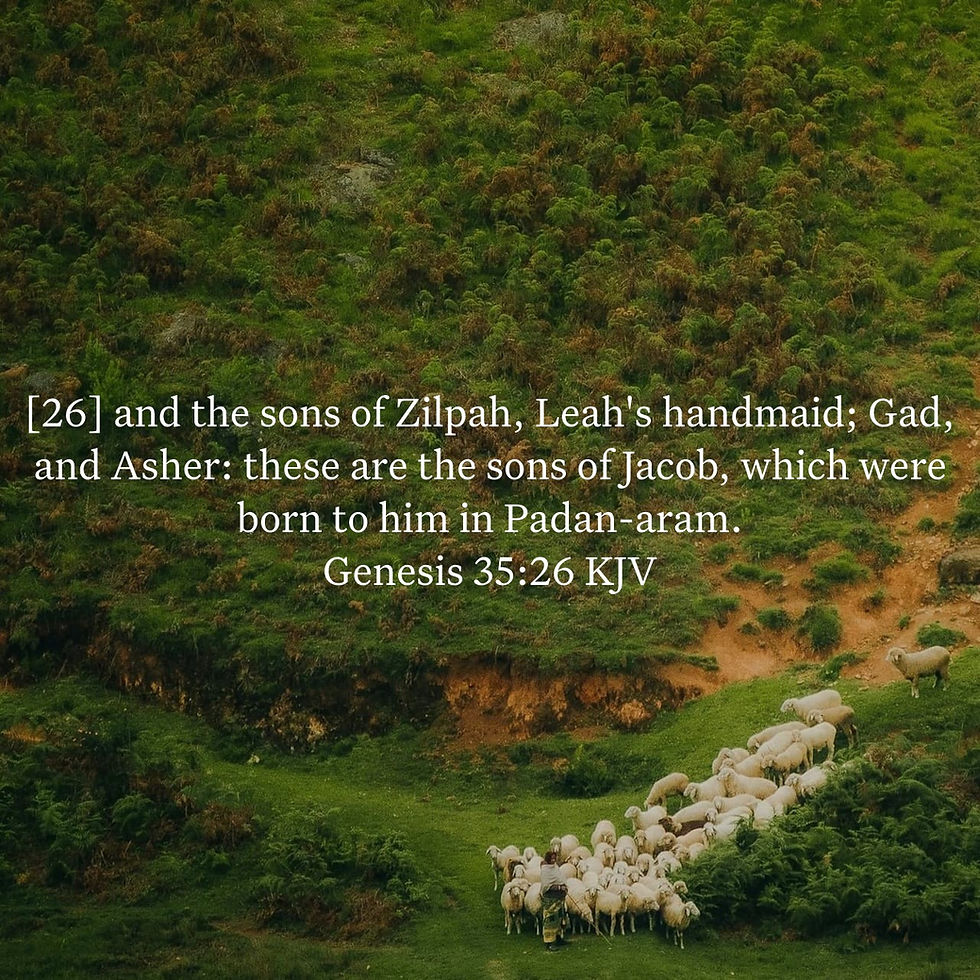
The Sons of Zilpah Were Gad and Asher – Zilpah’s sons also became full tribal fathers in Israel.
God Works through Imperfect Family Circumstances – Gad and Asher were born in rivalry, yet God incorporated them into His covenant purpose.
Gad Would Become Associated with Strength – Jacob later said Gad would be overcome but would overcome at the last.
Temporary Defeat Is Not Final Defeat – Gad’s blessing reminds believers that final victory belongs to God.
Asher Would Be Associated with Blessing – Leah named him in connection with happiness, and Moses later blessed Asher richly.
God Can Bring Joy from Overlooked Places – Asher’s line later included Anna, who saw the infant Christ in the temple.
The Sons Were Born to Jacob in Padanaram – The family that became Israel was formed during Jacob’s long season away from Canaan.
God Builds during Exile Seasons – Jacob left Canaan alone, but God brought him back with the beginnings of a nation.
Jacob Came unto Isaac His Father at Mamre – Jacob returned to the region associated with Abraham and Isaac.
God’s Promises Continue across Generations – Jacob’s return connects Abraham, Isaac, and Israel within one covenant story.
Mamre Was in Hebron – Hebron carried deep patriarchal significance.
Places Can Carry Layers of Covenant Memory – Hebron was tied to Abraham, Sarah, Isaac, Rebekah, Jacob, Leah, and later David.
Isaac Lived 180 Years – Isaac was the longest-lived of Abraham, Isaac, and Jacob.
Even Long Lives Are Brief before Eternity – Isaac’s 180 years are summarized in a single verse.
Isaac’s Life Was Quieter but Significant – His story may seem less dramatic, but he carried the covenant forward.
Faithfulness Does Not Have to Be Dramatic to Matter – Isaac’s life reminds us that quiet obedience can be deeply important before God.
Isaac Gave Up the Ghost and Died – The promised son eventually came to the end of his earthly life.
The Covenant Does Not Make People Immortal – Isaac died, but God’s promise continued.
Isaac Was Gathered unto His People – His death is described with covenant dignity and hope.
Death Does Not Erase Belonging – Isaac belonged to the people of God even in death.
Isaac Was Old and Full of Days – His life reached its appointed fullness.
God Appoints the Span of Every Life – Isaac’s days were not random; they were numbered by the Lord.
Esau and Jacob Buried Isaac – The two sons who had once been divided came together to bury their father.
Death Can Bring Estranged People to the Same Grave – Esau and Jacob stand together at Isaac’s burial after years of conflict.
Chapter 32 Devotionals
Conclusion
Genesis Chapter 35 teaches that God is faithful to restore His people, renew His promises, and lead them forward even through grief, sin, and death. The chapter begins with God calling Jacob back to Bethel, the place where He first appeared to him when Jacob fled from Esau. After the tragedy and turmoil of Shechem, God does not abandon Jacob. He calls him to arise, return, dwell, and build an altar. This shows the mercy of God toward His people. Failure does not have to be final when God calls us back to worship.
Jacob’s response shows what renewal should look like. He commands his household to put away strange gods, be clean, and change their garments. Before the family goes to Bethel, the idols must be removed. Genesis 35 reminds us that spiritual restoration is not merely emotional. It requires repentance. It requires surrender. It requires leaving behind what dishonors God. Jacob’s household could not carry strange gods into renewed worship and pretend nothing needed to change.
The journey to Bethel also shows the protection of God. Jacob’s family was vulnerable because of what Simeon and Levi had done in Shechem, but the terror of God fell upon the surrounding cities so they did not pursue them. God guarded the road of obedience. This does not mean obedience is always easy, but it does mean that God is able to protect His people from dangers they cannot control. The God who calls Jacob to Bethel is also able to bring him there.
At Bethel, Jacob builds an altar and calls the place Elbethel. This name matters because Jacob is no longer focused merely on the place called Bethel, the house of God. He is focused on the God of Bethel. The house matters because of the One who dwells there. The place matters because God spoke there. This is an important lesson for every believer. Sacred memories, churches, traditions, ministries, and spiritual landmarks are valuable only when they direct us back to God Himself.
God then appears to Jacob again and blesses him. The word “again” is full of grace. Jacob has not lived perfectly since his first Bethel encounter, but God remains faithful. God reaffirms his name as Israel, declares Himself to be God Almighty, and renews the promises of fruitfulness, nations, kings, and land. The covenant first given to Abraham and Isaac is personally reaffirmed to Jacob. God’s promises continue across generations because they rest upon His character, not human perfection.
Yet Genesis 35 also refuses to give us a shallow view of the life of faith. After Bethel comes suffering. Rachel enters hard labour on the way to Ephrath, which is Bethlehem. The woman Jacob loved deeply dies giving birth to Benjamin. This shows that spiritual obedience does not exempt believers from grief. Jacob had just worshiped at Bethel. God had just appeared to him. The covenant had just been renewed. Yet Rachel still died. God’s promises remain true even when the road ahead includes sorrow.
Rachel’s death is one of the most heartbreaking moments in Jacob’s life. She had longed for children, received Joseph, prayed for another son, and then died as Benjamin was born. She called him Benoni, son of my sorrow, but Jacob called him Benjamin, son of the right hand. This moment teaches that pain is real, but pain does not have to become the final identity of those who survive it. Rachel named the moment. Jacob named the future.
Jacob then buries Rachel on the way to Ephrath, which is Bethlehem, and sets a pillar upon her grave. The chapter gives us two pillars: one at Bethel where God spoke, and one at Rachel’s grave where Jacob mourned. One marks worship, and one marks grief. Both belong in the life of faith. The Bible does not ask believers to forget those they have lost. Faith does not make grief unreal. Instead, faith gives grief hope. Rachel’s grave near Bethlehem points forward to the place where Jesus Christ would be born, the Savior who would ultimately conquer death.
Genesis 35 then records another painful family failure. Reuben, Jacob’s firstborn, lies with Bilhah, his father’s concubine, and Israel hears it. Reuben had the position of the firstborn, but position could not replace holiness. His sin would later cost him the birthright. This is one of the sobering warnings of the chapter. God’s grace is real, but sin still has consequences. A person can have privilege, heritage, opportunity, and position, yet still lose much through lack of character.
The listing of Jacob’s twelve sons reminds us that Israel began through a deeply imperfect family. Leah’s sons, Rachel’s sons, Bilhah’s sons, and Zilpah’s sons are all named. These sons will become the tribal foundations of Israel, but their beginnings were not clean, simple, or ideal. They were born into rivalry, jealousy, favoritism, grief, and disorder. Yet God’s covenant purpose continued. This does not excuse the family’s sin, but it does magnify God’s grace. If God’s plan depended on perfect people, the story would have ended long ago.
Leah’s sons remind us that God sees the overlooked. Rachel was loved by Jacob, but Leah was seen by God. Through Leah came Levi and Judah, the priestly and royal lines. Through Judah would come David, and ultimately Jesus Christ, the Lion of the tribe of Judah. Rachel’s sons remind us that God is not limited by small numbers. She had only Joseph and Benjamin, yet through Joseph God preserved Israel in Egypt, and through Benjamin came significant figures such as Saul, Jonathan, Mordecai, and Paul. Bilhah and Zilpah’s sons remind us that God is not limited by social status or broken beginnings. Their sons also became tribes in Israel.
The chapter ends with Isaac’s death. Isaac gave up the ghost, died full of days, was gathered unto his people, and was buried by Esau and Jacob. Isaac’s life was quieter than Abraham’s and Jacob’s, but it was deeply significant. He was the promised son, the child of Abraham and Sarah, the one spared at Moriah, the husband of Rebekah, and the father of Jacob and Esau. He carried the covenant from one generation to the next. His death reminds us that even long lives are temporary, but God’s promises continue.
Genesis 35 is therefore a chapter about returning to God and continuing with God. Jacob returns to Bethel, but then he must keep walking. He worships, but then he grieves. He receives promises, but then he buries Rachel. His family is renewed, but then Reuben sins. The twelve sons are complete, but the household remains broken. Isaac dies, but the covenant continues. Through every movement of the chapter, one truth remains steady: God is faithful.
This chapter points forward to Jesus Christ in many ways. Bethel reminds us that God desires to dwell with His people, and Christ is the true meeting place between heaven and earth. Rachel’s grave near Bethlehem points forward to the town where Christ would be born. Benjamin’s renamed identity reminds us that sorrow does not have the final word. Reuben’s failure reminds us of the need for a better Firstborn. Isaac’s death reminds us that even the promised son of Abraham could not defeat death, but Christ, the greater Son, would rise forever.
Genesis 35 calls believers to return to God, remove idols, remember His faithfulness, worship Him sincerely, trust Him through sorrow, take sin seriously, and rest in His covenant grace. The chapter does not present a painless life. It presents a faithful God. The God of Bethel is still God on the road to Bethlehem. He is still God at Rachel’s grave. He is still God in a broken family. He is still God when Isaac dies. And He is still God when one generation ends and another must continue walking by faith.
Daily Challenge
Ask God to show you anything that needs to be buried before you return fully to worship. Put away the idols, remember where He has answered you in distress, and trust Him to lead you forward even if the road ahead includes grief, change, or uncertainty.


Comments